And I confess, enjoying the time much more than I would have expected. I wasn't a big Ramona Fradon fan from her work on Aquaman, but she really shines in this series, showing creativity and style. Check out this panel from Metamorpho #1:
The other half of the creative team was Bob Haney. Now Haney obviously had talent, but I gotta say, he phoned it in on the Brave & Bold team-up tales, which are among the most wince-worthy stories of the late 1960s. But here he had his own characters, not a random assignment to characters he otherwise had no connection to, so he put more effort into it and the results show.
I was startled to see this very early Easter Egg in Metamorpho #7 (July-August 1966):
Cave Carson had eight tryout issues in the early 1960s. Haney wrote the last three of them, which were the best of the lot.
Rex (Metamorpho) Mason's girlfriend, Sapphire, was a bubble-headed blonde with a rich scientist father. Simon Stagg sent Rex on missions for him, one of which resulted in him being transformed into a freak, capable of using all the elements found in the human bond in some pretty wild ways. Ironically this gave Stagg greater control over Rex, because now he could claim that whatever he wanted Rex to find was needed for a cure.
Ironically, Sapphire had no problem with Metamorpho's appearance, which gave quite a bit of anguish to the third member of their romantic triangle:
Java was a million-year-old pre-human whom Rex had found petrified in a swamp in Java, and whom Simon had brought back to life. He was clearly intended to provide the humor (and some of the menace) in the series, and for the most part it works.
Thursday, March 28, 2019
Wednesday, February 06, 2019
The Future Man of the Future
He's "so different" from the original Superman of Krypton? He's got a slightly different appearance, but he still has all of Superman's powers, wears the same uniform, does the same kind of superheroic feats, and still works as a reporter. Yeah, they give him a futuristic sounding name, and his weakness is not to Kryptonite, but to ordinary seawater.
The story begins with Superman being made a lawman for the Federation of Planets.
Now there are some obvious problems with that statement. First since this story was set 1000 years in the future (when it was published), that implies something like 40-50 generations later. Presumably our Superman would have many descendants, not just one. And some of them would no doubt be Superwomen, not Supermen.
This Superman's first task is to stop a rogue planet from destroying the solar system. Of course, this is just a slight variation on our Superman's continuing battle save the world from asteroids and meteors. This Superman also has his Fortress of Solitude, although his is so different; it's located out in space. Some crooks try to get into it to steal some weapons, but Superman catches them. We get more of the creepy DC scientofascism here:
Doesn't that "click...whirr" inspire confidence in the infallible nature of the computer? What's the slowdown, you ask? Well, they have a ray that slows people down to about 1/10th the speed of normal humans, which renders them harmless. And also defenseless.
The story ends somewhat abruptly with Klar getting an assignment from his robot editor. Muto, the future Superman's greatest enemy, has been spotted robbing a Neptunian bank. Klar realizes he must track the alien down.
The tale of the future Superman continued about six months later in Action #338-339. Muto reveals to three of his henchmen why he wants to kill Superman. See, his parents were on a trip in space when Superman (actually the father of the 2965 Supes) accidentally ripped open a dimensional warp while saving Earth from yet another comet. Their rocket went into the dimensional warp where Muto was born and:
He forces Superman to dive into some water to save three children from drowning. Supes discovers too late that they are not real children at all, but androids:
Fortunately Superman is able to reprogram the android kids with his heat vision so they drag him to safety.
That pretty much sets the tone for most of the rest of the final chapter of the story. Muto tries various tricks to get Superman surrounded by sea water. Oh, and at one point Muto aims a growth ray on everybody in Metropolis, which causes havoc:
Eventually Superman manages to trick Muto into attacking him near a lightning rod. The lightning opens up another dimensional warp, which sucks Muto into it.
Comments: The decision to make the future Superman's weakness sea water seems kinda silly. Basically crooks could just carry water pistols around with them to handle him. Indeed, in a later World's Finest issue, the future Joker is shown on the cover downing Superman with a squirt from the trick flower in his lapel.
The story begins with Superman being made a lawman for the Federation of Planets.
Now there are some obvious problems with that statement. First since this story was set 1000 years in the future (when it was published), that implies something like 40-50 generations later. Presumably our Superman would have many descendants, not just one. And some of them would no doubt be Superwomen, not Supermen.
This Superman's first task is to stop a rogue planet from destroying the solar system. Of course, this is just a slight variation on our Superman's continuing battle save the world from asteroids and meteors. This Superman also has his Fortress of Solitude, although his is so different; it's located out in space. Some crooks try to get into it to steal some weapons, but Superman catches them. We get more of the creepy DC scientofascism here:
Doesn't that "click...whirr" inspire confidence in the infallible nature of the computer? What's the slowdown, you ask? Well, they have a ray that slows people down to about 1/10th the speed of normal humans, which renders them harmless. And also defenseless.
The story ends somewhat abruptly with Klar getting an assignment from his robot editor. Muto, the future Superman's greatest enemy, has been spotted robbing a Neptunian bank. Klar realizes he must track the alien down.
The tale of the future Superman continued about six months later in Action #338-339. Muto reveals to three of his henchmen why he wants to kill Superman. See, his parents were on a trip in space when Superman (actually the father of the 2965 Supes) accidentally ripped open a dimensional warp while saving Earth from yet another comet. Their rocket went into the dimensional warp where Muto was born and:
He forces Superman to dive into some water to save three children from drowning. Supes discovers too late that they are not real children at all, but androids:
Fortunately Superman is able to reprogram the android kids with his heat vision so they drag him to safety.
That pretty much sets the tone for most of the rest of the final chapter of the story. Muto tries various tricks to get Superman surrounded by sea water. Oh, and at one point Muto aims a growth ray on everybody in Metropolis, which causes havoc:
Eventually Superman manages to trick Muto into attacking him near a lightning rod. The lightning opens up another dimensional warp, which sucks Muto into it.
Comments: The decision to make the future Superman's weakness sea water seems kinda silly. Basically crooks could just carry water pistols around with them to handle him. Indeed, in a later World's Finest issue, the future Joker is shown on the cover downing Superman with a squirt from the trick flower in his lapel.
Tuesday, January 15, 2019
Tracking The Intro of Continuing Characters in DC's Former One-Shot Mags
For most of their history up until about 1959, DC's war and science fiction magazines had not featured continuing characters. Instead the stories had been one-shots, with characters never returning. Apparently a decision was reached by management to require continuing features, and very quickly they were put in place:
March 1959: All American Men of War #67 introduced Gunner and Sarge. The team continued in the next issue, before moving over to Our Fighting Forces, beginning with #45, the May 1959 issue.
April 1959: Sgt Rock made his first appearance in Our Army at War #81 (as Sgt Rocky).
May 1959. Tank Killer makes his first appearance in All American Men of War #69.
May 1959. The Space Museum opens its doors for the first time in Strange Adventures #104. It would eventually settle into a rotation with Star Hawkins and the Atomic Knights, with each feature appearing every third issue, until Julius Schwartz turned the editorship reins over to Jack Schiff in 1964.
August 1959: Mademoiselle Marie, a French resistance fighter, debuted in Star Spangled War Stories #84.
August 1959. Mystery in Space, which had occasionally had regular features but not for awhile at the time, began running the Adam Strange series, starting with #53.
August 1959. Space Ranger became the regular feature in Tales of the Unexpected #40.
August 1959. House of Secrets #23 introduced Mark Merlin, a supernatural detective/debunker.
March 1960. Star Hawkins begins in Strange Adventures #114.
April-May, 1960. Star Spangled War Stories publishes the first of many zany War that Time Forgot stories, a series which featured US soldiers battling dinosaurs and other oddball creatures (including a memorable white King Kong).
June 1960. The Atomic Knights make their first appearance in Strange Adventures #117.
Nov-Dec 1960. Johnny Cloud, Navajo ace pilot of World War II debuts.
May 1961. GI Combat #87 hosts the first story featuring the Haunted Tank.
It should be noted that several titles held out even longer; My Greatest Adventure and House of Mystery did not have recurring features until May 1963 (Doom Patrol, #80) and June 1964 (Martian Manhunter, #143). And of course DC's romance titles resisted continuing characters until Heart Throbs and Secret Hearts began running their soap opera series around 1966.
March 1959: All American Men of War #67 introduced Gunner and Sarge. The team continued in the next issue, before moving over to Our Fighting Forces, beginning with #45, the May 1959 issue.
April 1959: Sgt Rock made his first appearance in Our Army at War #81 (as Sgt Rocky).
May 1959. Tank Killer makes his first appearance in All American Men of War #69.
May 1959. The Space Museum opens its doors for the first time in Strange Adventures #104. It would eventually settle into a rotation with Star Hawkins and the Atomic Knights, with each feature appearing every third issue, until Julius Schwartz turned the editorship reins over to Jack Schiff in 1964.
August 1959: Mademoiselle Marie, a French resistance fighter, debuted in Star Spangled War Stories #84.
August 1959. Mystery in Space, which had occasionally had regular features but not for awhile at the time, began running the Adam Strange series, starting with #53.
August 1959. Space Ranger became the regular feature in Tales of the Unexpected #40.
August 1959. House of Secrets #23 introduced Mark Merlin, a supernatural detective/debunker.
March 1960. Star Hawkins begins in Strange Adventures #114.
April-May, 1960. Star Spangled War Stories publishes the first of many zany War that Time Forgot stories, a series which featured US soldiers battling dinosaurs and other oddball creatures (including a memorable white King Kong).
June 1960. The Atomic Knights make their first appearance in Strange Adventures #117.
Nov-Dec 1960. Johnny Cloud, Navajo ace pilot of World War II debuts.
May 1961. GI Combat #87 hosts the first story featuring the Haunted Tank.
It should be noted that several titles held out even longer; My Greatest Adventure and House of Mystery did not have recurring features until May 1963 (Doom Patrol, #80) and June 1964 (Martian Manhunter, #143). And of course DC's romance titles resisted continuing characters until Heart Throbs and Secret Hearts began running their soap opera series around 1966.
Thursday, May 05, 2016
Wednesday, April 08, 2015
My New Comics Reading Device
Report to follow soon:
Report: I bought myself a Samsung Galaxy Tab 4 10.1 inch from Amazon. My comments here will focus on the comics-reading experience on the tablet. The good: Just about everything. The colors are bright and sharp. The screen is back-lit, so you don't even need a light to read by; handy if you're reading in bed and your significant other wants to sleep.
The size of the page is not too far off of an original comic book especially when you account for the gutters. When you get to a two-page spread you can just turn the device sideways and the picture rotates.
The bad: The only negatives I noticed are operating system and software-related. Android ignores folders; it would be easier to navigate between issues if they showed up. On the software side, for some reason Gallery displays the last (alphabetical) picture in every folder; if it showed the first it would be much easier to figure out which comic it was.
Update: I downloaded from the Google store a free program called Perfect Viewer which solves the above two problems; it shows the folders and the files in correct order. Not bad!
Report: I bought myself a Samsung Galaxy Tab 4 10.1 inch from Amazon. My comments here will focus on the comics-reading experience on the tablet. The good: Just about everything. The colors are bright and sharp. The screen is back-lit, so you don't even need a light to read by; handy if you're reading in bed and your significant other wants to sleep.
The size of the page is not too far off of an original comic book especially when you account for the gutters. When you get to a two-page spread you can just turn the device sideways and the picture rotates.
The bad: The only negatives I noticed are operating system and software-related. Android ignores folders; it would be easier to navigate between issues if they showed up. On the software side, for some reason Gallery displays the last (alphabetical) picture in every folder; if it showed the first it would be much easier to figure out which comic it was.
Update: I downloaded from the Google store a free program called Perfect Viewer which solves the above two problems; it shows the folders and the files in correct order. Not bad!
Thursday, November 27, 2014
The Anti-Superman Gang
One of the continuing sagas in the Silver Age Superman was the Anti-Superman Gang. Actually that's probably overstating things a bit; in reality they were just a convenient plot point for Weisinger and his writers.
The Anti-Superman Gang first appeared (as far as I can tell) in Jimmy Olsen #39, and in that story they're something of a sidelight to the main plot. See, Jimmy is so obsessed with making sure that he doesn't lose his signal watch that he hides it someplace while sleepwalking, can't find it the next day, and wears a spare wristwatch. Of course, he ends up having to signal Superman that day several times, and each time he has to come up with a creative means of doing so. At least twice the Anti-Superman Gang tries to steal the (wrong) watch, and in the climax, Jimmy spots the leader of the group, Ace Manton, improbably hiding out at a drive-in movie theater. Oh, and Jimmy finds his wristwatch hidden around his ankle.
The gang apparently didn;t give up after that, as they popped up in Lois Lane #13 a few months later. Lois is wearing a blonde wig in an effort to get a photo of a movie star and his new bride, when two members of the gang spot her. Hey, aside from that blonde hair, she's a dead ringer for Lois Lane and we can use her to get Superman.
Their next appearance was in Action #261. Two visitors to the Fortress of Solitude (which has been transported to Metropolis as an attraction to raise funds for charity) are members of the gang planning to blow up Superman's HQ. The plot is foiled in a typically convoluted fashion. See, the Kandorians had been trying to radio Superman to warn him (they were in deadly danger themselves). But a jewel in the fortress was interfering with the radio signals. Fortunately, the crooks had brought one part of the bomb in a lead-lined container (so Superman couldn't see what was really inside) and when one of the crooks discarded the container it conveniently covered the jewel so the radio waves could get to Superman.
They try their luck against the Fortress of Solitude again in Lois Lane #21. The plot again is absurdly convoluted. An inventor comes up with a Lois Lane doll (possibly inspired by the Barbie phenomenon) that sells like hotcakes. For the 10,000th doll, the inventor plans to make a life-sized Lois doll which will contain a nuclear bomb. See, the inventor is a member of the Anti-Superman Gang, and he correctly reasons that Lois will give the doll to Superman for his memento collection at the Fortress. I'd explain what goes wrong, but it's even more convoluted. We do get to learn the gang's motto:
The gang returns in Action #276. A wealthy philanthropist is dying and he summons Clark Kent to his deathbed. He's a great admirer of Superman and believes that Clark is secretly the Man of Steel. After checking the man's pulse (feeble), Clark figures what the heck and divulges that he is indeed Superman, doing a couple of super-feats to establish it convincingly. A few moments later, the old man passes away. But... it turns out that the wealthy philanthropist is secretly the head of the Anti-Superman gang, and had been inhaled a drug that briefly caused him to appear to be dying, However, the doctor who had given him the drug warned that it might cause hallucinations, and becoming aware of the hoax, Superman sets up an elaborate plan to convince the gang boss that Clark's revelation was in fact a side effect of the drug.
There were quite a few more appearances of the Anti-Superman Gang--Superman #145 and #152, Jimmy Olsen #75, etc. In Lois Lane #60 we learned the gang had a standing bounty out on Supes and his friends:
Jimmy only worth half as much as Lois? But that's actually an increase over the amount offered a couple months earlier in Jimmy Olsen #85:
In Jimmy Olsen #87, we learned that the Anti-Superman Gang included some of his more famous foes:
But aside from that story, the A-S G is made up of ordinary crooks.
The Anti-Superman Gang first appeared (as far as I can tell) in Jimmy Olsen #39, and in that story they're something of a sidelight to the main plot. See, Jimmy is so obsessed with making sure that he doesn't lose his signal watch that he hides it someplace while sleepwalking, can't find it the next day, and wears a spare wristwatch. Of course, he ends up having to signal Superman that day several times, and each time he has to come up with a creative means of doing so. At least twice the Anti-Superman Gang tries to steal the (wrong) watch, and in the climax, Jimmy spots the leader of the group, Ace Manton, improbably hiding out at a drive-in movie theater. Oh, and Jimmy finds his wristwatch hidden around his ankle.
The gang apparently didn;t give up after that, as they popped up in Lois Lane #13 a few months later. Lois is wearing a blonde wig in an effort to get a photo of a movie star and his new bride, when two members of the gang spot her. Hey, aside from that blonde hair, she's a dead ringer for Lois Lane and we can use her to get Superman.
Their next appearance was in Action #261. Two visitors to the Fortress of Solitude (which has been transported to Metropolis as an attraction to raise funds for charity) are members of the gang planning to blow up Superman's HQ. The plot is foiled in a typically convoluted fashion. See, the Kandorians had been trying to radio Superman to warn him (they were in deadly danger themselves). But a jewel in the fortress was interfering with the radio signals. Fortunately, the crooks had brought one part of the bomb in a lead-lined container (so Superman couldn't see what was really inside) and when one of the crooks discarded the container it conveniently covered the jewel so the radio waves could get to Superman.
They try their luck against the Fortress of Solitude again in Lois Lane #21. The plot again is absurdly convoluted. An inventor comes up with a Lois Lane doll (possibly inspired by the Barbie phenomenon) that sells like hotcakes. For the 10,000th doll, the inventor plans to make a life-sized Lois doll which will contain a nuclear bomb. See, the inventor is a member of the Anti-Superman Gang, and he correctly reasons that Lois will give the doll to Superman for his memento collection at the Fortress. I'd explain what goes wrong, but it's even more convoluted. We do get to learn the gang's motto:
The gang returns in Action #276. A wealthy philanthropist is dying and he summons Clark Kent to his deathbed. He's a great admirer of Superman and believes that Clark is secretly the Man of Steel. After checking the man's pulse (feeble), Clark figures what the heck and divulges that he is indeed Superman, doing a couple of super-feats to establish it convincingly. A few moments later, the old man passes away. But... it turns out that the wealthy philanthropist is secretly the head of the Anti-Superman gang, and had been inhaled a drug that briefly caused him to appear to be dying, However, the doctor who had given him the drug warned that it might cause hallucinations, and becoming aware of the hoax, Superman sets up an elaborate plan to convince the gang boss that Clark's revelation was in fact a side effect of the drug.
There were quite a few more appearances of the Anti-Superman Gang--Superman #145 and #152, Jimmy Olsen #75, etc. In Lois Lane #60 we learned the gang had a standing bounty out on Supes and his friends:
Jimmy only worth half as much as Lois? But that's actually an increase over the amount offered a couple months earlier in Jimmy Olsen #85:
In Jimmy Olsen #87, we learned that the Anti-Superman Gang included some of his more famous foes:
But aside from that story, the A-S G is made up of ordinary crooks.
Saturday, October 18, 2014
I Can't Believe I Missed This
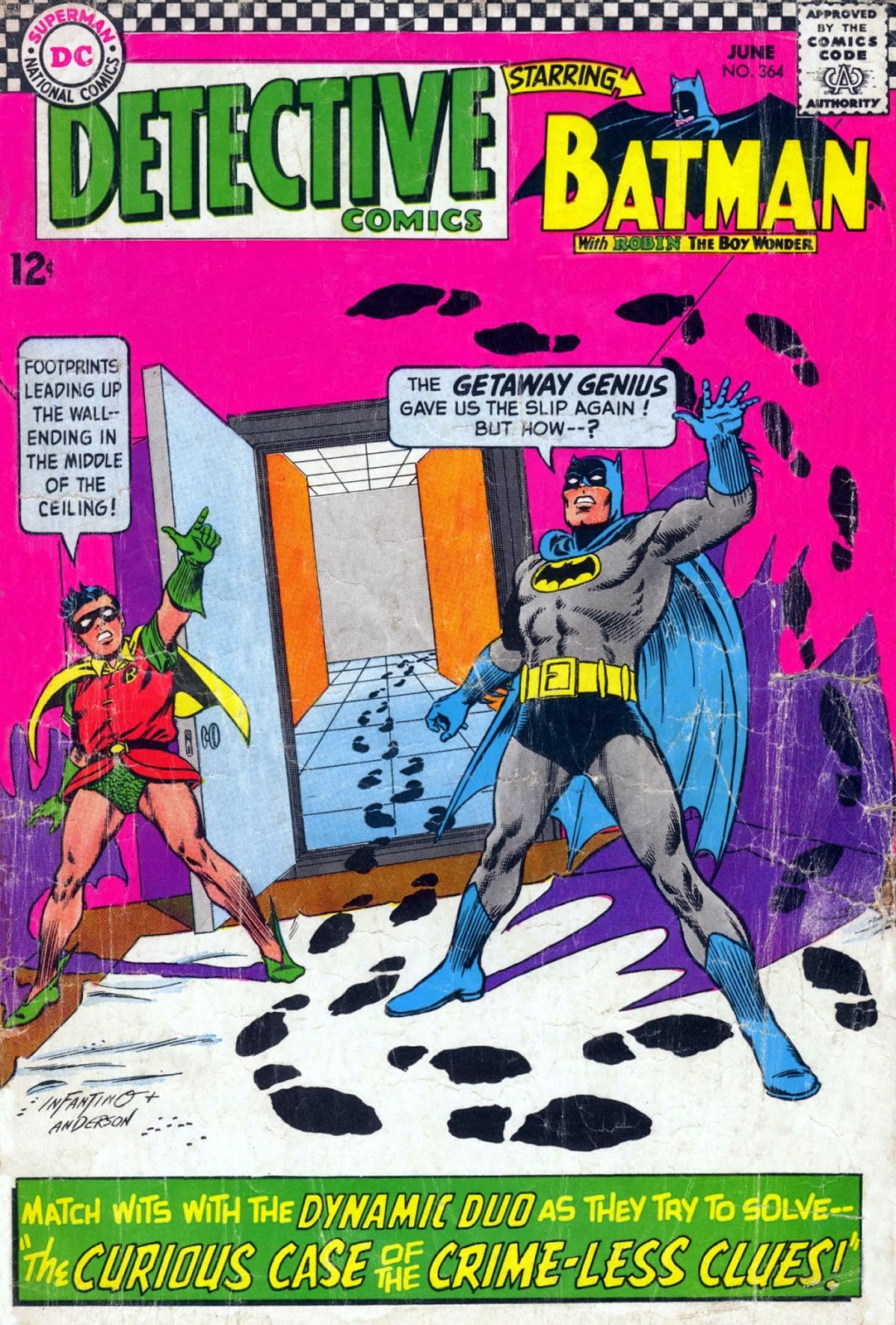
It was not in my collection back in the 1960s, and although I am a Batman fanatic, I somehow missed reading this story even when I got the issue:
But it ends up being an amazing issue for me. For starters, there is a Riddler clue:
That one might not be obvious to you, but it is to me, because it refers to my birthday: March 4th (March Forth!) But it does not end up being a Riddler story, or a Getaway Genius story as implied by the cover. In fact it is the final Outsider story:
I talked about the Outsider series years ago; I honestly thought I had read them all. I am a little chagrined to find out that there was another tale.
But it ends up being an amazing issue for me. For starters, there is a Riddler clue:
That one might not be obvious to you, but it is to me, because it refers to my birthday: March 4th (March Forth!) But it does not end up being a Riddler story, or a Getaway Genius story as implied by the cover. In fact it is the final Outsider story:
I talked about the Outsider series years ago; I honestly thought I had read them all. I am a little chagrined to find out that there was another tale.
Monday, September 08, 2014
The First Brainiac (Or the Sixth?)
In Jimmy Olsen #28, Jimmy gets caught in a whirlwind that Superman created to stop a hurricane from hitting Metropolis, and is transported to the Metropolis of 5921. He is startled to learn that he is reviled as the man who killed Superman, way back in 1958 (when the story was published). He is arrested, but hopes to get off as there are surely no witnesses who can attest to his identity.
DOH! This is the April 1958 issue, which came out three months before the first green-skinned, pink-shirted Brainiac story in Action #242. So is this the first Brainiac? Or since it takes place almost 40 centuries in the future, well after the Legion of Super Heroes Brainiac 5's era, is it the sixth? This time travel business can sure make things confusing!
We learn at the end of the story that Jimmy's murder of the Man of Steel was actually faked; it was all a ruse that Superman had come up with to trick a gang. Later, Superman hurls a time capsule into the future to clear Jimmy's good name.
DOH! This is the April 1958 issue, which came out three months before the first green-skinned, pink-shirted Brainiac story in Action #242. So is this the first Brainiac? Or since it takes place almost 40 centuries in the future, well after the Legion of Super Heroes Brainiac 5's era, is it the sixth? This time travel business can sure make things confusing!
We learn at the end of the story that Jimmy's murder of the Man of Steel was actually faked; it was all a ruse that Superman had come up with to trick a gang. Later, Superman hurls a time capsule into the future to clear Jimmy's good name.
Thursday, August 21, 2014
And Yet Another Swipe
I talked a few years ago about a very goofy story in Lois Lane #36, where everybody at the Daily Planet pretended that they never heard of Lois Lane, with the apparent result that she committed suicide by hurling herself off a cliff. It turned out (of course) that she didn't really off herself, and that it was all just a test to see if she could handle the wily tricks she'd have to face as a foreign correspondent for the Daily Planet. It took a couple issues, but eventually we got the follow-up.
Well, tonight I was reading some old comics and found out that this was actually a swipe from an earlier Jimmy Olsen tale:
In the Jimmy Olsen story, just as in the Lois Lane tale, the protagonist has just returned from a little vacay:
Jimmy insists on checking the back issues of the Planet, as does Lois, but there is no record of their award-winning scoops. They both head back to their apartments, but are startled to find other tenants in occupancy (in Lois' case it's especially cruel as her sister declines to recognize her).
Eventually we learn it was all a trick by Perry to test them as mentioned above for their suitability as foreign correspondents:
They realize that they're being tricked for different reasons. Jimmy had called for the "Chief" when Lois didn't recognize him and as he's the only one who calls Perry by that nickname, he realizes that since Perry emerged from his office he knew Jimmy despite his denials. Lois goes to see Lex Luthor in prison, but since Lex is in solitary she figures out that the warden would never let her see him.
But perhaps most surprising of all is that both stories turn out to be lead-ins to future tales. I discussed the rather ridiculous Lois Lane, Foreign Correspondent story, but Jimmy had his own follow up:
Jimmy's story is a little better. He and Clark travel to Hoxana, to find out if the new king is going to be a tyrant or a good guy. Jimmy quickly finds out that it's the former:
But the king overhears the clicking and only Clark's swift grabbing of the camera saves Jimmy from the firing squad, although Clark himself is imprisoned. From there the story develops rather predictably; Jimmy has a secret key that can open the prison door, so he tries to get himself arrested, but every time he ends up actually helping out King Otto. Eventually he succeeds, but the key subplot apparently gets forgotten and Jimmy and Clark are facing the firing squad. But Clark blows the bullets away, and then takes care of things as Superman.
This swipe is a little quicker than some of the other ones Weisinger did--Lois Lane #36 was published in October 1962, a little less than five years after Jimmy Olsen #25 (December 1957). But it is certainly noteworthy because of the lead-in nature of both stories to later tales.
Well, tonight I was reading some old comics and found out that this was actually a swipe from an earlier Jimmy Olsen tale:
In the Jimmy Olsen story, just as in the Lois Lane tale, the protagonist has just returned from a little vacay:
Jimmy insists on checking the back issues of the Planet, as does Lois, but there is no record of their award-winning scoops. They both head back to their apartments, but are startled to find other tenants in occupancy (in Lois' case it's especially cruel as her sister declines to recognize her).
Eventually we learn it was all a trick by Perry to test them as mentioned above for their suitability as foreign correspondents:
They realize that they're being tricked for different reasons. Jimmy had called for the "Chief" when Lois didn't recognize him and as he's the only one who calls Perry by that nickname, he realizes that since Perry emerged from his office he knew Jimmy despite his denials. Lois goes to see Lex Luthor in prison, but since Lex is in solitary she figures out that the warden would never let her see him.
But perhaps most surprising of all is that both stories turn out to be lead-ins to future tales. I discussed the rather ridiculous Lois Lane, Foreign Correspondent story, but Jimmy had his own follow up:
Jimmy's story is a little better. He and Clark travel to Hoxana, to find out if the new king is going to be a tyrant or a good guy. Jimmy quickly finds out that it's the former:
But the king overhears the clicking and only Clark's swift grabbing of the camera saves Jimmy from the firing squad, although Clark himself is imprisoned. From there the story develops rather predictably; Jimmy has a secret key that can open the prison door, so he tries to get himself arrested, but every time he ends up actually helping out King Otto. Eventually he succeeds, but the key subplot apparently gets forgotten and Jimmy and Clark are facing the firing squad. But Clark blows the bullets away, and then takes care of things as Superman.
This swipe is a little quicker than some of the other ones Weisinger did--Lois Lane #36 was published in October 1962, a little less than five years after Jimmy Olsen #25 (December 1957). But it is certainly noteworthy because of the lead-in nature of both stories to later tales.
Friday, July 25, 2014
I'm Sure You've Heard This Before....
Usual comic book serendipity thing. I was poking through some back issue bins at the local comic shop and I came across some issues of a comic called Myth Adventures, liked the cover art and picked a few up.
So I'm reading these stories and really getting into them and I thought, hmmm, let's look up the artist, Phil Foglio, on Wikipedia. So I did and saw he had a series in collaboration with his wife on-line, called Girl Genius, and started reading....
And four hours later I decided I should link it. Holy crap, this series is so much fun. It's not like I can claim to have discovered it; I suspect most of you have been reading it for years. But if you haven't, you definitely have to go check it out. The art has the perfect humorous style, and the story... well I've been reading it for four straight hours and am absolutely transfixed.
So I'm reading these stories and really getting into them and I thought, hmmm, let's look up the artist, Phil Foglio, on Wikipedia. So I did and saw he had a series in collaboration with his wife on-line, called Girl Genius, and started reading....
And four hours later I decided I should link it. Holy crap, this series is so much fun. It's not like I can claim to have discovered it; I suspect most of you have been reading it for years. But if you haven't, you definitely have to go check it out. The art has the perfect humorous style, and the story... well I've been reading it for four straight hours and am absolutely transfixed.
Friday, July 18, 2014
Angel & Ape #2
Of all the quirky titles that DC published near the end of the Silver Age, this must surely be the oddest. Well, aside from Brother Power the Geek. This happens to be the only issue I own; I don't think I've even read another.
The talent is certainly first-rate: Sergio Aragones on the script and art by Bob Oksner and Wally Wood. Oksner is probably the least-known today of that trio, but in the 1960s he was DC's go-to guy on humor.
Apparently the premise of the series is that Angel O'Day and Sam Simeon are partners in a private investigation office, although in this issue there is no evidence of a client; they more or less function as law enforcement. Sam has another job on the side; he's a "cartoonist" for Brain Pix Comics, where his boss is the wacky and devious Stan Bragg (obviously intended as a parody of Stan Lee).
The plot is pretty simple: Someone has convinced the Bikini family (a group of circus performers with larceny in their hearts) to combine their forces:
They kidnap Angel and thus Sam must rescue her. But first he has to deal with the self-promoting Stan Bragg:
An early reference to the fact that Stan didn't do much of the real "writing" at Marvel? Sam quits and decides to try his luck at DZ Comics:
But Stan comes up with an ingenious plot to win Sam back:
Stan's assistant convinces Sam to stay at Brain Pix in order to atone for the "death" of Stan.
Some of the humor in the series comes from the fact that very few people seem to realize that Sam is an ape:
Angel leads the circus crooks to Brain Pix's building, where she and the cops make short work of them:
The noise outside is enough to wake the dead:
Overall the issue is amusing, if not quite laugh out loud funny, and the artwork is terrific.
Tuesday, July 08, 2014
Swiped and Then Swiped Again
Mort Weisinger's enthusiasm for swiping story ideas from earlier issues of Superboy does not seem as high as it was for Adventure Comics, but here's a pretty impressive example of a double swipe. For starters, here is the cover to Superboy #52 (October 1956):
And Superboy #85 (December 1960):
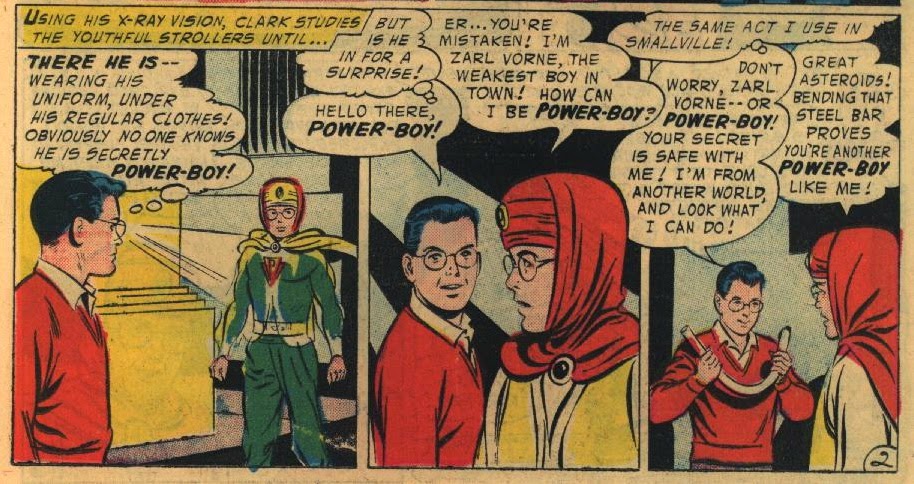
As you can see, in both cases, Superboy is startled to discover another super-powered boy on an alien planet. He changes into civilian clothes and confronts the lad:
The other boy comes from a startling place:
Clark realizes how the other boy got his powers:
So it looks like Superboy is finally going to have a super-powered buddy. But as they start off together, something happens:
Superboy eventually realizes that it's his presence that is causing the other superlad to lose his powers, and thus he must leave, resulting in a sad ending:
Weisinger recycled that ending in Superboy #87 (March 1961), in a Krypto story. Krypto rescues a beautiful female dog:
You've gotta love that he calls her Toots. She doesn't have super-powers, but it turns out that Krypto knows where she can get some:
And so she drinks from the pool and becomes super. Unfortunately:
Krypto soon realizes that he is no longer super when near Kolli, and so we get the same ending as in the two Superboy tales:
And Superboy #85 (December 1960):
As you can see, in both cases, Superboy is startled to discover another super-powered boy on an alien planet. He changes into civilian clothes and confronts the lad:
The other boy comes from a startling place:
Clark realizes how the other boy got his powers:
So it looks like Superboy is finally going to have a super-powered buddy. But as they start off together, something happens:
Superboy eventually realizes that it's his presence that is causing the other superlad to lose his powers, and thus he must leave, resulting in a sad ending:
Weisinger recycled that ending in Superboy #87 (March 1961), in a Krypto story. Krypto rescues a beautiful female dog:
You've gotta love that he calls her Toots. She doesn't have super-powers, but it turns out that Krypto knows where she can get some:
And so she drinks from the pool and becomes super. Unfortunately:
Krypto soon realizes that he is no longer super when near Kolli, and so we get the same ending as in the two Superboy tales:
Thursday, July 03, 2014
Mort Weisinger's Idea of Funny
What the? From Superboy #72 (April 1959):
Why would he put that postscript in there? He had to know that there were plenty of Superboy readers who were still at the age where they believed in Santa. It's hard to come up with a reason other than the obvious; that Weisinger was a first class jerk.
Subscribe to:
Comments (Atom)