



In the early 1960s, Marvel Comics had become something of a joke. They published a small line of magazines that mostly featured monsters with names like Fin Fang Foom or Shagg or Shamoo. But Stan Lee, the writer and editor for most of Marvel's stories noticed the superhero revival going on at DC Comics and decided to copy it. The first attempt was the Fantastic Four, a team title that was something of a knockoff of DC's Justice League of America.
The first issue told the origin of the team. The FF was made up of four characters who had travelled in a space ship to the radiation belt surrounding the Earth. The radiation caused strange mutations to the four. Reed Richards, the scientific genius leading the team, developed the power of stretchability, much like Plastic Man and the Elongated Man. Ben Grimm, a test pilot, turned into the super-strong (and super-ugly) Thing. Sue Storm, Reed's girlfriend, turned invisible, while Johnny Storm, her younger brother, burst into flame as the Human Torch.
The use of radiation as an origin device was new as far as I know, although Marvel would use it several more times in the next few years. Spider-Man, Daredevil and the Hulk would all see their powers result from exposure to radiation in one way or another.
The other novelty of the Fantastic Four was that the members were not "all for one and one for all". They bickered among themselves, especially Ben, who blamed Reed for his transformation into the homely Thing.
Saturday, December 24, 2005

Thursday, December 15, 2005
The Elongated Man
The Elongated Man first appeared in The Flash #112, April-May 1960. The Flash kept getting upstaged by this stretchable sleuth called the Elongated Man. Although EM had been a hero every time he appeared, the Flash wondered if he wasn't secretly behind a series of puzzling robberies. Who is the Elongated Man, and how did he come to be?
We are told in a flashback. Ralph Dibny had been an ordinary boy in the Midwest, when he was fascinated by an India-Rubber Man in the sideshow at a carnival. He vowed to learn how to stretch himself, but none of the carnies would tell him their secret. Then he remembered that all the stretching men had drunk a product called Gingold. By studying the product, he isolated the stretching ingredient. At first it didn't work on him, but then suddenly he began stretching wildly.
The Flash is suspicious of Dibny, but Ralph actually captures the thieves that had been ruining his good name, and they become friends. Of course, there had been stretchable detectives in the past, most notably Plastic Man, and there would be more before long--Elastic Lad and Mr Fantastic arrived in the next year or two.
The Elongated Man was created by Carmine Infantino. In his earliest appearances he wore a stretchable purple and blue suit with a domino mask. He appeared regularly in The Flash for the next couple years.
Things changed dramatically for the Elongated Man in 1964. DC had decided to fix the problem with Batman. There were two main problems: the art and the editing sucked. DC solved the first by adding Infantino to the Batman stable, while Julie Schwartz took over the editing chores.
The pot sweetener for Infantino was that the Elongated Man got his own feature in Detective Comics, starting with #327, the May 1964 issue. This was one of the very few times in the DC universe that a supporting character had graduated to his own feature; the prior ones that I can think of are Lois Lane, Alfred (briefly), Robin and Jimmy Olsen.
In Detective #327, Ralph Dibny and his new wife, Sue, were returning from their honeymoon in Canada. Ralph is now the "famous Elongated Man"; apparently the earliest superhero to maintain another identity, yet not keep it a secret. The Fantastic Four have an argument, but they never had secret identities, whereas Ralph clearly gave his up. Plus he's clearly one of the earliest superheroes to be married.
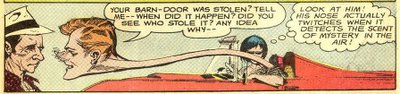
The pattern for the EM stories was established in that first appearance in Detective. Ralph and Sue are driving along, Ralph spots something suspicious and is off to investigate. The second story, in Detective #328, begins the tradition of Ralph's nose twitching when he scented a mystery:
The Elongated Man really hit the big time with Detective #331. For as long as Detective Comics had existed, it had always featured more than one story, and none of the other features had crossed over into Batman. But both those taboos were broken with "The Museum of Mixed-Up Men" in September 1964. Batman and the Elongated Man teamed up to defeat Boss Baron in a three-part adventure that consumed the entire issue. There was another crossover/full length story a year later in Detective #343's "The Secret War of the Phantom General". I don't believe there was another full-length story in Detective Comics after that until #500.
The next big change came at the end of Detective #350. Sue decided that her husband's costume was too boring, and gave him a new one, mostly red with black and yellow stripes. At about this time, the Batman TV show hit, and so the Elongated Man got read by a lot of people who otherwise would not have been reading a backup feature.
DC changed artists at Detective #357; Murphy Anderson and Sid Greene took over. Not sure what the story was there. For that issue only, Elongated Man's suit is primarily yellow. Perhaps a Reverse-Elongated Man? Or could the issue have been that the Silver Age Plastic Man comics DC had introduced made the uniforms too confusing?
The uniform changed again with Detective #359. Now it was purple with yellow and black. That was pretty much how it stayed for the rest of the run in Tec. Ironically the issue that finalized the uniform changes was also the one that doomed the Elongated Man's run in Detective, as it introduced the Barbara Gordon Batgirl. Elongated Man's last appearance in 'Tec was #383, so he appeared in 57 issues of Detective Comics. In Tec #384, Batgirl began an alternating feature with Robin.
I believe Elongated man next popped up in the Justice League of America during the mid-1970s.
We are told in a flashback. Ralph Dibny had been an ordinary boy in the Midwest, when he was fascinated by an India-Rubber Man in the sideshow at a carnival. He vowed to learn how to stretch himself, but none of the carnies would tell him their secret. Then he remembered that all the stretching men had drunk a product called Gingold. By studying the product, he isolated the stretching ingredient. At first it didn't work on him, but then suddenly he began stretching wildly.
The Flash is suspicious of Dibny, but Ralph actually captures the thieves that had been ruining his good name, and they become friends. Of course, there had been stretchable detectives in the past, most notably Plastic Man, and there would be more before long--Elastic Lad and Mr Fantastic arrived in the next year or two.
The Elongated Man was created by Carmine Infantino. In his earliest appearances he wore a stretchable purple and blue suit with a domino mask. He appeared regularly in The Flash for the next couple years.
Things changed dramatically for the Elongated Man in 1964. DC had decided to fix the problem with Batman. There were two main problems: the art and the editing sucked. DC solved the first by adding Infantino to the Batman stable, while Julie Schwartz took over the editing chores.
The pot sweetener for Infantino was that the Elongated Man got his own feature in Detective Comics, starting with #327, the May 1964 issue. This was one of the very few times in the DC universe that a supporting character had graduated to his own feature; the prior ones that I can think of are Lois Lane, Alfred (briefly), Robin and Jimmy Olsen.
In Detective #327, Ralph Dibny and his new wife, Sue, were returning from their honeymoon in Canada. Ralph is now the "famous Elongated Man"; apparently the earliest superhero to maintain another identity, yet not keep it a secret. The Fantastic Four have an argument, but they never had secret identities, whereas Ralph clearly gave his up. Plus he's clearly one of the earliest superheroes to be married.
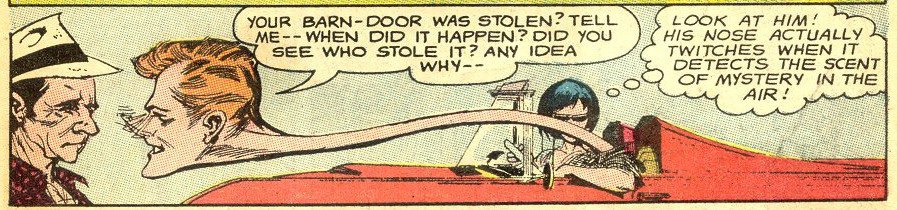
The pattern for the EM stories was established in that first appearance in Detective. Ralph and Sue are driving along, Ralph spots something suspicious and is off to investigate. The second story, in Detective #328, begins the tradition of Ralph's nose twitching when he scented a mystery:
The Elongated Man really hit the big time with Detective #331. For as long as Detective Comics had existed, it had always featured more than one story, and none of the other features had crossed over into Batman. But both those taboos were broken with "The Museum of Mixed-Up Men" in September 1964. Batman and the Elongated Man teamed up to defeat Boss Baron in a three-part adventure that consumed the entire issue. There was another crossover/full length story a year later in Detective #343's "The Secret War of the Phantom General". I don't believe there was another full-length story in Detective Comics after that until #500.
The next big change came at the end of Detective #350. Sue decided that her husband's costume was too boring, and gave him a new one, mostly red with black and yellow stripes. At about this time, the Batman TV show hit, and so the Elongated Man got read by a lot of people who otherwise would not have been reading a backup feature.
DC changed artists at Detective #357; Murphy Anderson and Sid Greene took over. Not sure what the story was there. For that issue only, Elongated Man's suit is primarily yellow. Perhaps a Reverse-Elongated Man? Or could the issue have been that the Silver Age Plastic Man comics DC had introduced made the uniforms too confusing?
The uniform changed again with Detective #359. Now it was purple with yellow and black. That was pretty much how it stayed for the rest of the run in Tec. Ironically the issue that finalized the uniform changes was also the one that doomed the Elongated Man's run in Detective, as it introduced the Barbara Gordon Batgirl. Elongated Man's last appearance in 'Tec was #383, so he appeared in 57 issues of Detective Comics. In Tec #384, Batgirl began an alternating feature with Robin.
I believe Elongated man next popped up in the Justice League of America during the mid-1970s.
Tuesday, December 13, 2005
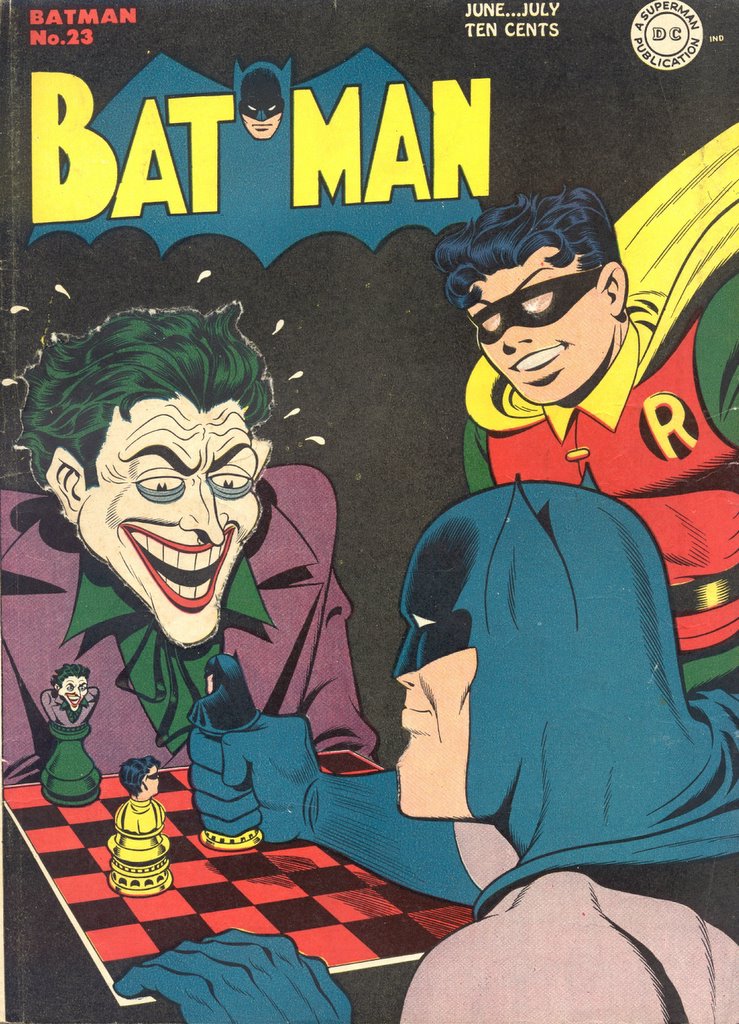
Gay Batman?
I'm pretty sick of this theory myself, but this is one of the odder panels in the Batman series (from Batman #84, June 1954):
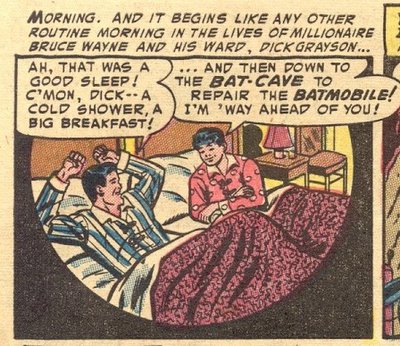
Actually it just looks like a poor job of art by Sheldon Moldoff; a later panel makes it clear they are not actually sharing a bed:

Now, you can make something out of the fact that they're sharing a room in Wayne Manor, but it's just a literary device to skip a few panels of Dick hearing Bruce's nightmares and coming down the hall.
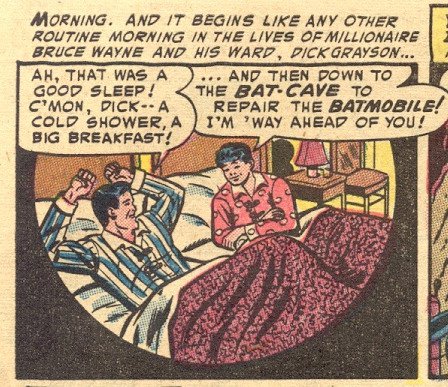
Actually it just looks like a poor job of art by Sheldon Moldoff; a later panel makes it clear they are not actually sharing a bed:

Now, you can make something out of the fact that they're sharing a room in Wayne Manor, but it's just a literary device to skip a few panels of Dick hearing Bruce's nightmares and coming down the hall.
Thursday, December 01, 2005
Classic Stories of the 1960s: The Sleeper Saga
I haven't focused much on Marvel Comics of the Silver Age much thus far. One of my favorite stories from Stan Lee and Company was The Sleeper Saga, which appeared in Tales of Suspense #72-74.
Tales of Suspense was an anthology magazine back then, featuring two separate characters, Iron Man and Captain America. Cap was a relatively recent addition to the Marvel Silver Age, having been discovered floating in a block of ice in Avengers #4, about a year and a half earlier. Of course, he had been a mainstay of Marvel (then known as Timely) back in the Golden Age, fighting the Nazis and especially a Nazi villain named the Red Skull.
When Stan decided to bring him back they couldn't decide at first what to do with him. Should they keep him in the World War II setting and have him be a retro hero? Or should they tell modern tales. In the first year or so they varied back and forth with several modern stories interspersed with his World War II reminiscences. Remember, World War II was a particularly popular topic with youngsters due to the influence of Hollywood blockbusters like The Great Escape and The Longest Day.
In The Sleeper Saga, they hit on an superb idea; Cap would appear in the present day, but he'd still be fighting the Nazis. The background for the story was that the Red Skull had accidentally killed himself late in World War II, when a hand grenade he threw bounced off Captain America's shield and landed near him. With his dying breath he vowed that he would have his revenge twenty years later.
Twenty years later was conveniently 1965, when the saga started with Tales of Suspense #72:
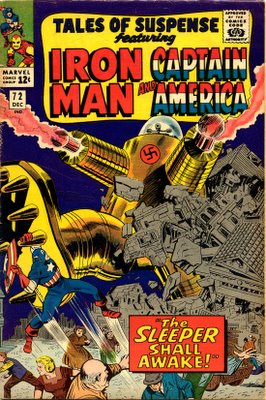
There were three sleepers; the one shown on the cover was only the first. Captain America remembers the Red Skull's warning and notices that today is exactly 20 years later. He has a list of names and locations that he took from the dying Red Skull, so he sets off in search of the people. Unfortunately he arrives too late, and the first sleeper has been awoken. Cap tries to battle it, but he's no match for the giant robot, and it goes off in search of the second sleeper.
The second sleeper turns out to be an incredible airplane, which looks like a flying stingray. When it meets up with the first sleeper, the two combine into a terrible flying robot. Cap notes that there is room on top of the airplane for yet a third sleeper. What will it be?
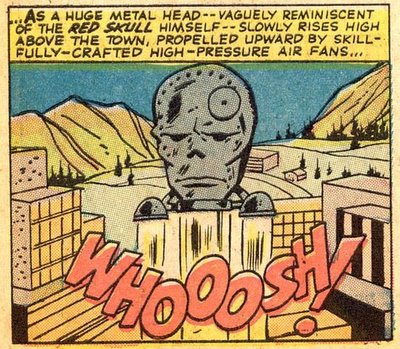
Cap realizes that the Red Skull's plan is to destroy the entire world by having the sleepers burrow down into the Artic ice and thus into the earth's core, then blow themselves up. In the end, Captain America sky-dives onto the combined sleepers and sabotages them with a blowtorch, so they explode where they can't do significant damage to the planet.
I believe there was another sleeper that came along later. The Red Skull would return before the end of the year, still alive despite his apparent death in ToS #72.
Tales of Suspense was an anthology magazine back then, featuring two separate characters, Iron Man and Captain America. Cap was a relatively recent addition to the Marvel Silver Age, having been discovered floating in a block of ice in Avengers #4, about a year and a half earlier. Of course, he had been a mainstay of Marvel (then known as Timely) back in the Golden Age, fighting the Nazis and especially a Nazi villain named the Red Skull.
When Stan decided to bring him back they couldn't decide at first what to do with him. Should they keep him in the World War II setting and have him be a retro hero? Or should they tell modern tales. In the first year or so they varied back and forth with several modern stories interspersed with his World War II reminiscences. Remember, World War II was a particularly popular topic with youngsters due to the influence of Hollywood blockbusters like The Great Escape and The Longest Day.
In The Sleeper Saga, they hit on an superb idea; Cap would appear in the present day, but he'd still be fighting the Nazis. The background for the story was that the Red Skull had accidentally killed himself late in World War II, when a hand grenade he threw bounced off Captain America's shield and landed near him. With his dying breath he vowed that he would have his revenge twenty years later.
Twenty years later was conveniently 1965, when the saga started with Tales of Suspense #72:

There were three sleepers; the one shown on the cover was only the first. Captain America remembers the Red Skull's warning and notices that today is exactly 20 years later. He has a list of names and locations that he took from the dying Red Skull, so he sets off in search of the people. Unfortunately he arrives too late, and the first sleeper has been awoken. Cap tries to battle it, but he's no match for the giant robot, and it goes off in search of the second sleeper.
The second sleeper turns out to be an incredible airplane, which looks like a flying stingray. When it meets up with the first sleeper, the two combine into a terrible flying robot. Cap notes that there is room on top of the airplane for yet a third sleeper. What will it be?

Cap realizes that the Red Skull's plan is to destroy the entire world by having the sleepers burrow down into the Artic ice and thus into the earth's core, then blow themselves up. In the end, Captain America sky-dives onto the combined sleepers and sabotages them with a blowtorch, so they explode where they can't do significant damage to the planet.
I believe there was another sleeper that came along later. The Red Skull would return before the end of the year, still alive despite his apparent death in ToS #72.
Wednesday, November 30, 2005
Lame Criminals of the 1960s--The Polka Dot Man

The only explanation I can think of for this goofy criminal is that some writer noticed the popularity of polka dots at the time (remember this was the era of the song "Itsy-Bitsy Teenie-Weenie Yellow Polka Dot Bikini") and decided to make a criminal with that theme. PD Man is another one of those crooks where you can't help thinking he could make a fortune just selling his inventions.
Saturday, November 26, 2005
More Recycling
Aka the Kendricks of Gotham City. In World's Finest #2, a brave attorney named William Kendrick is appointed special prosecutor in order to stop a gang war. In World's Finest #3, Frank Kendrick is a crooked businessman who hires the Scarecrow to terrorize his partner.
Wednesday, November 23, 2005
Green Lantern Silver Age: Qward
There's an odd little symetry to Flash #106-108 and Green Lantern #2-4. In both cases the issues are the second through fourth of the respective title for the Silver Age. Flash Comics had been around in the Golden Age for 104 issues, so when DC decided to give the Silver Age Flash (Barry Allen) his own magazine they started with issue #105, although technically the new comic was known as "The Flash". But with Green Lantern DC decided to go with a new #1 issue, even though there had been over 30 issues of the Golden Age Green Lantern.
But aside from that, DC tried something interesting. In Flash #106-108, they presented three consecutive stories featuring one villain, Gorilla Grodd. They also presented a slightly different world--Gorilla City, which vibrated on a different plane on earth and thus was invisible to humans.
In Green Lantern 2-4, DC presented three consecutive stories featuring one villain, or should I say, a new universe of villains. The universe of Qward was organized along evil lines. There were some outlaws who insisted on being honest, but they were persecuted. One of them, Telle-Teg, contacted Hal Jordan, knowing he was a rival of Green Lanterns for the affections of Carol Ferris, to ask him to help the honest citizens of Qward to emigrate to our world. This is accomplished but not before Telle-Teg is killed. The surviving honest Qwardians warn GL that the evil Qwardians are planning on stealing "all the power batteries in this universe".
Sure enough, in the following issue, the Qwardians steal GL's power battery by a clever ruse. They recreate Ferris Aircraft Company and observe where GL has the battery hidden. They steal it from the actual location while Hal is reciting the oath to the phony battery.
But then comes a completely unbelievable plot twist. Pieface, Hal Jordan's Eskimo airplane mechanic, is fixing his landlady's TV antenna when he suddenly tunes in the thoughts of the Qwardians who are transmitting to their homeword about the successful theft of the power battery. The Qwardians succeed in sending the power battery back to Qward, but Green Lantern trails it there and retrieves it.
In the final chapter of the initial Qward saga, Pieface is wounded by radiation from a rocket that was intended to hit GL. In order to save his buddy, GL goes back to Qward to face its champion, a robot who has been designed to destroy Green Lantern. Unfortunately for the Qwardians, the programming was not tight enough, and the robot realized the difference between good and evil, and agreed to fight alongside GL against its evil masters. It gives GL the cure for Pieface and holds off the Qwardians long enough for Hal to save his buddy.
There is at least one mistake in the series. In GL #3, the capital city is given as Qwar-Deen, but in the next issue it's referred to as Qward City.
But aside from that, DC tried something interesting. In Flash #106-108, they presented three consecutive stories featuring one villain, Gorilla Grodd. They also presented a slightly different world--Gorilla City, which vibrated on a different plane on earth and thus was invisible to humans.
In Green Lantern 2-4, DC presented three consecutive stories featuring one villain, or should I say, a new universe of villains. The universe of Qward was organized along evil lines. There were some outlaws who insisted on being honest, but they were persecuted. One of them, Telle-Teg, contacted Hal Jordan, knowing he was a rival of Green Lanterns for the affections of Carol Ferris, to ask him to help the honest citizens of Qward to emigrate to our world. This is accomplished but not before Telle-Teg is killed. The surviving honest Qwardians warn GL that the evil Qwardians are planning on stealing "all the power batteries in this universe".
Sure enough, in the following issue, the Qwardians steal GL's power battery by a clever ruse. They recreate Ferris Aircraft Company and observe where GL has the battery hidden. They steal it from the actual location while Hal is reciting the oath to the phony battery.
But then comes a completely unbelievable plot twist. Pieface, Hal Jordan's Eskimo airplane mechanic, is fixing his landlady's TV antenna when he suddenly tunes in the thoughts of the Qwardians who are transmitting to their homeword about the successful theft of the power battery. The Qwardians succeed in sending the power battery back to Qward, but Green Lantern trails it there and retrieves it.
In the final chapter of the initial Qward saga, Pieface is wounded by radiation from a rocket that was intended to hit GL. In order to save his buddy, GL goes back to Qward to face its champion, a robot who has been designed to destroy Green Lantern. Unfortunately for the Qwardians, the programming was not tight enough, and the robot realized the difference between good and evil, and agreed to fight alongside GL against its evil masters. It gives GL the cure for Pieface and holds off the Qwardians long enough for Hal to save his buddy.
There is at least one mistake in the series. In GL #3, the capital city is given as Qwar-Deen, but in the next issue it's referred to as Qward City.
Sunday, November 13, 2005
ACG Comics: Adventures Into the Unknown #124
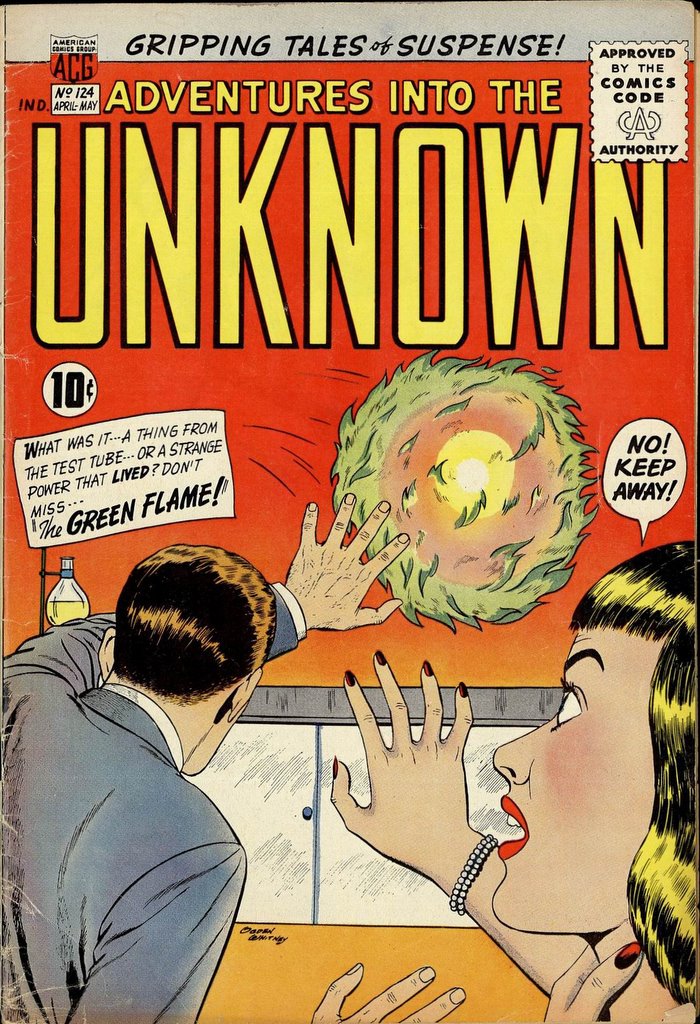
This April-May 1961 offering from ACG cover features "The Green Flame".

The opening story concerns the trials of one Michael Terrence O'Toole, a blue-collar guy struggling to get by as a steam shovel operator in Salem, Massachusetts. (Aside: Steam shovels are archaic; they have since been replaced by the backhoe.) So he and his wife have to make do with wishing for nice things rather than having them, even for their daughter Rosie. But Rosie wants a baton so she can be a drum majorette in the local high school band. In the meantime, Mike is having trouble with the foreman over the amount of dirt he moves. So one evening he gets drunk (the men he was with claimed it was NA beer) and goes to the job site and starts digging. And he breaks into a chamber where he finds a giant chest. When he opens it a witch climbs out, released after centuries of imprisonment. She immediately starts doing horrible things, like crashing planes and trains and ruining Mike's steamshovel. He grabs the wand from the witch and angrily wishes she was back where she came from. Of course, she flies back into the chest. He wills everything to be normal, saving the plane and train that the witch had destroyed. He heads home, giving the wand to his wife as a baton for their daughter.
Then comes the twist. ACG's editor/writer, Richard Hughes, always liked a little twist in his stories. Not quite the O'Henry twist that EC was known for a decade earlier, but still entertaining.
It turns out that the daughter wants to be the drum majorette because she likes a boy in the band, and when momma catches them making out, she burns the wand/baton. And Michael and his wife are just a little more satisfied with their life together.
There's a one-page filler called "Mysteries of Nature". Archaeologist discovers a roadside attraction is really a dinosaur skeleton preserved in lava.
The Fan Fare series entry follows. These appear to be reprints of earlier ACG stories. This issue's adventure concerns a fighter pilot who has to abandon his aircraft in the Middle East when it catches fire. He finds a garden where life seems perfect--delicious food, wonderful climate, plenty of water, etc. Eventually he tears himself away from the place to try to get back to civilization. After a long journey he is saved by an Arab on a camel. He realizes afterwards that he had found the Garden of Eden.
Another Fan Fare entry with "Space Probe". An invasion fleet sends the usual one scout craft to earth; when it fails to return the invasion is cancelled.
In the cover story, "The Green Flame", a scientist invents a green flame that appears to hold promise as a military weapon, but it rapidly gets out of control. Worse still, it shows intelligence, apparently burning the scientist's notes to prevent the military from creating a weapon to use against it. Can anything stop The Green Flame?
The opening story concerns the trials of one Michael Terrence O'Toole, a blue-collar guy struggling to get by as a steam shovel operator in Salem, Massachusetts. (Aside: Steam shovels are archaic; they have since been replaced by the backhoe.) So he and his wife have to make do with wishing for nice things rather than having them, even for their daughter Rosie. But Rosie wants a baton so she can be a drum majorette in the local high school band. In the meantime, Mike is having trouble with the foreman over the amount of dirt he moves. So one evening he gets drunk (the men he was with claimed it was NA beer) and goes to the job site and starts digging. And he breaks into a chamber where he finds a giant chest. When he opens it a witch climbs out, released after centuries of imprisonment. She immediately starts doing horrible things, like crashing planes and trains and ruining Mike's steamshovel. He grabs the wand from the witch and angrily wishes she was back where she came from. Of course, she flies back into the chest. He wills everything to be normal, saving the plane and train that the witch had destroyed. He heads home, giving the wand to his wife as a baton for their daughter.
Then comes the twist. ACG's editor/writer, Richard Hughes, always liked a little twist in his stories. Not quite the O'Henry twist that EC was known for a decade earlier, but still entertaining.
It turns out that the daughter wants to be the drum majorette because she likes a boy in the band, and when momma catches them making out, she burns the wand/baton. And Michael and his wife are just a little more satisfied with their life together.
There's a one-page filler called "Mysteries of Nature". Archaeologist discovers a roadside attraction is really a dinosaur skeleton preserved in lava.
The Fan Fare series entry follows. These appear to be reprints of earlier ACG stories. This issue's adventure concerns a fighter pilot who has to abandon his aircraft in the Middle East when it catches fire. He finds a garden where life seems perfect--delicious food, wonderful climate, plenty of water, etc. Eventually he tears himself away from the place to try to get back to civilization. After a long journey he is saved by an Arab on a camel. He realizes afterwards that he had found the Garden of Eden.
Another Fan Fare entry with "Space Probe". An invasion fleet sends the usual one scout craft to earth; when it fails to return the invasion is cancelled.
In the cover story, "The Green Flame", a scientist invents a green flame that appears to hold promise as a military weapon, but it rapidly gets out of control. Worse still, it shows intelligence, apparently burning the scientist's notes to prevent the military from creating a weapon to use against it. Can anything stop The Green Flame?
Sunday, November 06, 2005
Covers That Give Away the Ending

Maybe they thought that the Flash being turned into a block of ice wasn't dramatic enough, but how do you then decide to reveal the ending of the story?
And that is in fact how the Flash defeats Captain Cold. One of the worst covers of the Silver Age.
Wednesday, November 02, 2005
Great Stories of the Silver Age: Virus X
The Virus X story ran from Action #362-366 in early 1968. It starts when Ventor, a stage ventriloquist, tries to get revenge for his brother Bruno, who died in prison after being captured by Superman. Ventor kidnaps Clark Kent and hypnotizes him into hating Superman and being determined to kill him.
In the second story Luthor gives Ventor a test tube of Virus X, which is so powerful that it kills earth creatures almost instantly. It contains just enough Kryptonite to make it effective against Superman. Clark Kent starts to pour the virus on the bed where he knows Superman sleeps, and accidentally gets some on his own hands. As it works out, this restores his memory. Unfortunately it's too late as his hands have turned into green claws, showing he has been infected.
In the third instalment, the worlds best doctors and scientists are unable to cure Superman. Luthor claims to have an antidote, but he turns out to be lying. In the end, Superman places himself into a clear coffin and takes off for the heart of the hottest sun in the universe.
The fourth story is something of a retrospective. As Superman flies through space, the story of the entire Superman legend is retold in his memory. We learn of the death of Krypton and baby Kal-El's raising by the Kents, and his romances with Lana Lang, Lori Lemaris and Lois Lane. Even the Bizarros get into the act, strewing White Kryptonite in the path of his casket.
In the final story, it is revealed that the White K cured Superman by killing Virus X, which was a form of plant life. But when Superman returns to Earth, he discovers that somebody has taken his place. So the mystery becomes who has done it. Unfortunately DC gives it away in the splash page, which features the members of the Justice League of America. In the end, Superman is able to resume his role as Earth's mightiest hero. This leaves the loose end of Ventor, who has never been punished for his effort to kill Superman, as a letter writer points out in Action #369.
In the second story Luthor gives Ventor a test tube of Virus X, which is so powerful that it kills earth creatures almost instantly. It contains just enough Kryptonite to make it effective against Superman. Clark Kent starts to pour the virus on the bed where he knows Superman sleeps, and accidentally gets some on his own hands. As it works out, this restores his memory. Unfortunately it's too late as his hands have turned into green claws, showing he has been infected.
In the third instalment, the worlds best doctors and scientists are unable to cure Superman. Luthor claims to have an antidote, but he turns out to be lying. In the end, Superman places himself into a clear coffin and takes off for the heart of the hottest sun in the universe.
The fourth story is something of a retrospective. As Superman flies through space, the story of the entire Superman legend is retold in his memory. We learn of the death of Krypton and baby Kal-El's raising by the Kents, and his romances with Lana Lang, Lori Lemaris and Lois Lane. Even the Bizarros get into the act, strewing White Kryptonite in the path of his casket.
In the final story, it is revealed that the White K cured Superman by killing Virus X, which was a form of plant life. But when Superman returns to Earth, he discovers that somebody has taken his place. So the mystery becomes who has done it. Unfortunately DC gives it away in the splash page, which features the members of the Justice League of America. In the end, Superman is able to resume his role as Earth's mightiest hero. This leaves the loose end of Ventor, who has never been punished for his effort to kill Superman, as a letter writer points out in Action #369.
Saturday, October 29, 2005
Wednesday, October 26, 2005
Who's Liz Allen's Dad?
This error comes to us from Amazing Spiderman #17:

It's sure as heck not Mr Brant. Liz Allen (the blonde shown) is engaged in a romantic tug-of-war over Peter Parker with Betty Brant, which is why the writer thought of that name.

It's sure as heck not Mr Brant. Liz Allen (the blonde shown) is engaged in a romantic tug-of-war over Peter Parker with Betty Brant, which is why the writer thought of that name.
Thursday, October 20, 2005
Dan Hastings
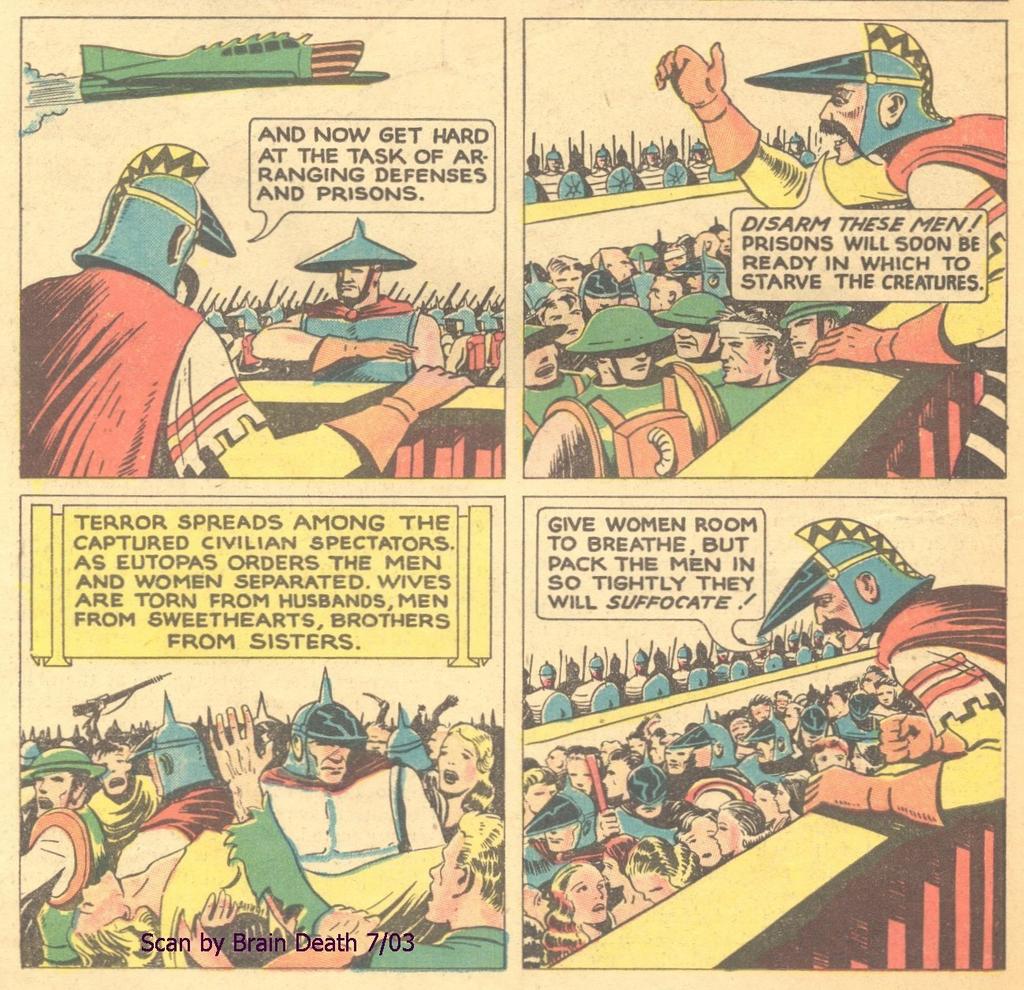
This is a little off-topic, as it's Golden or even Platinum Age. A few years ago I noticed some very old coverless comics on ebay. Star Comics #5 and #7 predated Superman, being published in 1937. One of the features in those issues was Dan Hastings. It was a science-fiction strip with a very evil villain named Eutopas:

Remember this is before Hitler's evil was widely known.
Remember this is before Hitler's evil was widely known.
Tuesday, October 18, 2005
Sunday, October 16, 2005
Supergirl--Action # 268
This is a pretty typical DC mystery story. Linda Lee accepts a week-long internship on the Daily Planet, when electrifying news breaks. There is a Supergirl on Earth, who came from the planet Krypton. At first Linda worries that perhaps her robot has performed the super-stunts. Then she fears that maybe she was affected by Red Kryptonite and is revealing herself during events that she later forgets. Eventually the new "Supergirl" shows up at the Daily Planet, but Linda is ready. She exposes the fake Supergirl to phony Green K, causing her to pretend to be affected. But when the Green K is exposed as bogus, so is the new Supergirl. She turns out to be an actress hired to hype a new movie.
Supergirl--Action # 267
This is one of those oddball cases where DC actually thought about the continuity problems raised by a story idea, came up with a solution, and then promptly forgot about it, causing continuity problems for years to come.
Linda Lee runs into several super-powered youths like herself who clearly know her secret identity. It turns out that they are members of the Legion of Super Heroes, who had by this point made a pair of guest appearances in Superboy stories. Apparently realizing that there might be continuity issues, the Legion introduced in this story was purported to be a new Legion, comprised of the children of the original Legion. However, in all future stories Supergirl is a member of the same Legion that Superboy belongs to. The continuity problem comes in that if Superboy has met Kara, then he will not be surprised when she pops out of the rocket when he is a man. It was later explained that Saturn Girl leaves a post-hypnotic suggestion erasing his memory of Supergirl whenever he returns to the Smallville era.
The story borrows quite often from the original Legion story in Adventure #247, as I have discussed in the past. In an amusing twist, Red Kryptonite affects Supergirl by turning her into a woman; according to the Legion by-laws this makes her ineligible for Legion membership.
Linda Lee runs into several super-powered youths like herself who clearly know her secret identity. It turns out that they are members of the Legion of Super Heroes, who had by this point made a pair of guest appearances in Superboy stories. Apparently realizing that there might be continuity issues, the Legion introduced in this story was purported to be a new Legion, comprised of the children of the original Legion. However, in all future stories Supergirl is a member of the same Legion that Superboy belongs to. The continuity problem comes in that if Superboy has met Kara, then he will not be surprised when she pops out of the rocket when he is a man. It was later explained that Saturn Girl leaves a post-hypnotic suggestion erasing his memory of Supergirl whenever he returns to the Smallville era.
The story borrows quite often from the original Legion story in Adventure #247, as I have discussed in the past. In an amusing twist, Red Kryptonite affects Supergirl by turning her into a woman; according to the Legion by-laws this makes her ineligible for Legion membership.
Saturday, October 15, 2005
Supergirl--Action # 266
Silly story here. A boy fantasizes about Streaky having superpowers, and it comes true when Streaky is exposed to the X-Kryptonite that Supergirl created again. Most of the humor in this piece revolves around the fact that the boy can't get his friends to believe that Streaky is pulling super stunts. Fortunately, in the end Supergirl convinces everybody that it was Krypto doing the stunts in a way that made it look like Streaky was super.
Friday, October 14, 2005
Supergirl--Action # 265
After a long build-up, Supergirl loses her memory due to exposure to red Kryptonite and accidentally finds herself in Smallville as its newest super-heroine. For awhile Smallville relives its former glory as the home of a mighty being, but when Superman discovers that Supergirl's been revealed to Smallville, he unleashes an amnesia gas on the town that even affects Supergirl. Quickly, he prints up revised copies of the town paper without mention of the girl of steel and puts Linda Lee back in the orphanage. His secret weapon remains unknown. Of course, today, the story of a Supergirl would be on Drudge and there would be no possibility of the story disappearing.
Thursday, October 13, 2005
Supergirl--Action # 264
Something of a sad story here. Supergirl is adopted by a Mr and Mrs Wilkins quite unexpectedly. At first she thinks only of how to get out of the adoption. But as time goes by she finds the couple who adopted her loving and heroic, as the father is a policeman. So it becomes tougher for her. "Fortunately" some crooks try to kill her to get back at Dad, and he realizes that it's not fair to her to be his daughter. Ironically, of course, we know that his daughter is safe from assailants.
Wednesday, October 12, 2005
Supergirl--Action # 263
Supergirl saves a young man who is an orphan from drowning. He ends up at the Midvale Orphanage with her, and eventually figures out her secret identity, even helping her conceal it when an accident happens. Eventually she realizes that he is not from Earth at all, but from another planet, where he's a prince, wanted for the murder of his aunt and uncle. Supergirl defends him and proves the killer was the evil Prime Minister Zoxxo. Once again in this issue Supergirl wears a red skirt instead of the blue.
Subscribe to:
Posts (Atom)