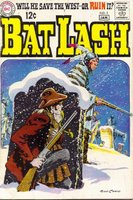
Sunday, May 27, 2012

Captain Compass

Captain Compass was one of many features that Detective Comics had over the years. He originally appeared in issues of Star Spangled Comics, starting in #83. He bumped Robotman from that book, and that feature moved over to Detective, starting with #138.

Mark Compass wasn't really a captain; rather he was a trouble-shooter/house detective, initially sailing on the SS Nautilus, and later roving on various vessels of the Penny Steamship Lines. He lasted in Star Spangled until the very last issue of that title, #130, after which the book was converted into Star Spangled War Stories.

With no place to call a home, Captain Compass was assigned to Detective Comics starting with #203, where, ironically enough, he once again bumped Robotman out of a slot, ending that long-running feature. Captain Compass was a decent detective, although like many in the comics he depended on eavesdropping:

And his fists:
Almost as much as his wits:
Captain Compass appeared in Detective until issue #225, when he was replaced by the debut of Martian Manhunter (he also missed #206, which had a Sierra Smith adventure instead). In his earlier adventures he sometimes flirted with a nurse he called Red, much to her displeasure:
Unfortunately, by the time the series moved over to Detective, Red had vanished. Captain Compass only made one more appearance after that; in an ensemble story in Detective #500 featuring many of the gumshoes who had appeared in the pages of Tec over the years.

Wednesday, May 16, 2012

Odds and Ends

Interview with Stan Lee at the Huffington Post.  I liked this question and answer:

If all the superheroes in the world were wiped out, but you could keep one around, who would you keep that had the highest value to humanity? And who would you keep for selfish reasons?
I think I’d have to say Iron Man because Tony Stark has the wealth, inventive genius and impenetrable armor to accomplish almost anything.
 Ah, but he also has that ticker problem which could leave the world hero-less at any moment.  Stan didn't answer which hero he'd keep around for selfish reasons, but I'd suspect the answer is Spidey; IIRC, Stan kept writing that title longer than any other Marvel book with the exception of Fantastic Four (both of which he relinquished effective with the October 1971 issues).

Hat Tip: A regular emailer.

Was Spider-Man a male chauvinist pig?

A Nick Cardy/Carmine Infantino self-swipe cover? Note the significant difference in the attitude of the kid in the chair in the two versions.

Jacque Nodell posts some Danish romance covers of the 1970s.  Not a whole lot of difference with American romance covers of the time, although perhaps a few less tears.

Tuesday, May 08, 2012

Dr Strange #171-173

In the middle of 1968, Marvel began expanding its line of comics. Three books that had been anthology titles--Strange Tales, Tales of Suspense and Tales to Astonish--were converted to single-feature comics: Dr Strange, Captain America and The Incredible Hulk, respectively. The features that had formerly shared those titles were given their own books: Nick Fury, Agent of SHIELD, Iron Man and Sub-Mariner. This apparently had to do with a restriction that the comics distributor of the times, (which was owned by DC) had imposed, allowing Marvel only a certain number of issues per month. Marvel found a new distributor and thus was able to circumvent the restriction.

Oddly enough, the two old Strange Tales features survived the shortest of the six new titles; both lasted only 15 issues before biting the dust. What happened? Well, like all the Marvel titles, they ran into the crunch of 1969. The inflation of the 1960s had resulted in higher costs for the publishers, and finally in late 1969, both DC and Marvel raised their prices to 15 cents. The timing was pretty awful, as the US economy was in recession as well, and the biggest chunk of the Baby Boom generation had reached the end of their prime comic-buying years. As with the 1961 increase, the result was an immediate decline in sales. Three pennies may not seem like a lot, but it was a 20% hike.

Because the former Strange Tales features were canceled, we do not know how it affected their sales, but we can judge by looking at some of the other Marvel books. Captain America lost 11% of his readers, while the Hulk was hit with a 6% decline. Thor shed 10% of sales, while the Avengers lost 13% and Sgt Fury 15%. The X-Men dropped 14% and Daredevil 16%. And when you consider that Marvel raised its prices relatively late in 1969's reporting period, the actual declines were probably higher than reported.

Still, all that was in the future as these two issues came out, and Marvel probably had high hopes for this title. The story starts out with Dr Strange in search of Clea, last seen being subjected to a spell of vanishment in Strange Tales #155. She had been vanished by the Ancient One in order to save her from the wrath of Umar, the sister of Dormammu. He learns where she is located via an apparition.

The Doc summons Victoria Bentley, who had become his regular companion following Clea's disappearance to help him find her. She's disappointed to learn that he only wants her help to bring back his old girlfriend:
However, they have barely entered the "Realm Unknown", when Victoria gets sucked into an odd globe. Dr Strange follows, but when he locates her:
Hmmm. As I discussed a long time ago, Stan Lee wrote Jane Foster out of the Thor series with a similar sequence where she revealed her lack of valor under stress. Perhaps this is a trend at Marvel? After a few warm-up battles, the issue ends with the big reveal:
Dormammu was always my favorite Dr Strange villain; there's something about that fiery face that is very menacing.

The second issue features a change in the artwork. Tom Palmer had done the pencils, with Dan Adkins on inks for #171 (Adkins had been working on the feature for about a year partly as a penciller and mostly doing both art chores). With #172 (and until the end of the series), Gene Colan took over. Marvel had struggled to find a worthy successor to Steve Ditko ever since he left the series in 1966; with Colan they found their answer:
A terrific and unique style and yet not an imitation of Ditko. Incidentally, in this issue and the first part of #173, Colan worked with traditional rectangular panels, but it was not long before he started experimenting, with fascinating results as you can see here:
The first half of #172 is taken up with an explanation of what happened to Dormammu when he seemingly died during a battle with Eternity. To make a long story short, he had been hurled into the Realm Unknown, where, by coincidence:
Dormammu had sent the apparition so that Dr Strange would come after Clea. Having captured Victoria and the Doc himself, Dormammu departs to the Doorway of Dimensions, leaving a "grisly guardian" to keep a watchful eye on his prisoners. Dr Strange manages to get free, defeat the guardian, and release Clea and Victoria:
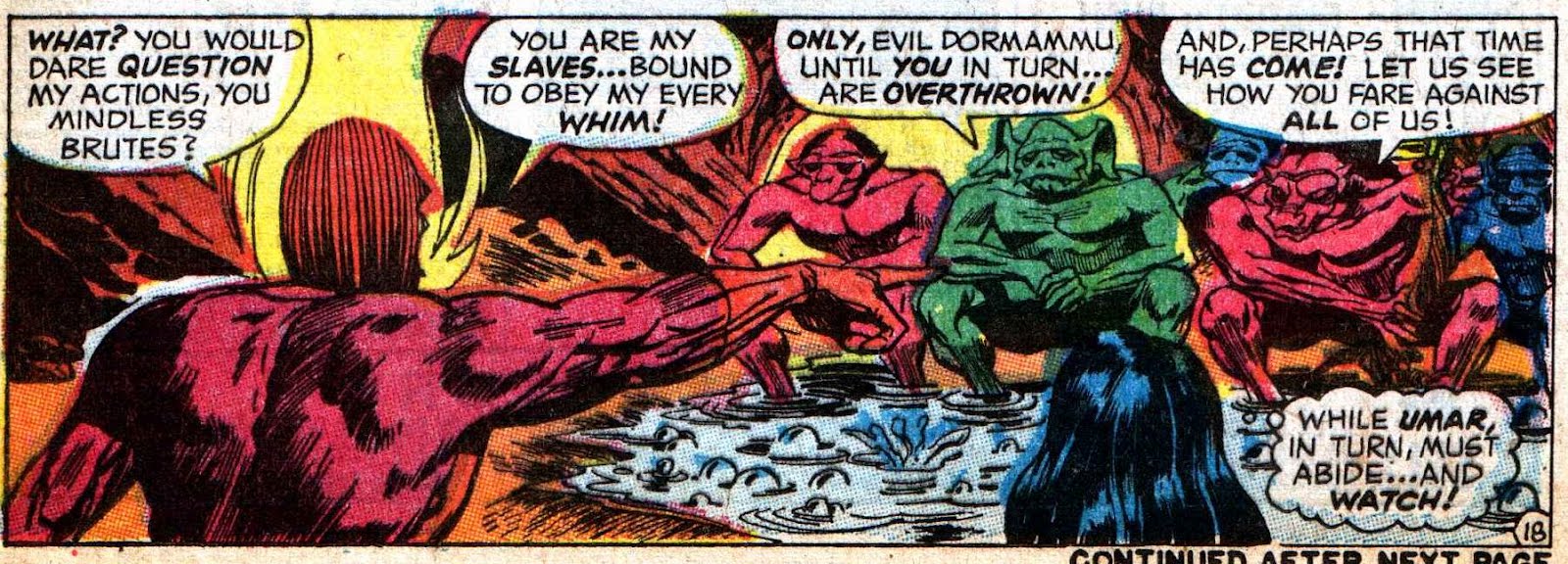
Meanwhile, we learn that Dormammu is leading a monster horde towards Earth. However, the monsters are somewhat restless under his command, and his sister has her own ideas about who should be in charge:
This was a major Marvel cliche back in the Silver Age; whenever villains teamed up they bickered even worse than the heroes. Dr Strange sends Clea and Victoria back to Earth while he battles Dormammu and his monsters. Or should I say Dormammu battles his own monsters and Dr Strange:

Not to mention (with a little help from Clea and Victoria) his sister:
She frees Dr Strange, who follows Dormammu into the Earth Dimension. They battle it out in the clouds above New York City. The Dreaded One seems to be too powerful but Strange has a hole card:
And so Dormammu is banished back to the Dark Dimension.

Comments: A beautiful series of books, ably written by Roy Thomas. Roy sprinkled lots of literary allusions throughout these stories. For example, the second issue is entitled I, Dormammu, an obvious reference to I, Claudius, the 1934 novel that was (in the 1970s) turned into a terrific PBS series.

Tuesday, April 24, 2012

Another Famous Letter Writer


Okay, so he gushes a little bit--strike that.  So he gushes like Old Faithful.  Consider it's George R. R. Martin, the man responsible for the outstanding dramatic series on HBO, The Game of Thrones (and, of course, the novels which it is based on).  And what's more, consider that the thrill of seeing his name in print like that supposedly inspired him to become a writer.  I'd say he's forgiven for his enthusiasm.

Wednesday, April 18, 2012

The Suicide Squad

DC was having considerable success launching new features and titles with their Showcase magazine, and so they decided to convert The Brave and the Bold into a similar mag, dropping the swashbucklers that had been featured in the mag so far, effective with the above issue.

The Suicide Squad (also named Task Force X) had four members; Rick Flag, the pilot and leader:
Karin (no last name specified at least in the first three issues), the blonde-haired nurse and love interest shown above, and Jess Bright and Dr Evans:
Despite the different specialties mentioned there, in practice the two functioned just as the "scientists" of the group, with little other than the glasses and the pipe to differentiate them.  Note in particular that this is a gang of four, much like several more successful series that were launched during the same era, i.e., the Challengers of the Unknown, the Sea Devils, Rip Hunter's crew and the Fantastic Four.

It is revealed in the opening story that all four members of the Suicide Squad were involved in World War II, and all of them had similar experiences where people around them all died, but left them behind to carry on the fight:
It's an interesting bit of characterization, which reveals why they are so willing to take on desperate missions for the US government.  This being the late 1950s/early 1960s, the desperate missions mostly involved monsters and dinosaurs:
There was only a modicum of characterization in the series.  We learned early on that Rick and Karin are in love with each other, and that Karin wants it to be open.  But Rick refuses because he knows that Jess and Dr Evans are also head-over-heels for Karin.  This is mentioned by Rick in every issue, but we only see it demonstrated once:
Why didn't the series catch on?  The concept of a Suicide Squad seems a good one; a few years later TV would have success with the Mission: Impossible series, which has a similar premise.  I suspect there are a couple of reasons, beyond the predictable monsters and minimal characterization.  For starters, the team is missing one critical element from the "smart guy, strong guy, woman, kid" formula that worked for the Fantastic Four, Rip Hunter, and the Sea Devils: the kid, who gives the readers someone to identify with.

Second, the timing.  The superhero craze was underway; after the first three issues featuring Rick's daredevil troupe, B&B launched one of the most successful DC features of the Silver Age: the Justice League of America.  With so many new and colorful superheros, it was hard for the Suicide Squad to stand out in the spinner racks.

DC did give them another three issues (B&B #37-39) to try to win their stripes, but they ran into a third problem.  Comics increased in price from 10 cents to 12 cents effective with the December 1961 issues, which included B&B #39.  The effect on circulation was immediate and dramatic, with almost all titles shedding 10-20% of their readers.  Under the circumstances it is hardly surprising that DC was less willing to launch a new mag.

This  post was inspired by an email from a reader named Kirk.  I tried to reply, but the recipient domain refused the message.  An aside to Kirk; the reason Andru and Esposito worked on Wonder Woman, Metal Men, Suicide Squad and the War that Time Forgot series has much to do with the editor of those features.  In every case it was Robert Kanigher.  Each of the DC editors had his own stable of writers and artists back then.

Wednesday, April 11, 2012

Dueling Wonders

Julius Schwartz mentioned in his wonderful autobiography, Man of Two Worlds, that there were certain elements which, when placed on the cover of a comic book, virtually guaranteed increased sales. The most famous example of this is the famed "Gorilla Effect" which I covered a couple years ago. Another certified sales technique involved having multiple images of the hero/heroine on the cover. Robert Kanigher appeared to be a fan of that particular gimmick:
This was all over the course of about five years, and these examples are just the most egregious. Kanigher found other ways to put two Wonder Women on the cover:
And there was always the option of dividing the cover into sections:
And this is even without counting the numerous "impossible" covers which featured Wonder Woman as a tot, girl and adult all at the same time:
Indeed, looking at them all, it almost appears that it was more likely to find multiple images of Wondy than single ones.

Friday, March 30, 2012

Superman #200

I believe this was the last of the Imaginary Stories published in Superman; it may have been the last anywhere in Weisinger's domain.  (Correction: My commenters note that there were several Imaginary Stories after this one, including in Superman). Note that rather oddly there is no cover hype about this being the 200th issue.  This is somewhat strange; only  a few months later DC would publish Batman's 200th ish with great fanfare.

In the story, Jor-El, Lara, and Kal-El survive the destruction of Krypton.  Brainiac, who's a good guy in this story, shrinks Kryptonopolis instead of Kandor, in order to save it, but is unable to do the same for the rest of the planet:

Krypton explodes before that happens.  And the element which powers his enlarging ray has also burned out, so he cannot expand Kryptonopolis on another uninhabited planet until he finds more.  So the El family ages, with little brother Knor coming along a few years later to become a buddy for Kal.

Eventually Brainiac finds the expanding element, but before he can use it his ship is hit by a meteor and crashes on Earth.  Fortunately, he had transferred a little of the element to Jor-El, who realizes he can enlarge one person to send out to the planet to become its protector.

And so, Kryptonopolis has a contest to see who will become Superman:
The contestants are eliminated one by one, until only Kal and Knor are left.  Note in particular that this segment echoes the origin of Wonder Woman, who was selected to take Steve Trevor back to the USA in a very similar competition.   In the finale, contrary to the cover scene, both men have to battle robots:
But Knor succeeds just before Kal can blind his robot, and so Earth ends up with the little brother, who goes to work for the Daily Planet as Ken Clarkson.  His initial outing, foiling a jailbreak, goes successfully, but the next time around some aliens are prepared:
Fortunately Kal managed to synthesize some of the expanding element, and so he tries to rescue Knor.  And when the aliens expose him to the Green K, we get a surprise:
Of course, if you're paying attention, you're probably wondering why the Green K killed Knor, but had a Red K effect on Kal.  It turns out that Knor was just rendered immobile by the Kryptonite.  When they both recover from the effects they send the aliens packing, and afterwards, Kal heads northward:

There is a note at the end of the story saying that just as this is Superman's 200th issue, it's the 100th anniversary of Canada being a "United Federation" (actually a Dominion).

Comments: Overall the story seems a little light, with few of the twists and turns that usually took place under Weisinger's editorship.

As noted earlier, there is not a lot of hype about the 200th issue, unlike the forthcoming Batman #200, which included a long conversation between two Bat-fans, a reprint of the first page from Detective #27 and a cover hyping the "200th Smash Issue".  There is some mention of it in the letters page:
But Chet Barker's math is wrong; at that point it was over 29 years since Action #1.

Tuesday, March 20, 2012

Trivia Quiz #46: Answers

1. Before Doc created the six famous Metal Men (Gold, Mercury, Iron, Lead, Tin and Platinum), with what substance did he create an earlier robot?
Doc Magnus created his first robot out of Uranium. Unfortunately, it proved unstable.

2. Which of the six Metal Men listed above was created first? In the first Showcase tryout (#37), Doc was shown dancing with Tina, the platinum robot. Afterwards, he created the other five Metal Men.

3. What Metal Men opponent was created out of photo-molecular energy siphoned from the Aurora Borealis? The Sizzler, a creation of Doc's nemesis, Professor Snakelocks, had that unusual constitution.

4. Who created the recurring villains, the Gas Gang? Doc Magnus himself created them.

5. Who was the first Metal Man to "die"? As shown in that original Showcase #37 issue, Tin biffed it: In fact, all of the Metal Men "died" by the end of that issue. Of course, being robots, they were pretty easily resurrected, faulty responsometers and all.

Fraser came, he saw, and he kicked butt on this quiz, getting all five answers correct. I had hoped to stump the experts with the first question, because it did not come in the Metal Men's own mag, but in Brave & Bold #55, a team-up between the elemental robots and the Atom.

Thursday, March 15, 2012

Trivia Quiz #46: Metal Men

1. Before Doc created the six famous Metal Men (Gold, Mercury, Iron, Lead, Tin and Platinum), with what substance did he create an earlier robot?

2. Which of the six Metal Men listed above was created first?

3. What Metal Men opponent was created out of photo-molecular energy siphoned from the Aurora Borealis?

4. Who created the recurring villains, the Gas Gang?

5. Who was the first Metal Man to "die"?

Monday, March 12, 2012

The Brave and the Bold #54

It's interesting that Robin, who had been around for 24 years at that point, gets third billing on this cover, although you can tell pretty easily that he's going to play a crucial role in the tale, given that "What chance do you have?"

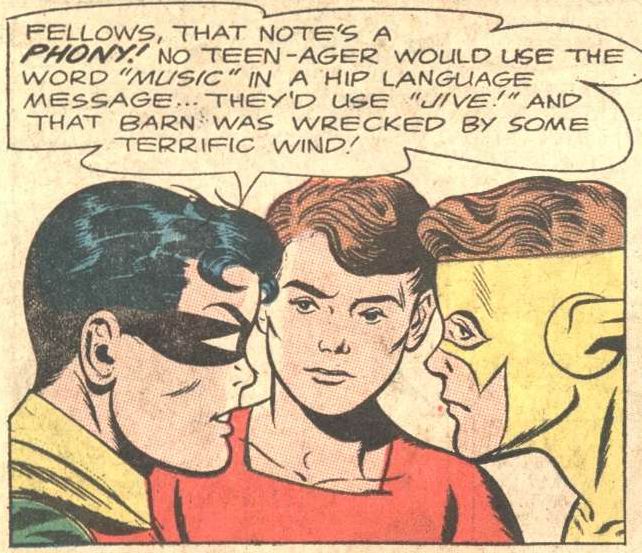
As the story begins, the teenagers in the town of Hatton Corners are rebelling against their parents.  They want a new clubhouse, and petition the trio of super-lads shown above to help them. But when the Teen Titans (a term not used in this book, although this is obviously the beginning of that group) arrive, they find that the kids have split the scene, leaving a note explaining that it was because the adults weren't hip to the music. Robin immediately realizes that it is a forgery:
No teenager would use the word "fellows" either.  Kid Flash and Aqualad go search for the missing teens, while Robin stays in town.  A twister suddenly appears and the Boy Wonder hustles the people into the bank vault for safety, but there is no room for him.  He clings to the door, but the twister tears him loose.  Fortunately Kid Flash comes to the rescue:
We get our introduction to the villain of the story:
 The adults have begun to miss the kids, and they explain the background. Stikk's ancestor leased the land for the town centuries ago with a very curious rental price: One passenger pigeon feather per year, or else the labor of one of the town's youth.  At the time it seemed like a ridiculous bargain, as there were plenty of passenger pigeons but Stikk had suddenly appeared demanding back rent for the prior 50 years.  Since the passenger pigeon was extinct, there was no way the town could comply, and so he has put them to work erecting a monument to himself:
The kids are starting to appreciate their parents as well:
Mr Twister goes off to renew his powers.  Kid Flash helps the kids finish their tower:
Robin follows the villain to an old Indian cave, where the secret of Mr Twister's magical staff is revealed to be a potion.  Meanwhile, Aqualad has discovered that the island on which the kids are trapped is resting atop a thin stalk of rock.  He commands some whales to move it away, getting gratitude from the teenagers and a little jealousy from Kid Flash:
You can see the Marvel influence there; prior to this the DC superhero teams had the "all for one and one for all" attitude.  Mr Twister takes out his anger on the town with Earth, Fire and Water.  The Earth arrives in the form of a dust storm that Kid Flash sweeps out of town.  The Water is a flood, but Aqualad has a solution:

But after Mr Twister kayos those two, how can Robin stop a rain of fire?  Easy, just rope the staff that gives the villain his powers:
Comments: It never is explained why the town now gets out of the requirement to pay rent to Stikk.  The story is entertaining, if a little wince-worthy in terms of the teenage lingo.  Writer Bob Haney would struggle with that for years to come.  As noted above, there was no indication at the time that this was intended as a tryout for the Teen Titans as an ongoing series; that would have to wait until a year later in Brave & Bold #60, when Wonder Girl joined the group.  Competent artwork by Bruno Premiani; I especially like that scene with Kid Flash building the tower.