


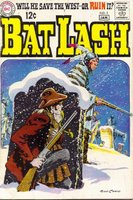


This comic arguably fits in better with the Golden Age, although its cover date is January 1955. "Women in the jungle" comics were extraordinarily popular during the 1940s and 1950s; it's not hard to guess that the appeal was the scantily-clad appearance of the females in question.
As the first story begins, Lorna spots the fierce Abaku tribe out to capture the peaceful Quaqui people and sacrifice them to their evil gods. As she rushes off to warn the Quaqui, she accidentally comes between a mother ape and her baby:

Mikki distracts the mother and Lorna and the monkey escape. As they head towards the Quaqui, Lorna muses that the mother was ready to die for her baby, just as she herself must be prepared to give her life for the Quaqui. She arrives as the battle begins and realizing that the peaceful villagers are no match for the Abaku warriors, she makes a bargain:

As she is about to be carried off to the sacrificial temple, she makes one request:

Things look bad for Lorna:

But Mikki unties her bonds and Greg, refusing to accept Lorna's argument that she made a bargain, comes up with an alternative sacrifice for the gods:

In the end, we learn that Greg, for all his admirable qualities, is just a little sexist:

Comments: Wow! Terrific characterization for Lorna, who really was quite prepared to sacrifice herself. Note as well her compassion for the mother ape. Granted, the Quaqui by analogy are the equivalent of her babies, but they are drawn by Werner Roth in a non-racist manner.
In the second story a "typhoon" (really a cyclone or tornado) is carrying off all the strongest men and animals in the jungle. Lorna discovers who is behind it here:

It carries her off to a hidden valley where she is attacked by a giant lizard and other things:

Eventually, she and Mikki end up atop a mesa with Greg, the strongest warriors and a few savage beasts. But then Chiga comes to see what happened to them, and Lorna commands him to transport them all back to the jungle. Later, Lorna tells Greg that Chiga agreed because he feels she's the strongest person in the jungle:

Comments: Silly story but I love the art by Roth again and the ending is amusing.
The third story is a backup featuring the "Jungle Adventures of Greg Knight". Greg is forced to kill a mother lioness when she attacks him in defense of her cubs. Now that the cubs are defenseless, Greg adopts them, knowing that the lioness' mate will come after him. That night, the lion attacks Greg's native assistant and carries him off. Greg follows and the cubs (who have gotten free of their cage) trail him. As the lion and Greg battle it out, he spots the cubs about to go over a cliff:

The lion, impressed by Greg's saving of his young, leaves him alone and carries off the cubs.
Comments: Entertaining story with art by Al Hartley, who would later become known for his Christian comics work.
The finale is Moon Madness. A pair of hoodlums try to take over Greg's animal refuge, but when the full moon comes up, all the animals go mad, and nearly kill the crooks. Lorna saves the criminals from certain death and eventually the moon goes behind a mountain, calming the jungle. What happened?

Comments: Note in particular that Lorna is not shy about expressing her affection for Greg. This completes the role reversal which has her as the most powerful creature in the jungle, and Greg as, well, kind of a wimp.
Overall I found the issue very entertaining, with terrific art and solid stories.


