Showing posts with label Charlton Comics. Show all posts

Tuesday, July 12, 2011

First Kiss #2


I haven't talked much about Charlton Comics here. Aside from Steve Ditko's terrific work, it's safe to say that they are considered the ugly stepsister of Silver Age comics, with (mostly) mediocre art and stories. Their comics even seemed to be printed on cheaper paper than the other publishers. And yet they did publish a boatload of comics in the Silver Age; at least 2500 that I've been able to catalog, and I'm positive that I'm missing some.

Like most publishers in the Silver Age, Charlton eschewed the superhero comics except during Batmania. They published a LOT of romance comics, even more than
DC. Their active romance titles in the Silver Age included Career Girl Romances (37 issues), Cynthia Doyle, Nurse In Love, Dr Tom Brett Young Intern, First Kiss (40 issues), High School Confidential Diary and Confidential Diary (17), Hollywood Romances (10), I Love You (82), Just Married (74), Love Diary (69), My Secret Life (29), Nurse Betsy Crane (16), Romantic Secrets (44), Romantic Story (83), Secret Romance (10), Secrets of Love and Marriage (25), Secrets of Young Brides (40), Sweetheart Diary (34), Sweethearts (92), Teen Confessions (65), and Teen-Age Love (70 issues). When flipping through the comics racks back then, I often thought of Charlton as the equivalent of Harlequin in the comics.

The opening story in this issue is pretty good despite the dull-as-dishwater title, Love Him, Love What He Does. Alice is a bit ashamed of her prizefighter boyfriend George. She wants him to take up a more genteel profession, like her friends' husbands:

So she gives him an ultimatum: Either he gives up boxing or she dumps him. However, he's on the verge of a title bout and isn't about to abandon the sport he loves. Alice, who's been moping about, decides to attend the big fight, initially hoping that he will lose and come to his senses:

And win he does, making Alice realize that she's as proud of him as she would be of a lawyer or doctor:

The story could have been more dramatic if there had been a confrontation before the fight between the two lovers, with Alice initially admitting that she hoped George would lose, and then him recovering to win the bout when he realizes that she's rooting for him. Still, it's a solid effort. The subtext (accept your man for who he is, not for who you wish he were) is a frequent theme during romances of this era, although that would change as editors began to demand that leading men be wealthy and/or powerful. Of course, you could argue that a championship fighter was exactly that; back in the 1950s they were probably the most well-paid figures in sports.

The second story is not as satisfying; you can probably guess the ending from this panel alone:

The dreaded mustache tells us that he's not the right man for her. She goes out shopping, gets stuck in a ditch and meets an arrogant man who tells her to stop spinning her wheels. No real surprises here; the arrogant man is her true love.

The third story does present some interesting points. Doris Wiles had married a wealthy playboy, who died and left her and her infant son penniless. She works her way up from waitressing to running her own restaurant. A wealthy former friend of her husband, improbably named Carlos McLean, starts to woo her. But wait, he has the dreaded mustache! Is he a villain?

Nope, and he seals the deal when her son swallows something that puts him in peril:


I'm going to guess that the specialist went by the name of Dr Heimlich. ;)

There's an interesting PSA:

I don't remember DC publishing any overtly religious PSAs during the Silver Age, although they certainly published ones that promoted religious tolerance.

Solid Gold Heart closes out the book. Donna is a succesful model who wants to make the jump to acting. Her downstairs neighbor is Larry, a self-employed biochemist. Donna is promoting her career and making the gossip columns by going out with various wealthy playboys, but she wishes Larry were more successful. One days she promises to attend a sales pitch to an investor, but then her manager calls with a rich date who will certainly get her name in the paper. Torn, she attends the date even though it is at the same corner as Larry is waiting. But it all works out in the end, as:

It's an entertaining story, largely selling the same message about accepting your man for who he is as the opening tale. And as in the opener, the woman doesn't really have to suffer, as it is clear her man will become wealthy.

There's a "movie date" filler bit of advice here:

One oddity; the comic does not seem to contain many ads aimed at women; in fact the inside front cover contains a Joe Weider body-building ad.

Friday, March 25, 2011

Are You Ready for Freddy?


Karl at the House of Cobwebs wrote a couple of posts about this series and so I decided to check it out for myself. Freddy is obviously intended as a knock-off of the Archie series, but with some oddball differences. For starters, Archie is reasonably admirable and upright; Freddy has, shall we say, a more ambiguous moral code.

In the first story in this issue, Freddy encounters his buddy Stuff, with a gallon of some foul-smelling perfume, which gives him an idea:

I'm not saying that Archie would be above such a prank, but at least he'd wait until Reggie did something to provoke him. As it happens, Rip gives the bottle to Peggy, Freddy's adored object, but something goes wrong:

So Freddy decides to give her an even bigger bottle of the stuff, but by that time her sense of smell returns (she had a cold) and so she's annoyed at both of them. He sells the rest of the bottle to Rip on the basis that Peggy liked it. Rip finds out it works as a great insecticide, and Freddy buys it back at twice the price. But when he offers to use it to protect Mrs Van Bank Vault's roses:

So Freddy tosses it in the dump, but a passing hobo notes that it melts (sic) tin cans and decides to use it as a trash eradicator, presumably becoming rich.

Archie had L'il Jinx, Freddy has the Little Wise Guy for a quick "gag":

There are two of these fillers in the comic, and they both follow the same formula; LWG has a problem, solves it, and (improbably) makes money.

The second Freddy story again highlights his lack of morals. There's an art contest, with the winner getting a trip to New York City as the prize. One problem: Freddy's got no talent and the teacher in charge of judging the paintings insists on realism. So Freddy gets a bright idea:

The teacher is so taken with Freddy's work that he awards it first place. One problem:

Freddy takes back the frame, explaining:

But the teacher is not so easily deterred:

Comments: Yuck! As you know, I judge comics from the Silver Age on the curve, with allowances that this was throwaway kid's entertainment. I'm more interested in solid characterization rather than depth of plot or intricacy of artwork. But this story is terrible on characterization. Not only is Freddy a cheater and a serial liar, but he gets away with it in the end! I can't help but wonder why we are supposed to be rooting for Freddy (besides the fact that his name is on the cover).

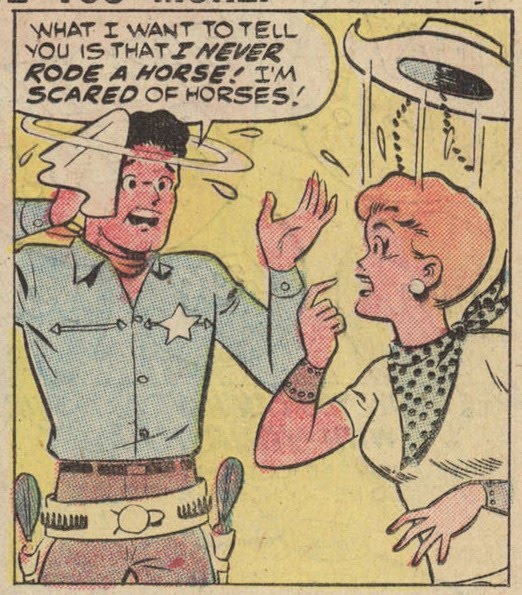
The next story features Simple Saima (a young woman). She's tired of her boyfriend Dummy Dooley and wants to meet Rock Boulder, the cowboy TV star, who's staying at a nearby resort. She's rather forward in her approach:

But Saima means "hoss" riding and she doesn't take no for an answer, resulting in Rock being shoved onto the most ornery horse in the stables. He has a wild ride and in the end confesses:

He explains that he has stunt doubles who do the riding for him. Disgusted, Saima goes back to Dummy Dooley. He may be stupid but at least he doesn't need a double.

Comments: The cowboy star who doesn't really ride is something of a cliche these days, and I suspect it was back then as well.

Remember the "free prizes" mentioned on the cover? Here they are:

Yep, for only 120 corners from Charlton comics, you could get a free tee shirt. Such a deal! Note that if you bought just one comic and sent 60 cents, you could get the same shirt, so they're essentially valuing those extra 119 comics at 60 cents, or about 1/2 a penny each. Judging from the quality of this issue that seems a little generous. ;)

The final story is another Freddy story. His angry neighbor, Mr Tantrum, doesn't believe in UFOs:

So Freddy dangles a flying saucer he got for 120 Charlton corners (just kidding; the actual text says five box tops from a cereal brand) in front of Mr Tantrum's window. But his neighbor (who's apparently a little nearsighted) assumes it's a bug and sprays it with insecticide. Freddy inhales a bit of the fumes and falls of the roof:

So while Mr Tantrum may be rational about some things, he's still got his "woo" side.

Overall, the comic is oddly entertaining, in a perverse sort of way. It's not "so bad it's good," and it's certainly not good. The artwork by Jon D'Agostino is above average for Charlton's somewhat low standards if nothing special, and the stories are reasonably coherent.

Thursday, December 31, 2009

Go Check Out

A new blog focusing on the Charlton and the Mighty MLJ Heroes. I have touched briefly on the Charlton heroes the Question and the Blue Beetle, but I have not covered the MLJ heroes like the Fly, the Web and the Jaguar, all of whom were active in the Silver Age. There are very interesting posts over there highlighting some similarities between the two sets of characters. I laughed out loud when I saw how the Web convinced IronFist that there was no fun in being an "ultra-villain" anymore. Now that's unique!

Monday, March 30, 2009

Electro Prototype at Charlton?


Here's a July 1960 Charlton featuring the work of Steve Ditko. The opening story should be of some interest to Spiderman and Daredevil fans, as it features the appearance of a clear prototype for Webhead and Hornhead's longtime foe, Electro. George Clinton (pre-Funkadelic) is an accountant who suddenly and inexplicably finds his body supercharged with electricity. This look a little familiar?


Quite a bit like this:


Clinton goes out into the countryside so as to not be a danger to others, but then suddenly he senses a purpose:


And he sends a bolt skyward:


Comments: The story is ho-hum, but of course the Ditko artwork and the Electro connection make it much more interesting. Ditko seems to be experimenting with his style here; I certainly don't recall him doing lots of close-up portraits as he did in this story.

Saturday, February 07, 2009

Single Issue Review: Mysterious Suspense #1


This story was actually published by cover date in October 1968, and thus arguably falls between Blue Beetle #4 (Dec 1967) and Blue Beetle #5 (Nov 1968). What happened? I'd guess that Charlton had issues in the pipeline when the Blue Beetle series was canceled and they decided to put them out anyway. The story in Mysterious Suspense appears to have been intended as a multipart backup story. Charlton added a splash page by another artist to make it look more like a normal issue.

In the story, the Question observes big-time mobster, Max Kroe, palling around with tycoon Jason Ord. It is clear to him that Ord is crooked. Meanwhile, Vic Sage (the Question's secret identity) is losing sponsors for his news broadcasts, thanks to the backstabbers at the studio.


Vic tells the station owner his suspicions about Ord, but can't be more specific without revealing his identity as the Question. His own staff sticks with him, but some of the others urge him to bend a little:


On one level, Vic is talking about the events in the story, but on another he's expressing Ayn Rand's objectivist philosophy at the same time. Rand was a firm believer in unfettered capitalism, and an ardent anti-communist. But she was also opposed to halfway measures like socialism or even liberalism. At one point she was quoted as saying, "There is a right way and a wrong way, but the middle is always evil."

What the men are offering Vic is the middle. He doesn't have to condone Ord's activities, just accept his money. But he's made of sterner stuff than that. Sage is given a two-week deadline to prove his charges against Ord.

And being opinionated, he does not soften his message:


Let me emphasize here that what is interesting about this comic is not Ditko's opinion on political issues of the day. Rather it is the creator of one of the greatest superheroes of all time telling us what he thinks makes a hero. That is a compelling topic and one worth exploring here, not whether the US should be involved in the UN.


In Part II, Ditko ratchets up the pressure on Vic. His assistant, Al, is framed on murder charges by Kroe and Ord.


Some very complex themes are being discussed in this comic book that were almost certainly going right over the heads of any teenage boys reading it.

The Question manages to find the identity of the real killer, but before he can be apprehended, Kroe bumps him off. Reasoning that he has to go to the top on the case, the Question calls Ord and threatens him with blackmail. Ord and Kroe meet in a warehouse, where Vic is captured by a gunman. Things look pretty grim, but Vic manages to hide. By cleverly switching back and forth from the Question, Sage convinces the crooks they're facing two men.

Meanwhile, Vic is about to be fired by the station manager, much to the delight of the loathsome Syd. Nora proves that she's good for more than looking pretty:


Vic manages to find a phone and call the cops for help. He gets Kroe and Ord on tape admitting to their criminal activities, and the cops arrive in time to save him from being killed by Ord, who has already shot Kroe.

Syd quickly rushes on the air to break the story, and takes the lion's share of the credit. What will Vic do?


Comments: As I discussed above, while the political aspects of Ditko's story are entertaining and challenging, the real significance of the comic is the debate over what makes a hero. Ditko lost the debate back then, but in my opinion, time and history have proven him correct. As superheroes lost their purity, their unwavering belief in the righteousness of their cause, they also lost that special quality that made them iconic heroes, a standard that boys could measure themselves against knowing they might never achieve that status themselves, but that it was worth striving to attain nevertheless.

Incidentally, since it has come up that this post is included in the Pennsylvania State Library, my name for attribution purposes is Pat Curley.

Saturday, July 05, 2008

How Many Ways Is This Wrong?

Oh, my lord:


How do you make one of the greatest villains in history a hero? Granted, Stevenson was always a little ambivalent towards Silver, allowing him to escape with a portion of the gold at the end of Treasure Island. When I first saw this I assumed that the CCA had told Charlton, "Yes, you may have a pirate comic book, provided the pirate is lovable." But apparently it was based on a movie and subsequent TV series as you can see from this poster:


Here's a brief clip from the movie:


Looks like a faux swashbuckler a la the Crimson Pirate.

BTW, take a closer look at that cover. Notice something missing?