



Bizarro returned in Action Comics #254, July 1959. Lex Luthor happened to discover an old newspaper story about Superboy's initial encounter with Bizarro during a visit to Smallville. He steals the plans to Professor Dalton's duplicator machine, and recreates it. Then he lures Superman to his laboratory and beams the Man of Steel. Sure enough, Bizarro appears. However, much to Luthor's dismay, the creature is not controllable and indeed, brings him promptly to jail.
Bizarro also tries to do good deeds, but because he's imperfect, he makes mistakes which are misinterpreted. He soon finds himself under an all-out assault. Then in a surprising move he tells the generals to stop trying to kill him; he will do it himself. He tries flying into a mountain but of course with Superman's powers and invulnerability he just bores a tunnel through it. Jimmy gets a photo of the action, and Bizarro overhears Lois exclaiming what a great photo it is. He assumes that she's fallen in love with him, and of course falls for her.
He brings her to a shack he has constructed on an island and proposes, but she admits that she loves only Superman. Bizarro has an idea; perhaps if he focuses the duplicator ray on himself, it will create another Superman. It does, but this one talks as poorly as Bizarro himself (although Lois doesn't notice this at first). But when she realizes it, the New Bizarro reveals himself as conceited, unlike the humble Bizarro on whom he's based. Briefly Superman and Bizarro team up to fight the New Bizarro, who is eventually killed by Kryptonite.
But Superman and Bizarro continue to battle over Lois until she has a brilliant idea. She creates an imperfect duplicate of herself for Bizarro to love. He and Bizarro Lois Lane go off together to live on their own planet.
Bizarro's popularity is not hard to understand. Gee, tries to do good, but sometimes screws up because of not thinking things through? That wouldn't describe most adolescent boys, would it? Especially since it's understood that Bizarro's not evil, he's just misguided. In addition, he lets the reader feel a little superior: we may screw up but at least we recognize it. Bizarro never regrets anything.
Prior entry in the Bizarro series.
Showing posts sorted by relevance for query Bizarro. Sort by date Show all posts
Showing posts sorted by relevance for query Bizarro. Sort by date Show all posts
Saturday, April 29, 2006
Wednesday, February 09, 2011
Superboy #68

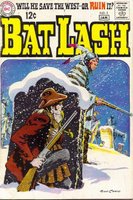
Although he became a comical, silly character in the 1960s, the original Bizarro, shown above, was played as a tragic figure initially. The story is somewhat loosely based on Frankenstein as portrayed in the Boris Karloff 1930s movie, which in turn was somewhat loosely based on Mary Shelley's classic novel.
As the story starts, Superboy is helping an inventor, who is trying to duplicate a sample of radium. If his duplicator ray works, it will be a boon to hospitals, which use radium to treat patients.
An aside here: Radium was constantly being mentioned in the Silver Age. It was used as a treatment for cancer, with radium being planted in the body to kill the cancer cells (and probably a fair amount on non-cancerous cells. It is not used any more that way; according to this site, it is more common to use either indium or caesium, although the actual treatment is still pretty similar. Radium was indeed an extremely valuable substance and remains pretty spendy: Current prices are about $50 million per pound.
But the experiment does not work; the synthetic radium fails to register on the Geiger counter. But as Superboy is about to leave, the inventor trips, and accidentally beams the ray on the Boy of Steel, creating a faulty duplicate:

It's probably not commonly known, but in the original Frankenstein book by Shelley, the monstrous part of the monster was not that he was horrifically ugly, or that he had an abnormal brain (he didn't). It was that he lacked a soul.
When they return from getting rid of the glowing pieces of the machine, Bizarro has gone for a walk. Superboy asks again, is it alive? No, insists the inventor, no more than a car that moves is alive. We get the first inkling that Bizarro doesn't talk the way he did on the cover here:

Bizarro is upset at the reactions of the people to him, who recoil in horror. But when he sees his own reflection in a shop window, he reacts similarly:

But Superboy is helping corral some escaped animals from the Smallville Zoo (which appeared to have very poor animal enclosures, judging by how often breakouts happened). A posse is quickly formed, led by Professor Dalton, but their efforts to shoot Bizarro have no effect on the monster's invulnerable skin.
He retreats to the safety of the Kents' home, but Mom is terrified of her new "son":

He adopts a farming family on the outskirts of town and attempts to be helpful. But when he wears a scarecrow costume to town as his secret identity:

A psychiatrist could probably write a dissertation on why kids found Bizarro so compelling. On the one hand, the monster often makes silly mistakes while trying to do good; it's not hard to see how youngsters could find themselves in the same situation. On the other hand, he's so goofy that the readers, only a few years removed from infantile behavior themselves, could feel superior to him.
But at the end of Chapter 1, Bizarro finds one person who "sees" the real him:

Melissa is an amalgam of two characters from the movie, in which Frankenstein encounters a girl too young to be frightened of him, and a blind man who befriends him.
In the second part of the story, Bizarro comes to school and disrupts a gym class with his extraordinary strength, forcing Clark to save his fellow students:

He melts the screws with the heat of his X-ray vision. The boys reject Bizarro and he flies off in tears. Superboy realizes it's time for some more drastic measures. He locates a Kryptonite meteor in space, and, wearing a lead costume to protect himself, hurls it at the monster. But Bizarro is immune to the glowing fragments of the planet Krypton.
Determined to prove his good intentions, Bizarro sculpts a likeness of Superboy on a nearby mountain. But improbably:

Superboy and the military team up to try to destroy Bizarro with conventional weaponry, but (aside from some dynamic action), nothing happens. However, as he flies back to Smallville, Bizarro is momentarily weakened when he passes a garbage truck.
Bizarro overhears Melissa wishing that there was a babbling brook in her backyard, and drills down to a spring to create one. But when she falls into the water, he learns that she is blind. If she were sighted, she'd fear him like the rest of Smallville. Meanwhile, Superboy has realized that the glowing fragments of the machine that created Bizarro are what weakened him. And:

Their collision destroys Bizarro, but it does have an upside:

Comments: An absolute classic. I loved this story the first time I read it in a reprint giant as a youngster, and it still enchants me. It must have been very popular with the kids of the time, for DC soon brought back Bizarro as an antagonist for the adult Superman. Weisinger encouraged the kids to write in with their ideas about the stupid things the Bizarros did. This proved popular enough that they were briefly given the backup slot in Adventure Comics, bumping Aquaman.
Sunday, April 30, 2006
Tales of the Bizarro World Part 1
Following his return in Action #254 and #255, Bizarro made several more appearances. Apparently the character was popular enough that DC gave him a continuing feature in Adventure starting with #285, the June 1961 issue. This had a cascading effect. Congorilla was dropped after a long history as Congo Bill that stretched through More Fun to Action (for over 200 consecutive issues) to Adventure. Congo Bill was at the time the third-longest running feature in DC Comics, after Superman and Batman.
Aquaman was bumped from the backup spot in Adventure that he had held down for almost 15 years. He was briefly sent over to Detective, causing the cancellation of Roy Raymond, who exposed frauds on his tv show in that slot for about 12 years. After eight issues there, he was sent to World's Finest, resulting in the cancellation of yet another long-running series, Tommy Tomorrow (although DC would soon give the series several tryout issues).
Just another example of how Bizarro tended to bump things around, I guess. Now, when Bizarro appears on Earth, he's trouble for Superman and a somewhat tragic figure. But on his own world he's an everyman, with a wife and children.
Yes, children. Never mind that we had been assured from the beginning that Bizarros weren't alive, somehow they could reproduce sexually because Bizarro #1 and Bizarro Lois Lane #1 had both a son and a daughter, and there were many other children.
The Bizarro stories often focused on the oddities of that world:

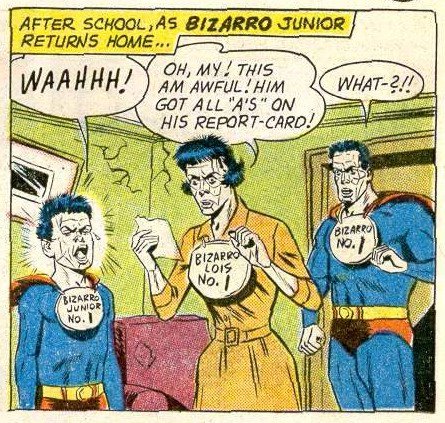
The writers, egged on by readers' suggestions, came up with more and more examples of just how bizarre the Bizarros were. The Bizarro washing machine takes clean clothes and makes them dirty. The Bizarro children go off to school, where they try hard to learn the wrong answers. This causes some ironic problems:

In the second story we learn the Bizarro Code:

We also discover the name of the Bizarro planet: Htrae (Earth spelled backwards).
Aquaman was bumped from the backup spot in Adventure that he had held down for almost 15 years. He was briefly sent over to Detective, causing the cancellation of Roy Raymond, who exposed frauds on his tv show in that slot for about 12 years. After eight issues there, he was sent to World's Finest, resulting in the cancellation of yet another long-running series, Tommy Tomorrow (although DC would soon give the series several tryout issues).
Just another example of how Bizarro tended to bump things around, I guess. Now, when Bizarro appears on Earth, he's trouble for Superman and a somewhat tragic figure. But on his own world he's an everyman, with a wife and children.
Yes, children. Never mind that we had been assured from the beginning that Bizarros weren't alive, somehow they could reproduce sexually because Bizarro #1 and Bizarro Lois Lane #1 had both a son and a daughter, and there were many other children.
The Bizarro stories often focused on the oddities of that world:

The writers, egged on by readers' suggestions, came up with more and more examples of just how bizarre the Bizarros were. The Bizarro washing machine takes clean clothes and makes them dirty. The Bizarro children go off to school, where they try hard to learn the wrong answers. This causes some ironic problems:
In the second story we learn the Bizarro Code:

We also discover the name of the Bizarro planet: Htrae (Earth spelled backwards).
Tuesday, April 11, 2006
The Bizarros, Part I
The first Bizarro appeared in Superboy #68, October 1958. Superboy is on hand to watch Professor Dalton try out his new duplicator ray. Unfortunate, the duplication process is imperfect; when Dalton tries to duplicate radium the resulting material does not have any radiation. As Superboy leaves, Dalton accidentally trips on the machine, beaming it on Superboy. It creates an inexact duplicate of the Lad of Steel.
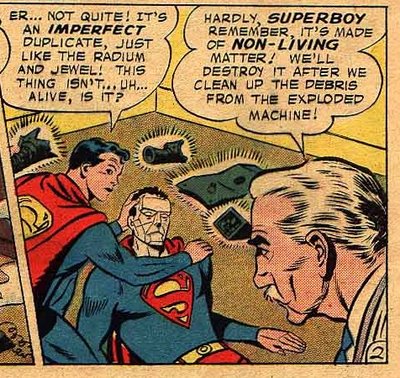
At first they assume the creature is dead, but then it gets up and starts moving around. Frightened by his own appearance in a storefront window, Bizarro throws a car through it, convincing everybody that he's a menace.
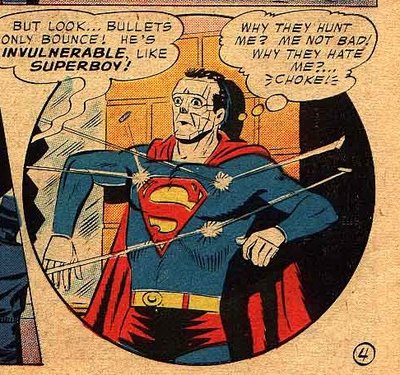
At this point the story becomes something of a cross between Frankenstein the book and Frankenstein the movie. Bizarro finds a friend, but it's only because the girl is blind. Eventually Superboy realizes that the glowing fragments of the machine that created Bizarro would have the same effect on the creature that Kryptonite does on him. Since Bizarro isn't really alive, it's not the same thing as killing him. In the end, Bizarro charges at Superboy and is destroyed in a sudden explosion, that conveniently restores the eyesight of the young girl who befriended him.
Some points: Is this the first "three-part book-length novel" in a Superman title? Although Bizarro died in this issue, Lex Luthor created another Bizarro in a two-part story in Action Comics the next year and the Bizarros (since there were soon lots more of them) created their own wacky world, which was the subject of a series of stories in Adventure Comics immediately prior to the Legion of Superheroes.

At first they assume the creature is dead, but then it gets up and starts moving around. Frightened by his own appearance in a storefront window, Bizarro throws a car through it, convincing everybody that he's a menace.

At this point the story becomes something of a cross between Frankenstein the book and Frankenstein the movie. Bizarro finds a friend, but it's only because the girl is blind. Eventually Superboy realizes that the glowing fragments of the machine that created Bizarro would have the same effect on the creature that Kryptonite does on him. Since Bizarro isn't really alive, it's not the same thing as killing him. In the end, Bizarro charges at Superboy and is destroyed in a sudden explosion, that conveniently restores the eyesight of the young girl who befriended him.
Some points: Is this the first "three-part book-length novel" in a Superman title? Although Bizarro died in this issue, Lex Luthor created another Bizarro in a two-part story in Action Comics the next year and the Bizarros (since there were soon lots more of them) created their own wacky world, which was the subject of a series of stories in Adventure Comics immediately prior to the Legion of Superheroes.
Friday, May 02, 2008
The Silver Age Superman Family

You can't tell the players without a scorecard, right? Here are (most of) the members of the Silver Age Superman Family as they appeared on the back cover of Superman Annual #6, Winter 1962-1963:
1. Jonathan and Martha Kent. Superman's adoptive parents had been around since the late 1940s, appearing in the Superboy stories only. The Kents were initially farmers, but in the Superboy series at the time they were now proprietors of a general store (a smaller forerunner of today's supermarket). They had passed away shortly before Clark moved to Metropolis to pursue his career.
2. Krypto. Krypto had been baby Kal-El's pet on Krypton, who made it to Earth in a test rocket of Jor-El's. His first appearance was in Adventure #210 (July 1955).
3. Streaky, the Supercat. Streaky was a earthly pet of Supergirl's who gained superpowers when exposed to X-Kryptonite, a product of an experiment by Supergirl in an attempt to cure her weakness to Green Kryptonite.
4. Comet, the Superhorse. Comet was originally a centaur who first appeared in Action #292 (October 1962). Circe, a female magician, attempted to turn him into a man, but the spell backfired and he became a horse. As compensation, Circe gave him superpowers. When an actual comet entered the solar system, he would be briefly transformed into a human being, in which form he became one of Supergirl's many boyfriends.
5. Mr Mxyzptlk. Pronounced Mix-yez-pit-el-ik. He was a fifth dimensional imp and prankster. Although very annoying, he was not a villain per se, being more of a pest. He could be forced to return to his own dimension for three months by being tricked into saying his name backwards. He had many appearances in the Golden Age as Mr Mxyztplk, but he had been defunct for several years before returning in Superman #131 (August 1959).
6. The Legion of Superheroes. A team of crime-fighters and do-gooders from the 30th Century who first appeared in Adventure #247 (April 1958). The characters pictured here are Sun Boy, Cosmic Boy, Lightning Lad, Saturn Girl and Chameleon Boy. The group included many other members, with Superboy and Supergirl each joining during the Silver Age.
7. Jor-El and Lara. Superman's parents from Krypton. Although dead for many years, they made frequent appearances in the Silver Age through time travel, imaginary stories and devices that could capture the past. Jor-El, in particular, became a very significant character during this era.
8. Lori Lemaris. Lori is "The Girl in Superman's Past", Clark Kent's college sweetheart in a wheelchair, who turned out to be a mermaid from Atlantis. First appearing in Superman #129, (May 1959), Lori refused a marriage proposal from Clark, but they remained good friends, and she was one of the few people on Earth to know his secret identity.
9. Bizarro #1. Bizarro was a poor copy of Superman created by a ray machine, who did everything wrong. The first Bizarro perished at the end of Superboy #68 (October 1958). A later version was created by Luthor in Action #254 (July 1959). By this time, Bizarro lived on his own square world called Htrae. Bizarro #1 was the original Bizarro, but there were many others by this time, hence the little medallion designating him as the original copy.
10. Professor Potter. The professor was the catalyst for many silly Jimmy Olsen and Lois Lane stories. He was forever inventing gadgets which would kick-start the story, and initially appeared in Superman's Pal, Jimmy Olsen #22 (August 1957).
11. Superman and Supergirl. The stars of the show. Superman first appeared in Action Comics #1 (June 1938), while Supergirl showed up in Action #252 (May 1959).
12. Lana Lang. Clark Kent's neighbor in childhood, Lana was a frequent pest for Superboy, forever suspicious of his secret identity. Although she had been a longtime character in Superboy as a teen, she made her first appearance as an adult in Showcase #9, in yet another story entitled, "The Girl in Superman's Past." Lois and Lana were (usually) friendly rivals for Superman's affections. Lana worked as a TV reporter in Metropolis. (Kudos to commenter Paul Saether for the correction on Lana's first appearance).
13. Lois Lane. Superman's main girlfriend in the Silver Age, she was also Clark Kent's competitor at the Daily Planet. She had been around since Action Comics #1, marking her as tied for the longest-running character in the DC universe, with her boyfriend. Lois had a few tryout appearances in Showcase during 1957 and was awarded her own book in March 1958.
14. Perry White. The editor of the Daily Planet, Perry was the boss of Clark, Lois and Jimmy Olsen. Usually portrayed as hot-headed, Perry also had a heart of gold. Perry had been around since the Golden Age, although he actually debuted on the Superman radio series.
15. Lucy Lane. Lois' younger sister was Jimmy Olsen's more-or-less steady girlfriend, although neither of them hesitated to date others on the side. Lucy first appeared as an airline stewardess (they weren't called flight attendants back then) in Superman's Pal, Jimmy Olsen #37 (April 1959).
16. Jimmy Olsen. Like Perry White, Jimmy Olsen had debuted on the radio show and then moved over to the comics. He had been a very minor character in the comics before getting his own book in September-October 1954, and the prominence of the character in the radio and TV series were probably the cause of him receiving his own book before Lois Lane.
17. Beppo, the Supermonkey. The final member of the supermenagerie, Beppo was a Kryptonian monkey who had stowed away in the rocket in which Jor-El sent Kal-El to Earth. First appearing in Superboy #76 (October 1959), he was an infrequent character in the DC Universe.
Not shown:
Pete Ross. As I have discussed in the past, Pete was the first character to discover Superboy's real identity chronologically. Pete first appeared in Superboy #86 (January 1961)
Bottle City of Kandor. Kandor was the capital of Krypton before it was shrunk and placed in a bottle by Brainiac. Kandor became a frequent setting for Superman stories after he rescued it in Action #242 (July 1958). I have a long post on Kandor coming up.
Lex Luthor. Luthor was one of Superman's oldest foes from the Golden Age, and the only villain who appeared more or less continously from the 1940s onward. One of the real treats of the Silver Age Superman was the evolution of Luthor's character from that of a standard mad scientist into a complex character. I discussed Luthor's changes in the Silver Age here.
Phantom Zone criminals. The Phantom Zone was first mentioned in Adventure #283 (April 1961). It was a "twilight dimension" where Kryptonians who had violated the law were sentenced. While there they had no physical presence or any ability to interact with the real world other than to talk to people who were telepathic. Ironically, being in the Phantom Zone turned out to be a blessing for the criminals, since they survived the end of their planet. Periodically one of them would escape, causing havoc for Superman. Also, Superboy used the Phantom Zone to save Mon-El, who was dying of lead poisoning at the time.
Fred and Edna Danvers. The Danvers adopted Linda Lee (Supergirl) a few years after her arrival on Earth and learned her real identity.
Zor-El and Alura. Supergirl's natural parents, they were thought to have perished with Argo City, but they beamed themselves into the Survival Zone, an alternate Phantom Zone. Eventually Supergirl rescued them, and they lived in Kandor.

Wednesday, April 07, 2010
Trivia Quiz #39 Answers and Prize Awarded!
Wow, once again my readers amazed me with the depth of their knowledge, and three correspondents got all the answers correct, which meant that I had to go with my predetermined tie-breakers.
#1. What color was the Joker's suit?
I had decided prior to the contest to accept purple as the color, since I believe I have mentioned that color a few times myself. However, this was the tie-breaker, as while researching the Joker's history I discovered that it was a very distinct shade of purple:

#2. Who was the son of the Joker?
Although he was never named specifically, in the story The Son of the Joker, he was described as the Joker's protégé.
#3. What crime boss willed his fortune to the Joker?
William "King" Barlowe willed his fortune to the Joker in The Joker's Millions (Detective #180). However, it turned out to be a trick, as Barlowe had placed a large amount of phony money and jewels with only a small amount of the real stuff as a gag on the Clown Prince of Crime.
#4. It is well-known that the Joker appeared in a story in the Golden Age which also featured the Catwoman, and another story where he teamed up with the Penguin. Who was the next super-villain to team-up with the Joker?
Lex Luthor teamed up with the Joker in the appropriately-named "Superman and Batman's Greatest Foes" in World's Finest #88.
5. Who was Gotham City's police commissioner in the 21st century?
Gotham City's police commissioner in the 21st century was Commissioner Rekoj, a descendant of the Joker who was as good as his ancestor was evil.
6. How did the Joker get his distinctive appearance?
In Detective #168, it was revealed that the Joker had gotten his bizarre look when he jumped into a vat of chemicals at the Monarch Playing Card Company to escape the Batman.
7. Was there a Bizarro Joker?
This was a tricky one and all my correspondents got it right for the wrong reason. There was a Bizarro Joker in the modern age, as revealed in DC Comics Presents #71. However, even before that the Joker was an honorary Bizarro. From World's Finest #156:

8. Who was the Joker's diminutive sidekick in the Silver Age?
Gagsworth A. Gagsworthy, better known as Gaggy, was the Joker's vertically challenged person of hench:

Aaron of Silver Age Gold, and "Jim" got all eight answers correct, as did Commander R. A. Benson, but only Commander Benson got the bonus point for coming up with "lavender" as the color of the Joker's suit, so he wins the tee shirt.
Thanks to Melanie of Nerdy Shirts for offering the prize; if you're looking for a cool, yet nerdy shirt, they're your source!
Wednesday, March 18, 2009
Single Issue Review: Jimmy Olsen #64

Everything a youngster needed to know about relationships back in the early 1960s, he could learn from Mr Sensitive himself, Jimmy Olsen.
The first story is Jimmy Olsen, Hollywood Star. The splash shows Jimmy about to drown in a pool of quicksand as the camera rolls, but the text box at the side informs us that this is really happening, and that we should prepare ourselves for a surprise ending.
The story begins with Jimmy falling off a high-rise office building under construction. Fortunately he calls Superman with his signal watch and is saved in the nick of time. We discover that it's actually a stunt for a movie on Superman's life and that Jimmy's sticking around in LA, which in typically demure DC fashion is referred to as "the television city on the coast". Jimmy encounters some of the biggest stars of the time:

What follows are some bizarre short gags, which really don't fit Jimmy Olsen. He encounters a Bizarro, who does some weird stuff. But it's not a Bizarro, it's:

Bizarro Bob Hope!
And then a parrot escapes on a set to the top of a mast. Jimmy has the elastic formula with him and saves the bird which results in him getting some attention from the starlets:

I get the feeling that Jimmy's a Maxim kind of guy, maybe some of that Axe body wash, I mean class all the way.
But then we get one of the classic dun-dun-DUH panels of all time:

Quicksand? Did you say quicksand?
I decry the appalling tendency for liberal judges in Metropolis to permit obvious gangsters out on bail to murder red-headed cub reporters:

But with Jimmy in the quicksand he doesn't even have to fire his gun. As the bow-tied boy reporter is about to drown an unknown person comes in to rescue him:

Who is Jimmy's mysterious savior? Well, to spoil the 46-year-old suspense, it's Boris Karloff although even Jimmy never finds out.
Mort gives the identities of the Hollywood celebrities in the commissary shot:

Note: Although the idea of a story featuring some famed characters was not new, it was interesting that their names were given in the comic, especially Karloff's; I think kids back then would have seen it as something different and surprising
I don't know who "Margie" is; it does not appear to be the gal from My Little Margie. Anybody?
Update: Michael Rebain points to the TV show called Margie which aired around those years, and I was able to find this promo pic for the show with the lead actress (Cynthia Pepper):

As you can see, it looks like somebody's idea of what college was like in the 1920s.
Story #2 (yes, we've barely cracked this classic) is summarized here:

Could this be a story exposing Lois' irrational prejudice against fiery beings? As it turns out, Lois and Jimmy are assigned to cover the story of an exploding volcano in the South Seas, as is another familiar redhead, who gets just a little too honest with Lois:

The locals, a bunch of ignorant savages despite the suits, are talking about fire gods emerging from the volcano. The sophisticates from Metropolis yuk it up a bit:

A few seconds later they are on the run themselves as they encounter the fiery beings, who appear to be following Lana and Jimmy:

Because of their fiery hair. At first the story seems like a classic, "How can we kill these monsters?" tale, but Jimmy proves protective of the little creatures and coaxes them back into the volcano and gets a scoop.
Comments: The mediocre story is aided by the lack of Superman other than as a statue in the town, so that it's a question of whether Jimmy can save the lava beings.
The letters page starts off with a request for Jimmy to give it to Lucy Lane "good and rough".

And indeed given Lucy's treatment of Jimmy in the cover story we can see where Joanne got that sentiment:

But Jimmy goes home with a friend's shortwave radio set, and a few modifications later he's talking to intergalactic babes who want to meet him:

She helps him make a bracelet that gives him super-smarts. But does he use it for the good of humanity? Does he find a cure for cancer?
Well, first he busts Lucy's twisting pilot buddy as a spy. But then he puts some poor carnival operator out of business to impress her:

But Lucy still doesn't consider Jimmy #1 on her hit parade, so when Allura calls again he agrees to be transported to her planet.

Unfortunately they prove unable to overcome their prejudiced size-ism despite the fact that they are perfect for each other.
Monday, March 15, 2010
Mort Weisinger's Superman: Key Dates and Issues
I have written about this previously, but sometime in 1958 Mort Weisinger and his writers and artists set about creating the character that would come to be known as the Silver Age Superman. It was an era of tremendous creativity, that saw many terrific stories and innovations. Here are some of the most important:
April 1958: Adventure #247 introduces the Legion of Super-Heroes.
July 1958: Action #242 introduces the Silver Age Fortress of Solitude..
September 1958: Action #244 introduces Brainiac and the bottle city of Kandor.
October 1958: Superboy #68 introduces the teen-aged Bizarro.
December 1958: Adventure #255 introduces Red Kryptonite.
February 1959: Superman #127 introduces Titano, the Super-Ape.
April 1959: Jimmy Olsen #37 introduces Lucy Lane.
May 1959: Action #252 introduces Supergirl (Kara Zor-El); Superman #129 introduces Lori Lemaris and Atlantis.
July 1959: Action #254 introduces adult Bizarro.
August 1959: Superman #131 introduces Mr Mxyzptlk (Silver Age version).
April 1960: Adventure #271 introduces the teen-aged Lex Luthor, and establishes the motivation for his hatred of Superboy/Superman.
January 1961: Superboy #86 introduces Pete Ross.
April 1961: Adventure #283 introduces the Phantom Zone.
June 1961: Superboy #89 introduces Mon-El. (Corrected the intro of the Fortress and Brainiac/Kandor).
Monday, May 17, 2010
Adventure #299

This is an imaginary story. The first two pages tell the familiar origin of Superman, taking us to the point where the Kents drop him off at the orphanage while they try to adopt him. However, before they can:

So the government gets hold of him and the military sees him as a potential weapon but:

Of course he breaks free. But when he seeks out the Kents, he makes a few mistakes:

So they don't want him either. Eventually he encounters an aspiring tyrant:

So they do the classic "We'll pretend to love him so that he'll help us take over the world," routine, but inevitably he discovers their real feelings towards him. Eventually he leaves Earth and becomes the greatest hero on another world. But he's always wondered what would have happened if he grew up with the Kents, so he heads back to find out, but runs into a curious golden meteor:

So when he lands on Earth, he's lost his superpowers. The Kents still adopt him and:

Comments: An offbeat, oddball tale, that still illustrates some of the recurring themes in the DC Silver Age. The curious workings of fate conspire to make Clark need glasses and to become the weakling that he always pretended to be in the "real" stories. And second, this turns out to be the first appearance of gold Kryptonite:

This is the last issue for the Tales of the Bizarro World; effective with #300 the backup feature (soon promoted to the lead) was the Legion of Super-Heroes. The title should bring back some memories to Boomers:

This is a reference to the old TV show, Car 54 Where Are You, which had one of the great song intros of all time:
There's a holdup in the Bronx,
Brooklyn's broken out in fights,
There's a traffic jam in Harlem
That's backed up to Jackson Heights
There's a scout troop short a child,
Kruschev's due at Idlewild...
Car 54, where are you?
In the story, Bizarro #1 and his son vacation on Earth as police officers, where they are under the command of Captain Bloke (the real commanding officer in Car 54 was Captain Block). They perform terribly, as indicated by this scene where they supposedly frisk a prisoner:

But since they are invulnerable and super-strong he finds himself unable to get rid of them. But when he's struck on the head and becomes convinced they are good officers, he gives them a golden badge, which of course:

Comments: Nothing special, but the cultural mention of Car 54 does give this story an added something.
Monday, November 30, 2009
Trivia Quiz #37: Solve the Puzzle Cover
I've talked a bit in the past about Mort Weisinger's fondness for what I call puzzle covers. These covers show something bizarre and unexpected, which he hoped would compel the kid to at least take the magazine off the rack and flip through it to find out why the event depicted on the front was taking place. Here's your opportunity to match wits with Mort:
1. Why is this happening?

a. It's a plot to fool some aliens
b. It's the result of Red Kryptonite
c. It's actually a Bizarro Supergirl
d. It's a plot to fool some crooks
2. Why is this happening?

a. It's a plot to fool some aliens
b. It's an effect caused by a comet
c. It's an effect of Red Kryptonite
d. It's actually Bizarro Superman
3. Why is this happening?

a. It's a plot to fool some aliens
b. It's a plot to increase the Daily Planet's circulation
c. It's a plot to fool some crooks
d. It's an effort to save Superman's secret identity
4. Why is this happening?

a. It's a plot by Mr Mxyzptlk
b. Superman really likes Jimmy's guitar licks
c. It's an effect of Red Kryptonite
d. It's a scheme by a saboteur
5. Why is this happening?

a. It's a plot by Mr Mxyzptlk
b. Jimmy really has a secret super-punch
c. It's a plot to fool some crooks
d. It's an effect of Red Kryptonite
Subscribe to:
Posts (Atom)