Tuesday, April 19, 2011

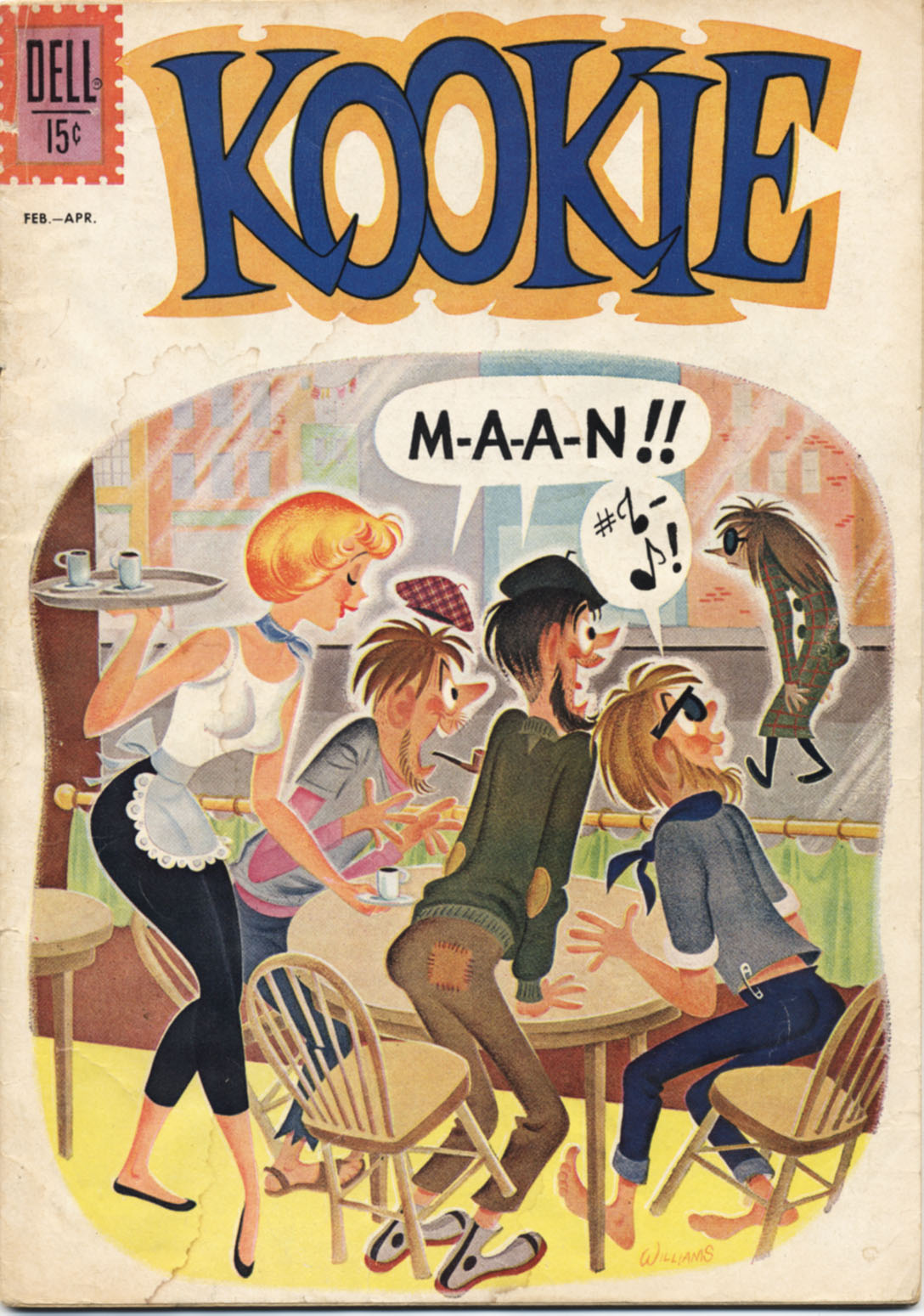
Kookie #1


The beatniks were a source of endless amusement to the mainstream media in the late 1950s and early 1960s, much in the way that their descendents, the hippies and the Goths, would be later. The stereotype of the beatnik is pretty much apparent on the cover: berets, long (for the times) hair, unkempt beards, patched clothes and imaginative footwear. Bob Denver played a beatnik on Dobie Gillis (before he became Gilligan). Snapper Carr got his nickname because he snapped his fingers, much like beatniks did in lieu of clapping their hands.

So it was not particularly surprising that the comic found its way onto the newstands in early 1962. Kookie herself is not a beatnik, she's a sweet young woman who works in a coffee shop apparently frequented by the beat crowd. She has dreams of making it big on Broadway, but like all aspiring actresses, she's dirt poor and has a roommate, the rather plain-looking Clara.

In the opening story, Clara can't sleep because of all the bongo-playing (another beatnik stereotype):

She wakes up late for work and hurries out the door. But her neighbor wants her to try on his latest creation:

But she can't get the ring off her finger, so she hurries to work with the jeweler following. When she gets to Mamma Pappa's (the coffee shop), the proprietor of the same name solves the problem:

By the way, despite the cover image, it does not appear that the male beatniks are immune to Kookie's charms:

A wealthy couple comes in, slumming it:

Later, Kookie delivers a cup of coffee to a sculptor, who uses it to soften the stone he works on:

He decides to let Kookie deliver the final blow. No particular surprise, the statue falls apart.

The second story is a little more amusing. Kookie has been offered a role in an off-Broadway play!

It turns out the houseboat is sinking, but that doesn't matter, as the play is about a young couple struggling to keep their heads above water. But the boat has sunk, and so they won't be able to stage the play until the tide goes out.

There follows a second feature called Bongo and Bop, about two beatniks who decide to go into a park to see what this fresh air stuff is all about. Once they get a whiff of the stuff, a change comes over them:
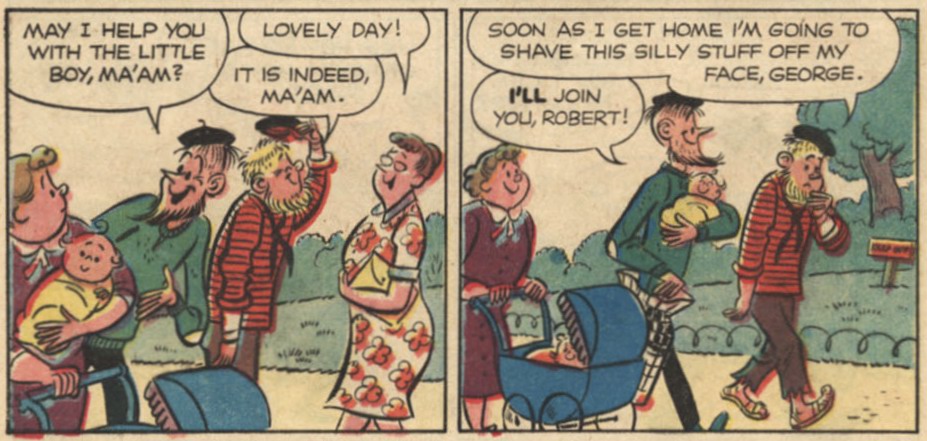
But when they step out of the park, the exhaust fumes from a bus overwhelm them and:

The final Kookie tale has her worried about walking home from the coffee shop, because Mamma Poppa's landlord has been harassing her. Mamma comes up with a solution: she can climb up a fire escape and take the rooftops home. But:

Now that makes no sense at all. Overall, I found the issue moderately amusing, with the Bongo and Bop story standing out as the best in the issue. Kookie made it to a second issue, but then disappeared for good.

Saturday, April 16, 2011

Marvel Swipe #1

Marvel didn't do as much recycling of old stories and plots as DC did, for several reasons:

1. Marvel had a much shorter back history than DC did when it came to superheroes, and it was in the process of reprinting a much greater portion of that history than DC did.

2. Marvel stories were more difficult to recycle as the supporting cast of characters was constantly changing.

But they did do one major swipe in the course of only a few years and it involves this magazine:

Marvel made several efforts at establishing a magazine like Creepy or Eerie, which would be oversized, sell for a premium over comics, and feature black and white interiors. They finally succeeded, of course, with the Savage Sword of Conan, but before that there were the short-lived efforts of Savage Tales (1971) and The Spectacular Spiderman (1968). It appears likely that neither magazine sold well enough to justify continuing, probably because the kids who bought ASM and Conan just weren't used to flipping through the magazine racks, which were often separate from the comics.

Marvel dusted off the story from Spectacular Spiderman #1 in ASM 116-118, early 1973. Large portions of the story were used with virtually no changes, as you can see here:


Aside from the update on recent events in the latter, those two splashes are word for word, as are the next eight pages or so. But, as I noted, Marvel's supporting cast changed often, and some surgery was required in order to make the story work.

For instance, consider this scene:

Fine in 1968, but in 1973, Captain Stacy had been dead for over two years. This creates a major problem, as a significant subplot of the earlier story is that the Captain is one of the few people not swept up in the enthusiasm for Raleigh's candidacy, which sets the stage for one of the story's major subplots. As a result, the skeptic role must be switched over to Joe Robertson, although that still creates an uncomfortable moment. In the original, the dialogue here makes sense:

Here's the update:

Would Jameson talk to Robbie, his editor, about "my" newspaper? Wouldn't he be more likely to refer to it as "the" newspaper, or if he was being magnanimous, "our" newspaper? Note as well that the reference to Peyton Place (which was canceled in 1969) was deleted, and the comparison to Goldwater now uses Humphrey instead (which isn't as funny, because Goldwater lost in a landslide, while Humphrey was only narrowly defeated). This reveals another problem with Marvel recycling; Stan's constant use of then-current pop culture references.

There's one other major change to the story. In the original we learn pretty quickly that Raleigh's faking it:

But in the revised version that scene is rewritten:

Overall, that particular change makes a lot of sense, as it adds some drama to the story. However, it is still pretty obvious from the start that Raleigh is not all he's cracked up to be. There's something about the nature of fiction that tells us that the lone skeptic is always right. And Raleigh's biggest supporter is J. Jonah Jameson, the worst judge of character around.

In both stories, the Raleigh campaign is being attacked by a gigantic thug. In the original, the thug is controlled by Raleigh himself, while in the reprise, it's a shadowy figure known as the Disruptor, who turns out to be Raleigh in disguise. In both stories, in classic Marvel fashion, the thug turns on his master in the end, killing him. In both stories, Jameson stays clueless to the end:

In the sequel, Spiderman hides the Disruptor's costume, letting Raleigh be considered a hero, because:

Thursday, April 14, 2011

Adventures of the Fly #9


The first new superhero created by Jack Kirby in the 1960s wasn't one of the members of the Fantastic Four. It wasn't a character created for DC or Marvel. It was the Fly, an Archie Comics superhero. Unfortunately, Kirby's association with the magazine ended after the first issue, and this story is illustrated by John Giunta.

It's not hard to figure out the inspiration for the Fly. In 1958, Vincent Price starred in a movie called the Fly, where a scientist experimenting with teleportation, accidentally gets his body scrambled up with that of a fly which had entered the device with him. In this series, the Fly appears to have the various powers of flying insects, which he activates by rubbing a ring.

The opening story is pretty banal. Thomas Troy (secretly the Fly) is on a business trip to Havana, with his pretty secretary, Donna Morse. Havana? Yep, the comic has a cover date of November 1960, which is shortly after the US embargo on Cuba after the revolution. The comic was obviously written and drawn prior to that, but well after Castro took power. However, there is no mention in the book that Cuba is anything other than a fun-loving Latin American country. Of course, that implies some things we modern audiences would look askance at:

The Fly has left Donna at a swanky nightclub with its owner, a handsome American businessman named Kent, who is selling the business (good timing!), while he goes in search of some criminals who fled to the island nation. Donna wishes she was with the Fly instead. But when some criminals kidnap Kent, she follows after, at great peril to herself:

Apparently, some fun-loving Latin Americans, in the carnival atmosphere, tip over the gangsters' car, saving her. When she finally tails them to their hideout, she's shocked to discover that Kent is actually their boss. The Fly arrives in time to save her. He mentions that he actually was responsible for overturning the car earlier.

The second story features a team-up with the Shield. A yogi has been thrilling crowds with his illusions:

Yes, apparently a "phony performance" is illegal in the Fly's hometown. Tom Troy volunteers to defend him from the charges, but the yogi is not content to let justice take its course:

One deplores the laxity of the local jail, which allows criminals to retain their masks and burn giant pots of incense. The yogi gets away with the help of some demons from the spirit world, and goes on a criminal rampage. This scene with the Shield gives us an idea of how he succeeds:

But it isn't until someone wearing a gas mask is unaffected that the Fly and Shield catch on that the yogi is using a hallucinogenic gas and suggestions to convince people that they are seeing monsters and demons.

The third story is the cover tale. Obviously the Cat Girl is based on the Catwoman, who at that time hadn't been seen for some six years at DC and wouldn't appear for at least another six outside of reprints (and the Batman TV show). She first appears at the zoo, where she frees all the big cats. The Fly uses his various powers to entrap them:

Later, he encounters her with a panther and a tiger, which she sics on him. But after subduing the animals, the Fly must save her:

Curious as to who she is and how she controls the big cats, he lets her take him to a cave which serves as a lair. There he discovers her secret. The story ends like many a Batman-Catwoman tale:

Comments: Entertaining stories and competent artwork. The Fly continued through issue #30 and then the series was renamed "Fly Man", which lasted for another nine outings.

Monday, April 11, 2011

My Big Score

I've accumulated a fair number of cool comics over the years, including a few "key" issues. But my first big score came around 1969, during the summer between eighth grade and high school.

As a (mostly) DC fan, there were a number of issues that I desperately wanted to buy. Action #1 and Detective #27 were prominently on that list, of course, but I'm talking about comics that I thought I had a reasonable chance of finding in a garage sale some weekend. And among those, two of the most important were Flash #123 and Secret Origins #1.

Flash #123 was the issue where it is revealed that all of DC's Golden Age heroes--the Jay Garrick Flash, the Alan Scott Green Lantern, etc.--actually lived on a separate Earth from their Silver Age counterparts. Barry Allen gets to meet Jay Garrick in that issue. I had read most of the story in an 80-Page Giant, but a few pages were missing at the front of that book so I was anxious to read the rest.

Secret Origins #1 was DC's third 80-Page Giant, and contained the origin stories of most of the members of the Justice League of America. They didn't undersell on the advertising for that book:

So anyway, my local newspaper had an annual event called "Kids' Classifieds" where kids could advertise for free anything they wanted to sell. When that paper came out, I was on the phone dialing up all the kids advertising comics for sale. About the third one down, I hit paydirt. This kid had Flash #123, Secret Origins #1 and a whole slew of other DC silver.

One problem: The kid lived in Hillsdale, which was probably 8-9 miles as the crow flies from my parent's house, and it was not a straight shot on any road, so by bike it was probably going to be 12 miles or so. And the guy was not willing to hold the comics for me; he said "first come, first served." So I told my mom I was going up to Ramsey (which was the next town up) and pedaled furiously to his house. So I get there and we pretty quickly made a deal; IIRC it was something like $15 for the lot. In addition to the two biggies, he had Green Lantern #2 and #3 (coverless), the first two appearances of the evil universe of Qward. There were also quite a few issues that I already had in my collection.

But the best part of the story is what happened next. Another collector showed up just as I was leaving, and bought the duplicates off me for the same $15 I had paid the original owner. So I walked out with a bunch of cool comics for nothing other than the treadwear on my bicycle tires. :)

Friday, April 08, 2011

How Superboy Makes a Dress

I've been reading a bit of the Golden Age Superboy and came across these two rather amusing examples. In both cases, a gal's dress has been spoiled just prior to an important date. Here's Superboy taking care of Lana Lang, from Adventure #168:

And here he is doing a similar number for Smallville's "Cinderella":

The latter pic is from Adventure #160, which features a bit of terrific characterization for Clark, as he nobly volunteers to take a "homely" girl named Alice Norris to a big dance. Of course, as is cliche in such stories, once Alice removes her glasses and lets her hair down, she turns into a beauty.

Tuesday, April 05, 2011

Atom #7


In response to fan demand, DC liked to do team-ups with their heroes. Being DC, they tended to institutionalize the practice by making them annual events. Flash regular team-ups with Green Lantern, so it was a natural for Julius Schwartz to match his third GA reincarnation with his fourth.

The story, written by Gardner Fox and illustrated by Gil Kane and Murphy Anderson, starts with a bit of a puzzle. Some crooks had escaped from a tall building which was too far from nearby rooftops for them to have jumped. There was no sound of a helicopter, so how could they have escaped? They take the puzzle to local physics grad student, Ray Palmer who comes up with an answer:

In Gardner Fox's Wikipedia entry, there is this note:

A polymath, Fox sprinkled his strips with numerous real-world historical, scientific, and mythological references, once saying, "Knowledge is kind of a hobby with me." For instance, in the span of a year's worth of Atom stories, Fox tackled the 1956 Hungarian revolution, the space race, 18th-century England, miniature card painting, Norse mythology, and numismatics.


So it is no surprise that I was able to locate an article from Time Magazine in 1927 on the European fad of balloon jumping:
Walk along the ground with a breeze at your back, approach a fence, bend your knees, spring lightly into the air when you feel the tug of the balloon. You will sail over the fence so easily and land so gently that you will be surprised. Barns and trees can be surmounted with more vigorous leaps, usually requiring a light second push-up with the tip of the toe on the barn's roof or on the tree's outlying branches.

Balloon jumping is already a popular sport among the English gentry, and is attracting the attention of playful Long Islanders.

Later, while Jean and Ray are out bird-watching, they experience a strong earthquake. They also notice a bird that is out of the normal for the Atlantic Flyway.

Meanwhile, Hawkman has also noticed some birds out of their migratory routes. When he asks them why:

Using some special contact lenses he has designed, Hawkman is able to see the radiation is coming from the East Coast and:

We learn that explorers had found the Cosmitron on a world ruined by war. It gave off radiation, but aside from that the scientists from Thanagar could not determine the machine's purpose. Hawkman contacts Shayera, who is on Thanagar and tells her to check to see if the Cosmitron has been stolen. Then he heads east to find the source of the radiation.

The Atom is at the police station when a call comes in about the balloon robbers. He accompanies them to the scene:

Okay, now that's just a bit silly on Gil Kane's part; there's no way a couple of tiny balloons like those shown could lift even a fraction of a man's weight. Here's a look at what is actually required.

So the cop shoots Atom up into the air with the speargun, which is actually a pretty cool idea. He starts popping the balloons, but by the third crook they're over the getaway boat and so the man makes a quick getaway. Meanwhile, the Atom is so far out to sea that he wonders if he will be able to swim back to shore. Fortunately, he's plucked out of the air by... Hawkman!

The Winged Wonder and the Mighty Mite make short work of the balloon crooks, then Hawkman hurries off in search of the Cosmitron. He locates it lying on the ground in a woods, but as he approaches, tiny men in a space ship attack him:

The aliens manage to kayo Hawkman and get away with the device. Hawkman meets up with the Atom at police headquarters and tells his story. Meanwhile, the aliens are hovering above the Earth. We learn what the Cosmitron does:

They transmit a warning to the United Nations. They were the original rulers of our planet and they intend to resume control. If the UN does not capitulate, they will cause terrible disasters to strike our planet. Perhaps this is an optimistic view of the response of the delegates:

The aliens take a knife to the globe, causing a huge furrow to appear in the ground. We get a page or two of explication on the history of the aliens. They had used the Cosmitron to get control of many planets, but eventually the power (provided by earthquakes) ran out and the Thalens were overthrown. Many years later their descendants had recovered the Cosmitron and intended to resume their conquest of the galaxy.

Since Hawkman's spaceship is gone (with Shayera back on Thanagar), he cannot get to the alien ship, but the Atom can, in a model of Hawkman's craft. Once inside, he steals the Cosmitron:

And after a fairly easy battle, the aliens are defeated, the Cosmitron destroyed, and even the furrow repaired.

Comments: I loved the little bits of backup information that Fox provided, and the artwork is terrific. The Cosmitron is an interesting piece of technology. Atom and Hawkman had several other team-ups in the future and eventually shared the Atom's magazine towards the end of the Silver Age.

Saturday, April 02, 2011

Metal Men

Commander Benson has a post up on the "New" Metal Men, the era in the late 1960s where the MM became more of a secret agent group than a collection of robots with amazing powers. As CB notes, DC made an oddball decision to change what had been a pretty successful series, and to eliminate the basic premise for the series.

This development, and the notion of giving the Metal Men human appearances, destroyed the most inviting aspect of the series. One of its strengths had always been that, in action, the Metal Men provided remarkable visuals for the reader---Gold stretching into lengths of micrometre-thin wire; Mercury turning into globs of fluid; Iron and Lead changing into massive walls or constructions. Even at repose, they had been striking in terms of colour---gold, red, blue, grey, silver, white.


Indeed. Although I covered the initial Metal Men Showcase tryout issue earlier, I thought it might be interesting to take a longer look at the team.

As mentioned in CB's post, one of the interesting facets of the Metal Men was the way the stories contained a relatively painless introduction to chemistry. It was a rare issue that didn't contain something like this:

Or this:

Or this:

And editor Robert Kanigher often used educational fillers:

Another interesting thing about the series was that the robots were all given different personalities. This was blamed on Doc Magnus' (the creator) "faulty responsometers". Mercury was a hot-tempered martinet, while Gold was noble and intelligent. Lead and Iron were lunkhead strongmen. Tin was perhaps the most interesting character, with his oddball combination of timidity and courage, as I discussed years ago. The final member of the initial team was Tina, a platinum beauty who was madly in love with her inventor:

Mmmmm, machine oil!

I classify the series as "superhero" in nature, mainly because the robots do things that shouldn't ordinarily be possible. For example, while we accept that platinum could be stretched out into an extremely fine wire, is it reasonable that a platinum robot could do so? There are presumably gears and pulleys inside that would be damaged, right? In addition, Iron and Lead are often shown making themselves much bigger than normal; how exactly do they add that mass to their forms?

As mentioned above the series was pretty successful. Here are the circulation figures for 1964:

1965:

And 1966:

Metal Men was moving 396,000 copies an issue! But in the next two years, sales just plain collapsed, probably due to Batmania and the superhero craze that accompanied it. Sales were down to 240,000 per issue in 1967 and 207,000 in 1968, putting the series dangerously close to the 200,000 mark where DC in that era typically cancelled titles.

I agree with CB that the change was a mistake. The problem with dramatic shakeups is that they are almost certain to annoy a large percentage of your existing audience, with no guarantee that it will capture new readers.

Wednesday, March 30, 2011