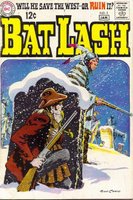
Mort Weisinger's enthusiasm for swiping story ideas from earlier issues of Superboy does not seem as high as it was for Adventure Comics, but here's a pretty impressive example of a double swipe. For starters, here is the cover to Superboy #52 (October 1956):
And Superboy #85 (December 1960):
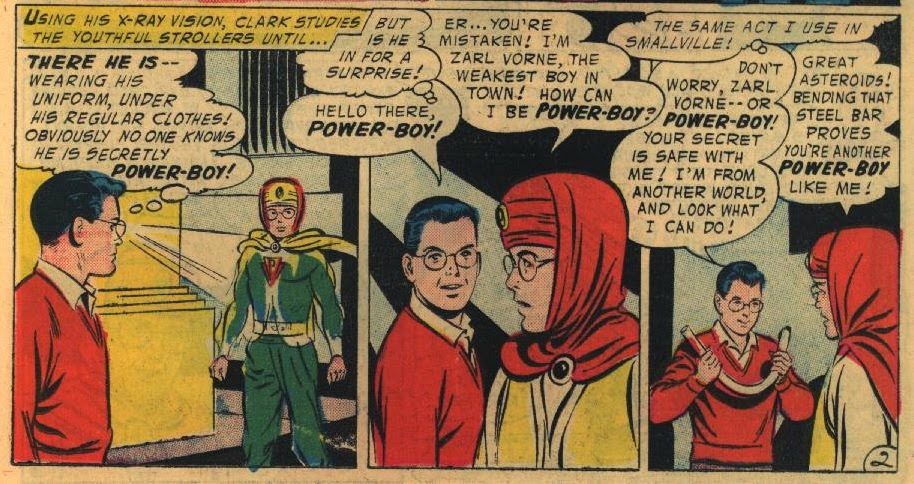
As you can see, in both cases, Superboy is startled to discover another super-powered boy on an alien planet. He changes into civilian clothes and confronts the lad:
The other boy comes from a startling place:
Clark realizes how the other boy got his powers:
So it looks like Superboy is finally going to have a super-powered buddy. But as they start off together, something happens:
Superboy eventually realizes that it's his presence that is causing the other superlad to lose his powers, and thus he must leave, resulting in a sad ending:
Weisinger recycled that ending in Superboy #87 (March 1961), in a Krypto story. Krypto rescues a beautiful female dog:
You've gotta love that he calls her Toots. She doesn't have super-powers, but it turns out that Krypto knows where she can get some:
And so she drinks from the pool and becomes super. Unfortunately:
Krypto soon realizes that he is no longer super when near Kolli, and so we get the same ending as in the two Superboy tales:
Tuesday, July 08, 2014
Thursday, July 03, 2014
Mort Weisinger's Idea of Funny
What the? From Superboy #72 (April 1959):
Why would he put that postscript in there? He had to know that there were plenty of Superboy readers who were still at the age where they believed in Santa. It's hard to come up with a reason other than the obvious; that Weisinger was a first class jerk.
Tuesday, July 01, 2014
A Wink from Clark
Reading through the Silver Age Superboy, I noticed how many stories ended with this:
The winks tend to happen at the end of secret identity stories; I'm sure there are plenty of examples in Superman as well.
This is somewhat akin to the "Ending with Iris" bit in the Flash, and the "Bah!" responses from the Joker; a way of letting us know the story is over.
Update: Kirk House points out in the comments that the practice of ending the story with a wink from Clark may have originated with the Superman cartoons of the early 1940s from the Fleischer studios. Here's the first one in that series, which does indeed end that way:
Wednesday, June 18, 2014
Some Lesser Swipes
As I mentioned the other day, I have been working my way through the mid-1950s Superboy issues looking for more swipes by Weisinger and company. I came across two more, although these were not quite as blatant. First:
Despite the rather obvious swipe of the cover concept, the stories themselves have only a superficial similarity. In the Superboy story, Clark was unaware that his teacher had instructed the class to wear Superboy costumes for Superboy day in Smallville, because he had been absent from the classroom when the order was made. In the Supergirl story, a TV producer had given everybody at Stanhope copies of her uniform (including Linda), but hers was damaged when she used it on a mission in her other identity. The latter story turns out to be an effort by the TV guy to expose Supergirl's secret identity. In the former, Clark sweats it out that the reason he was chosen to be dressed in plainclothes was that someone had guessed his secret, but it turns out instead that hidden inside his jacket was a letter signed by everybody in town thanking Superboy.
It's comparable to these two stories with identical titles:
Same concept, different execution. In the first story (from Superboy #50) a gang of crooks have come to Smallville to hide out with their loot, although one of the underlings is worried about the rumors that a young lad has super powers has recently been making things tough for the local criminals. The boss, as shown, finds the concept of a Superboy to be ridiculous, although he soon learns otherwise. In the later story, Superboy goes to a nearby old West town where the local hoods haven't heard of him.
Wednesday, June 11, 2014
The Secret Origin of Pete Ross
I've been working my way through the mid-1950s issues of Superboy, looking for more stories that were later swiped by Weisinger, and the first one I found is rather significant.
Did you know that Pete Ross' original name was Billy Todd? He popped up in Superboy #47 (March 1956). When we meet him, Billy is helping Clark deal with some bullying:
Just as Pete did in Superboy #86 (January 1961):
He offers to be Clark's pal, but the Boy of Steel is too worried about protecting his secret identity. Fortunately, Ma and Pa Kent intervene, inviting the new chum to dinner. After the meal, Clark shows off his hobby:
As he would later to Pete.
Billy later shows off his own hobby, which is creating miniature replicas of famous structures, such as the Eiffel Tower, the Empire State Building, and the Golden Gate Bridge. Pete has different pastimes: acting and detective work.
Now that they are friends, Clark finds himself (as Superboy) often saving Billy from perilous situations:
As he also did with Pete:
Which leads inevitably to some awkward moments:
Clark is disturbed to learn that his new pal is checking Superboy's measurements:
Which leads him inevitably to the conclusion that his supposed buddy is plotting to betray him. But fortunately there is an innocent explanation:
Pete Ross went on to become a recurring character in the DC Silver Age, albeit a minor one. As I have discussed earlier, he became the only person other than Ma and Pa Kent to know Superboy's secret identity. Billy Todd? As best as I can tell, this was his only appearance.
Update: Kirk House pointed out in the comments that in Action #457, Pete Ross's son apparently lost his will to live. Only one thing could save him; if Superman divulged his secret identity to the young lad. The story is pretty good; ironically the many times that people have suspected Clark Kent as Supes works against the disclosure, as Jon Ross cites those incidents for his skepticism. Fortunately he has figured out another way to prove it that Clark had not protected himself against:
There are a couple of interesting ironies about this story. First, Pete could have told his son that Clark was Superman, or at least confirmed it, except that Supes himself was unaware that his boyhood chum knew the truth. Second is that the many times Clark had been suspected of being the Man of Steel and managed to deceive people into reconsidering actually worked against him. This echoes a Golden Age Batman story where Bruce Wayne lost his position as the guardian of Dick Grayson, in large part because he had convinced the public that he was a dissolute playboy.
The concept of someone making a deathbed request to learn a superhero's secret ID had been used several times already, including at least two Batman tales and one in Jimmy Olsen:
Saturday, June 07, 2014
You Can Learn a Lot from Comic Books
Some of which just ain't so. Consider these two amazing "facts" which I discovered while reading a couple of Superboy issues from 1954-1955:
I can imagine a kid believing those things, but an adult should be just a little more skeptical. Women in general live longer than men (about 7 years longer the last I heard), so it would be quite surprising to learn that a man actually held the title for the oldest documented living human. We would also, given advances in medicine and corresponding advances in average life expectancy, for the oldest person ever to me more recent. And in fact, according to Wikipedia, the current record for the oldest person is a Frenchwoman named Jeanne Calment, who passed away just 17 years ago at age 122. In fact, of the ten longest-living people, only one (the tenth) was a man.
As for Drakenberg, simple math reveals that even with the dates given he did not "complete 146 years," but 145. And this website reveals why that age is suspect at best:
As for the male deer bot fly Wikipedia notes:
In 1938 Irving Langmuir, recipient of the 1932 Nobel Prize in Chemistry, examined the claim in detail and refuted the estimate. Among his specific criticisms were:
Here's another bit from a text piece on how the toys of the 1950s were preparing kids for the jobs of tomorrow:
Now that may seem a bit sexist, but this was the 1950s when Dad went off to work and Mom took care of the kids. In fact, my mother (before she got married) had her first job as a switchboard operator. But I certainly hope no young girls practiced too hard on this toy, as the switchboard was already on its way out.
I can imagine a kid believing those things, but an adult should be just a little more skeptical. Women in general live longer than men (about 7 years longer the last I heard), so it would be quite surprising to learn that a man actually held the title for the oldest documented living human. We would also, given advances in medicine and corresponding advances in average life expectancy, for the oldest person ever to me more recent. And in fact, according to Wikipedia, the current record for the oldest person is a Frenchwoman named Jeanne Calment, who passed away just 17 years ago at age 122. In fact, of the ten longest-living people, only one (the tenth) was a man.
As for Drakenberg, simple math reveals that even with the dates given he did not "complete 146 years," but 145. And this website reveals why that age is suspect at best:
The certificate also states the names of Drakenberg's parents, and of the farm at which he was born. In the postscript of the latest edition of Drakenberg's biography from 1972 Paul G. Ørberg disproves all the facts listed in this certificate (Ørberg 1972). The vicar of Skee in 1732 was Johan Schoug and the vicar in 1626 was Christoffer Lauritzen Friis; the two vicars named in the document have apparently never existed. The farm on which Drakenberg had allegedly been born had just been built in 1626, and was owned by someone else; no trace can be found of the people named as Drakenberg's parents and finally no church register going back to 1626 exists from the church of Skee, and it is doubtful whether one ever has. In other words the certificate proving the amazing age of Drakenberg is a forgery, though a very successful one.
As for the male deer bot fly Wikipedia notes:
In 1938 Irving Langmuir, recipient of the 1932 Nobel Prize in Chemistry, examined the claim in detail and refuted the estimate. Among his specific criticisms were:
- To maintain a velocity of 800 miles per hour, the 0.3-gram fly would have had to consume more than 150% of its body weight in food every second;
- The fly would have produced an audible sonic boom;
- The supersonic fly would have been invisible to the naked eye; and
- The impact trauma of such a fly colliding with a human body would resemble that of a gunshot wound
Here's another bit from a text piece on how the toys of the 1950s were preparing kids for the jobs of tomorrow:
Now that may seem a bit sexist, but this was the 1950s when Dad went off to work and Mom took care of the kids. In fact, my mother (before she got married) had her first job as a switchboard operator. But I certainly hope no young girls practiced too hard on this toy, as the switchboard was already on its way out.
Sunday, June 01, 2014
What Do These Two Covers Have In Common?
Superboy #60:
Supernan #198:
It's pretty obviously the gadget that somehow sees through clothing to reveal the S insignia on Superboy's/Superman's costume. These gadgets are referred to in the stories as X-rays, although of course they do not work the way X-rays really do. A real X-ray actually goes entirely through the person until it hits the film which then reveals the internal organs and bones. There is no reason for the device to stop at one layer of clothing. Although Superman's costume is invulnerable, it is not impervious to X-rays, at least according to this cover:
The two hand-held X-ray gadgets actually work pretty much like young boys hoped the X-ray specs advertised in the comics would.
The Superboy #60 story is the more interesting of the X-ray gadget stories. When Superboy learns that a quiz show is intentionally stacking the deck against a young Smallville inventor, he helps the boy create some devices, including, ironically, the X-ray device that reveals his secret identity. This appears to predate the public revelations about the quiz show scandals of the late 1950s. I talked four years ago about an even earlier Batman story that exposed shenanigans in the genre.
In the Superboy story, the young inventor is eventually able to keep $30,000 (the amount he had accumulated before the Boy of Steel's intervention). That would be a small fortune in those days, enough to purchase a house, car and a college education.
The Superman story is less interesting; it turns out that the bearded Clark Kent is actually from another dimension, where Superman was evil and had disposed of Clark. But then we learn that it's all a trick to trap Superman in the other dimension.
By the way, in both stories, Clark is able to convince people that the actual device being used on him was actually just a projector which put the S emblem on his chest.
Monday, March 24, 2014
Weisinger's Fingerprints All Over 1958
I wrote awhile back that I had read all the Action issues from #230-#240 and could not really note any discernable change in the editorial style until #241, the first issue that bore the unmistakable imprint of Mort Weisinger's heavy hand.
Well, I was wrong, and I was wrong because I had not read many of the issues that came before #230. Looked at in context, it is easy to see that Weisinger was intimately involved in the Superman stories of 1958 (and even earlier), and that these stories presage the Silver Age Superman to a very large degree.
Let's start with Action #231, from August 1957:
This was an unusual story for Action, as it heavily featured Jimmy Olsen, who despite his billing as Superman's Pal in his own magazine, was definitely second fiddle (or possibly fifth clarinet) to Lois Lane as a supporting character in any of Supe's main mags. Weisinger regularly published stories in Action and Superman that featured Jimmy and Lois, stories that clearly belonged in their own mags. But he was cross-selling; making the Superman readers more interested in the other characters as well.
Although it is not mentioned in #232, Jimmy Olsen's signal ring started popping up in Superman stories starting with Action #236:
The DC Wikia says that Jimmy's signal watch first appeared in Action #238, which is clearly wrong; aside from the earlier mention above, it was actually mentioned in every story of Jimmy Olsen #1, which came out three years earlier, and used in Jimmy Olsen #2>
Superman had used occasional robots over the years, but this was probably the first serious one:
But even that one required Superman to control it remotely with his X-ray vision. Far more independent robots were coming soon.
So I was wrong to say that Weisinger's touch was not evident in Action #230-#240.
Thursday, March 20, 2014
Plastino's JFK Story Now Where It Belongs
At the JFK Library in Boston:
Kudos to DC for doing the right thing.
Superman has finally soared into the John F. Kennedy Presidential Library and Museum in Boston.
Legendary comic book artist Al Plastino thought he donated the 10 hand-drawn comic strips of Superman teaming up with John F. Kennedy decades ago, but the artwork somehow fell in the hands of a private owner.In December, comic book publisher DC Entertainment bought the black-and-white artwork and donated it to the library.Plastino died in November at the age of 91. His four children, grandchildren and wife attended the exhibit opening on Thursday.“We are just thrilled that these came home to where they belong,” said his daughter MaryAnn Plastino Charles, who made the trek from Alabama.
Kudos to DC for doing the right thing.
Wednesday, February 26, 2014
Those Pesky Asteroids!
And comets, meteors and rogue planets!
Here's another thing I noticed in my reading of the Action Comics starting with #200. Superman seemed to spend half of his time saving Earth from one asteroid or other bit of cosmic debris after another.
Action #204:
It took awhile for the next one to come along, but after that it was Katie bar the door. Action #221:
Action #222:
And #223:
Action #227:
#229:
Action #232 featured not one, but two near impacts:
In some cases, these asteroids/comets/meteors performed functions similar to Red Kryptonite later in the Silver Age. For example, the comet in #221 imparted to Superman a magnetic power that was handy at times, but gave him headaches in his secret identity as Clark Kent. The meteor in #232 ended up giving Superman the powers of Superman Junior. The meteorite in #204 appeared to force Superman to perform all his super-feats while standing on his head. And the comet in #227 was thought to have caused his X-ray vision to become uncontrollable.
I'll see if there are any further examples of this. I seem to recall that one of the episodes of the Superman TV show in the 1950s also featured Superman saving Metropolis from an asteroid.
Tuesday, February 18, 2014
The Man in the Background
I've been remiss in posting a lot lately, but I've also been reading a lot of comics that fall outside the target of this blog; I'm working my way through a couple of series, including the 1970s Flash issues and Cerebus.
But as it happens, I got a hankering to read the Action Superman stories starting from issue #200, and I began noticing the man in the background of a lot of scenes set at the Daily Planet offices. And I do mean a lot. Action #200:
Action #202
That's the only instance I can find so far of him having any lines, but he appears quite often:
Sometimes he's portly, sometimes he's rather svelte:
But the pipe and the bald head are absolutely ubiquitous. Well, the bald head is, occasionally he does take the pipe out of his mouth:
He's also the little man in this picture which was pointed out by longtime commenter Ralph C:
There's not really any mystery here; apparently Superman artist Wayne Boring put editor Mort Weisinger into a lot of panels as an inside joke.
Update: For a more biting look at Mort Weisinger from Boring, check here. Hat tip to commenters Wordsmith for the suggestion and Diane for the link.
Friday, January 17, 2014
Cool New Sci-Fi Comic
Okay, obviously this is a little off-topic, but late last month I was contacted by the writer of a new sci-fi comic who hoped for a review. I was particularly impressed because I get these pitches all the time from people looking for a link who indicate very strongly that they haven't looked at my site and don't realize that it has nothing to do with getting a diploma online, or whatever they're pitching.
Matt Ritter, on the other hand had clearly looked over the site. He frankly acknowledged that perhaps it wasn't a perfect fit for a modern comic. So I agreed to look it over and no, it's not a perfect fit for Silver Age comics fans. But it's still a lot of fun, and actually fits in with another of my passions which many of you may share: old-time video games.
Nova Phase is about a young female bounty hunter trying to get off into space. When she captures the notorious criminal Fred "Quick-Draw" Gunnard, she apparently has enough cash to fulfill her dreams. But... let's just say there are unexpected expenses and she is discouraged. Fortunately she had relieved Quick Draw of his lucky coin, which turns out to be the object of a galaxy-wide hunt.
I'd tell you more, but that's all I know right now. The artwork is intended to have the look of an old-fashioned RPG along the lines of Sega Genesis's classic Phantasy Star, (an old favorite of mine) and it's superbly executed with solid sequential drawing. Here's a look:
The characters are interesting, the plot entertaining and there' a sprinkling of humor throughout the story. I really, really enjoyed reading this through both times. The first issue is free and the second can be had for the bargain price of 99 cents through Comixology. There are six issues planned in the series, although given the quality I see in the first two issues I certainly hope that there will be sequels.
This comes with my highest recommendation, and no, I don't get any commission, although I hope Matt will let me have the rest of the issues free, because I'm dying to find out what happens next.
Subscribe to:
Posts (Atom)