Friday, February 04, 2011

Amazing Spiderman #1


George M. Cohan once observed that plotting a three-act play was relatively simple. In Act 1, you get the hero up in a tree. In Act 2, you throw stones at him. In Act 3, you get the hero down from the tree.

Many comic stories follow this simple formula. Where Spiderman was different, was that Stan and Steve never got him down from the tree; they just kept throwing the stones at him.

This issue offers a classic example. After a quick summary of the events in Amazing Fantasy #15, we see that Uncle Ben's death has put Peter and Aunt May in a rough situation:

Peter considers taking up crime to pay the bills, but he knows it would break his aunt's heart if he were ever arrested. So he gets the bright idea of going into show business. Problem solved? Nope, because there's another stone waiting:

Spidey indeed finds it impossible to cash his check. And things get even tougher with the first appearance of his longest-running nemesis:

The inspiration for J. Jonah Jameson is probably found in the works of Ayn Rand. In the book The Fountainhead, Howard Roark runs afoul of a character named Ellsworth Toohey, who sees it as his duty (as a socialist) to tear down heroic individuals in favor of the ordinary working man. Ditko was famously a Rand fan, and echoes of her philosophy often appeared in Spiderman and in the Question series, as I discussed here.

Jameson's son is an astronaut (note: astronauts were huge celebrities in 1963), and is being launched into space shortly after Spiderman is basically drubbed out of the entertainment biz. But his space capsule develops a problem and he appears to be doomed until Spiderman steps in:
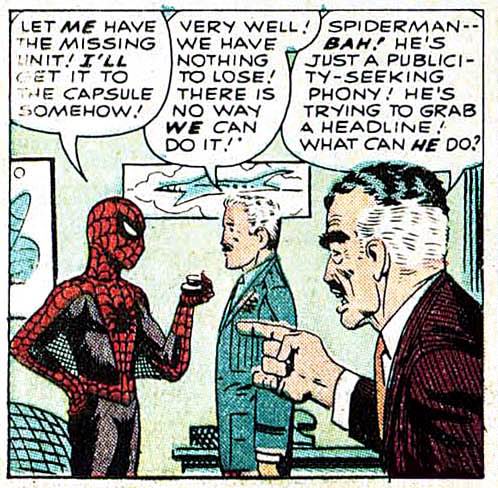
He commandeers a plane and a pilot from a nearby base and:

He rescues Jameson's son and emerges a hero to all, right? Well, yes to the former, but Stan and Steve haven't finished off their pile of stones:

Jameson has trumped up a patently ridiculous charge that Spidey had caused the problems with the capsule in the first place, so that he could look like the savior. So our friendly neighborhood Spiderman remains treed:


In the backup story, Spiderman tries to join the Fantastic Four, figuring that he ought to command a good salary with them. But:

The remainder of the story features Spiderman's first battle with the Chameleon, a quick-change artist. At one point, the Chameleon impersonates Spiderman himself. Peter captures him but the Chameleon gets away and does another makeover. We see the first appearance of Spider-Sense here:

The Spider-Sense is an ingenious gimmick that would become an important weapon in Spiderman's arsenal. But when he catches the phony cop, the Chameleon claims loudly that Spiderman is really the Chameleon in disguise again. This results in Peter fleeing, angry and hurt:

Like I said, the stones never stopped coming.

Sunday, January 30, 2011

Clark Kent: Not An Atheist

Because, as the old saying goes, there are no atheists in foxholes. And Clark (or his Superman identity) certainly found himself in foxholes often:


Thursday, January 27, 2011

A Modest Defense of Death

Well, the latest outrage to hit the comics community is the "death" of the Human Torch, Johnny Storm.

In the latest issue (No. 587) of the Fantastic Four, out today, Johnny Storm, the Human Torch, heroically dies in battle.


Death is natural. Death is normal. Given the extraordinary dangers these characters face on a monthly basis, it would be unrealistic for some of them not to die. One of the reasons superhero stories can be so dramatic is that the writers can take the characters right up to the brink of death. It would be unnatural for some of the heroes not to topple off the cliff.

I have no idea if death is more common today than it was in the Silver Age. Certainly in the last few years, some pretty iconic heroes have shuffled off the mortal coil: Batman and Captain America, for starters. In the Silver Age it was mostly the second-stringers that took the dirt nap: Proty, Ferro Lad, Fredrick Foswell, etc. Lightning Lad was arguably the most important character to die, and of course, he didn't stay that way:

This, to me, is the real problem. It's not that characters die; it's that they are resuscitated. I mentioned that Batman died recently; well, not really. To people in the comics universe he appeared to die, but in actuality he went back to the Stone
Age, then jumped forward a few times in a very confusing series called the Return of Bruce Wayne. I don't read Captain America anymore, but I gather Steve Rogers is back as well. And the articles discussing Johnny Storm's demise make it clear that nobody really thinks he's going to be pushing up daisies for long:
Even though you know this death will not be permanent (superheroes almost always return), this is quite the event since the character has been around for 50 years.

If it's unrealistic for comic characters to keep dodging the bullet, how much more unrealistic is it for them to stop the bullet but then be revived? We all know someone who's passed away and been buried; how many of us have later encountered them on the street?

Don't get me wrong; I loved the Lightning Lad story when I first read it. I also was fascinated by the (brief) return of Gwen. But what works once or twice rapidly becomes cliched.

Death and resurrection breeds cynicism. And cynicism is Kryptonite to fantasy.

Monday, January 24, 2011

Amazing Fantasy #15


I consider Spiderman the single best Silver Age character. For starters, he has the best motivation for putting on the outfit and fighting crime: Because when he failed to stop a criminal, it resulted in the death of his uncle Ben. That is a simple, direct and personal motivation.

Second, of all the Silver Age superheroes, he has the best-realized secret identity. As I have mentioned before, all of the superheroes have a pretty strong cast of supporting characters when wearing the mask and tights. But only Peter Parker seems to have much of a life outside the spandex.

Think about all the characters that Peter interacts with. He has Aunt May at home. He's got (initially) Flash Thompson and Liz Allen at school; after graduation that expands with the addition of Gwen and Harry. He's got J. Jonah Jameson, Betty Brant, Joe Robertson and Fred Foswell at the Daily Bugle where he works. And most of those characters have supporting actors of their own. There are even people that we hardly notice in the Silver Age: Professor Warren and Doctor Bramwell, for instance.

So I thought I would go through the Silver Age Spiderman in a bit more detail than I have in the past. The book he debuted in, Amazing Fantasy, had debuted as Amazing Adventures, then switched to Amazing Adult Fantasy with the seventh issue. For this finale to the series, the word "Adult" had been dropped.

Characters introduced: Peter Parker, Uncle Ben (dies), Aunt May, Flash Thompson, the Burglar (kills Uncle Ben). In addition, we meet Peter's high school science teacher, who is named (in ASM #15 as Mr. Warren (apparently not the same man as Professor Warren). All (except for the Burglar) are introduced on this second page, which does a good job of introducing us to Peter:

That's a solid introduction to the character, giving us the general outlines: Good-hearted, studious but a bit geeky. He attends a science lecture that night, where he is bitten by the famed radioactive spider. He discovers his odd powers and uses them to win a hundred dollars by lasting a round in the ring with Crusher Hogan. This results in his brief TV career. At the studio, he makes a critical mistake:

A short while later, Uncle Ben is murdered by a burglar. Peter tracks him down in an old warehouse, but is stunned to realize:

Note the pupils in his eyes in that bit; the idea that his mask was opaque had not yet been developed. And in the end, comes the phrase that the Spiderman movie made famous:

The story closes with an exhortation to buy the next issue of Amazing Fantasy for the further adventures of Spiderman. Of course, that next issue never arrived, and it was not until seven months later that ASM #1 hit the newsstands.

Comments: An argument can be made that aside from the compelling motivation, there is not that much new about Spiderman in this introductory story. Clark (Superboy) Kent had some troubles fitting in with his classmates, although it was never a continuing theme, just an occasionally recurring one.

But look a little harder and you'll realize that there is a great deal of novelty in this story. Was there ever a superhero before this whose reaction to his powers was the quite natural, "How can I make a buck off this?" Was there ever one who had a continuing antagonist like Flash Thompson, who was not a villain per se, just a bully?

A very solid introduction to the series.

Friday, January 21, 2011

Is May the Cruelest Month?

I have often commented that DC released 30 comics a month, regular as clockwork, during the Silver Age. I based this on the fact that DC released about 3500 comics in the 1950s and about 3600 comics in the 1960s; simple math gave me the rest.

But it occurred to me last night that perhaps the distribution pattern was slightly different than I imagined. Wasn't it more likely that DC ramped up production a bit during the summer months, when kids had more free time? So I decided to do a little research into the matter. For reference, I used the Master List of DC comics compiled by Mike Voiles at Mike's Amazing World of DC Comics.

It turns out that 30 comics a month is a good rule of thumb. From 1955-1970, the fewest number of comics released by DC in a month was 25 in May 1961, while the greatest number was 39 in August 1958. But the vast majority of months the number of comics released ranged between 27 and 33.

Note that I am using "release date"; i.e., the date that the comic first appeared on newsstands, which was generally a month or two earlier than the cover date. There was definitely some seasonality to the releases, as can be seen by looking at the number of comics released by month over the entire 16-year period:

January: 479
February: 498
March: 465
April: 488
May: 460
June: 523
July: 493
August: 517
September: 473
October: 492
November: 476
December: 497

Note the oddball month of February in there; February consistently had more comics released than March, even though most years February had 28 days in it compared to 31 for March. If forced to speculate I'd note that back in those days, both Washington and Lincoln's Birthdays were holidays in most of the country, meaning kids had more time off school in February than in March. Why the jump in April? Spring break is my guess.

If we define the summer season as June-August, the seasonality becomes more obvious:
Winter: 1473
Spring: 1413
Summer: 1533
Fall: 1441

Wednesday, January 19, 2011

In Search Of...

Emailer Jason writes of his search for a particular story from his youth:

But I've been trying to find one Superman story in particular, based only on a vague recollection of its plot and a very vivid image of a single illustrated frame. I'm wondering if what I remember might call to mind any particular issues.

In the story, the Man of Steel is powerless and on another world (probably one with a red sun, but I can't really remember). In the frame I recall so vividly, he takes of the top of his uniform and washes it in a stream, noticing as he does that the colors run in the rushing water.


Figure late 1950s to late 1960s for the timeframe. The part about Superman taking off his shirt made me think of Superman #164, which features Superman and Luthor bare-chested on the cover slugging it out in the ring on the red sun world of Lexor. But Superman's colors don't run in that issue, nor do they in the major Lexor stories in Superman #168, and Action #s 318, 319, 332, 333 or 335. I also checked Superman #184 and Action #370 after Jason mentioned that the story featured a pre-modern society element (either a primitive culture or a planet that resembles earth's pre-history). No luck. Anybody? Bueller?

Update: Commander "Ferris" Benson found it! In Action #262, Clark, Lois, Perry and Jimmy are transported into another dimension, where Superman lacks his super-powers. On the tenth page of the story, there's this sequence:


While we're on the subject of quests, here are two of my own:

One from the mid-60s has the Fox and the Crow battling as usual. The Crow slips a letter under the door of the Fox, but his "hand" was muddy and so the Fox thinks he's gotten a "Black Hand" letter. I remember it because I asked my dad what a Black Hand letter was and was astonished that he didn't know (Dad was my Wikipedia).

I've picked up dozens of Fox & Crow issues over the years and never found that story; I've even purchased the (shudder) Stanley and His Monster issues at the end of that run.

Update: A longtime buddy checks in with the answer to that one: Fox & Crow #86:

In case you're wondering, a Black Hand letter is defined in Wikipedia:
Typical Black Hand tactics involved sending a letter to a victim threatening bodily harm, kidnapping, arson, or murder. The letter demanded a specified amount of money to be delivered to a specific place. It was decorated with threatening symbols like a smoking gun or hangman's noose and signed with a hand imprinted in black ink; hence the Sicilian name 'La Mano Nera (The Black Hand) which was readily adopted by the American press as "The Black Hand Society".


The other is a Baby Huey story from the early 60s where Papa is looking for help with his crossword. He needs a 16-letter word for "a ringing in the ears" and Baby Huey promptly replies "tintinnabulation".

Friday, January 14, 2011

Superman and Lois

Over at Superman Fan, blogger Nightwing posts a scathing review of a Silver Age Lois Lane story. He's particularly hard on the supposed romance between Lois and Superman:
Honestly, I don’t know why so many people talk up the Superman/Lois relationship as some kind of great romance, when most of the time he treats her as at best a pain in the neck and at worst some kind of crazed stalker.

And given the details of that story, it's hard to argue that is an unfair assessment of their relationship.

As it happens, right after reading that post, I was flipping through Superman #142, and found another zany Superman and Lois story, called Lois Lane's Secret Helper. One night, Krypto and Supergirl overhear Lois Lane pouring out her heart to sister Lucy:

So Krypto decides to play Cupid. He does some research around the world to find out what gets men in the mood to pop the question. In Venice, he observes a man proposing after the couple was serenaded by a gondolier. So he spreads some birdseed around where Lois and Superman are talking to attract a few songbirds and:

But it proves almost as easy to distract Superman, as the singing of the birds attracts some cats and:

Next Krypto observes some castaways who decide to marry after being rescued from their desert island. He manages to maroon Lois and Clark. At first Lois is scornful of her companion, but when he manages to get some coconuts she warms up quite a bit:

So Krypto causes an earthquake to throw them together, but Lois is disgusted when Clark remains prostrated on the ground:

Next, Krypto observes that seeing another couple in love can cause a man to lose his inhibitions. So when Lois finds a stray female dog, Krypto brings her a bunch of bones as a gift and:

But the arrival of all those dogs on the scene ruins the moment, and Krypto gives up on getting Superman to marry Lois. He's so peeved, in fact, that he decides to become Lois' pet. Which doesn't work out so well for her, as a cop issues her a citation because he doesn't have a license.

Comments: This story is played strictly for laughs, and it actually delivers, partly because of Superman's rather ridiculous behavior in a) falling for Krypto's romantic cues and b) promptly losing interest in proposing to Lois the minute something unexpected happens.

Exit question: I rather enjoy the snark in Nightwing's post about Superman and Lois. However, I usually grade these stories myself on the curve, recognizing that they were written for kids. Would you like to see a little more bite to my posts, or should I stick to poking fun when appropriate but gently?

Tuesday, January 11, 2011

Detective #288


On the most obvious level, this issue is part and parcel of the horrific "monster of the month" era in Detective Comics that characterized a good part of Jack Schiff's tenure as editor of the Batman family of magazines. And make no mistake about it, that's the primary (and exceedingly silly) plot.

The story starts with a lightning bolt hitting a pool of chemicals causing a strange transformation:

The bit about life arising from chemical wastes is probably inspired by the movie, Godzilla. Batman and Robin encounter the creature and their initial attempt to defeat it reveals that it is more powerful than it looks:

So by this point in reading the story, I'm already yawning at the transparent absurdity. But then something interesting happens. The creature heads towards the house of an old actor who's become wheelchair-bound. Batman moves to help him, while sending Robin to the town to get help.

The actor is somewhat fatalistic, until he sees Batman in trouble:

And in town, Robin discovers that the only official around is a mere clerk, who doesn't think he can handle the crisis until:

There are quite a few Batman and Robin tales from the Golden Age that follow this pattern, and they are among the classics of that era. While the stale art and the monster focus prevent this story from reaching those heights, the subplots did make it quite a bit more entertaining than I expected.

The third subplot involves a bank robbery featuring an ingenious method of escape:

"Nothing can stop us now," is of course begging for trouble, and the creature flies into the blimp, grounding it. Batman and Robin capture the crooks, and help the clerk calm the local citizenry, then electrocute the creature. And in the end:

The Roy Raymond story (one of the last in that long-running series) sees Roy solve the case of an heiress who has been cursed with the gaze of Medusa, causing anyone she glances at to be turned to stone. Of course, it's all a plot by a guardian to steal her inheritance.
The Martian Manhunter story is rather bizarre. MM's good friend Larry Loder has fallen for a swindle. A bunch of crooks sold him some treasure-finding inventions, with which he hopes to pay back the investors who lost money with him earlier. And when you see the inventions, it's not hard to believe that he's a pretty poor financial advisor:

J'onn takes pity on him and makes the inventions seem to work. But it turns out that this was stage two of the crooks' con job:

So the Martian Manhunter makes sure that the final invention works in such a way that the crooks are caught by Larry. The reward money ensures that Loder will have enough funds to pay back all his investors, who presumably reinvested the funds with him in a bagful of magic beans.

Thursday, January 06, 2011

Brave & Bold #57: DC's First Ambivalent Superhero


Up till this point, DC's superheroes had all pretty much relished their superpowers. And why not? Who wouldn't want to be able to zoom at super speed, or have a ring that obeys your every command, or shrink down to the size of an atom... provided, of course, that you could also be normal whenever desired.

Ben Grimm, aka the Thing from the Fantastic Four, changed all that. While he had extraordinary strength, his powers came with a curse: he looked like a pile of orange rocks 24-7. Granted, it's been done to death since, but in the early 1960s this was pretty revolutionary stuff. When the Thing was followed up by characters like the Hulk, Spiderman and the X-Men, it was clear that Marvel was onto something. Comics fans liked heroes with permanent problems, not just the temporary annoyance of a Mr Mxyzptlk or a brush with Red Kryptonite.

DC obviously took note and responded with Metamorpho. Rex Mason was a world-famous adventurer who traveled the globe. His employer was Simon Stagg, a wealthy, but unscrupulous tyrant, who also had a gorgeous daughter named Sapphire. Rex and Sapphire were engaged, much to the dismay of Stagg's brutish assistant, Java, an unfrozen caveman who was smitten with the young woman himself.

As the story begins, Rex is returning from a visit to the jungles of South America, where he was in search of the formula used by witch doctors to create their shrunken heads. He makes quite an entrance:

That turns out to be a gag he's pulled on Stagg and the mayor, who had planned a ceremony and speech to greet the famed traveler. Actually Mason had parachuted from the plane earlier and landed in Sapphire's convertible. When Stagg's goons order the pair back to the millionaire's mansion, they make the most of their time:

Cute bit, probably inspired by the James Bond flicks of the time. Stagg has a new assignment for Mason, one that will pay him enough for him to marry Sapphire:

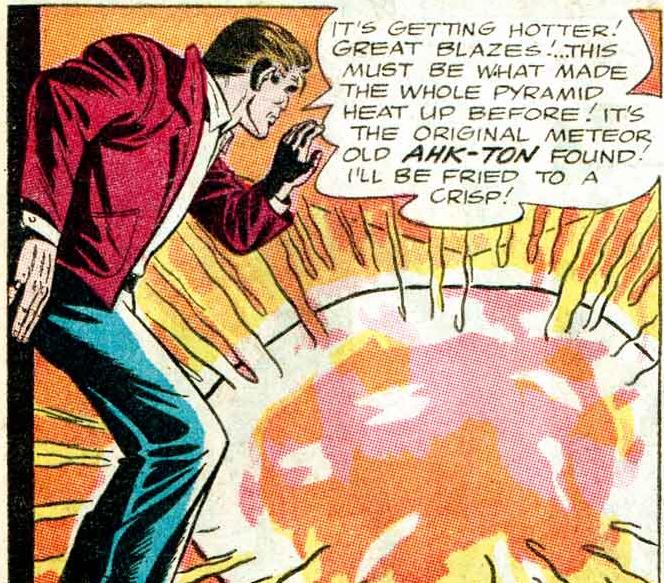
However, when they locate the hidden pyramid, problems arise. At first, the pyramid glows red hot. Then later, after finding the Orb of Ra, Java turns on Rex:

When he recovers, Rex finds himself trapped:

After passing out from the heat, Rex is surprised to discover he's still alive, but dramatically changed:

He's still sealed inside the pyramid, but "a strange thought occurs to his confused brain" and he turns gaseous, seeping through the cracks to the outside.

Java has escaped in a backup plane. Rex quickly realizes that with his new powers he can fix his damaged machine:

In the next chapter, Mason appears to have been boning up on those chemical lessons, as he seeks his revenge on Java and Stagg:

When Stagg tries to shoot him, Rex learns he's invulnerable to bullets in his new form. But not invulnerable to something else:

He and Stagg reach an uneasy truce. Stagg will try to help him get back to his normal state, and Rex will not destroy his castle. There follows a couple pages where Stagg experiments on Metamorpho, which functions mostly to define his powers. He's virtually invulnerable (except for that Orb of Ra) and he can change into almost any element found in the human body.

But Stagg is unable to reverse the incredible change. Java goes nuts and tries to burn down the castle, but Rex saves Sapphire, whose feelings have not changed:

She suggests that he use his powers for good until he can be changed back. Meanwhile, Daddy has hidden the orb in a shark tank he conveniently keeps in another part of the castle.

Comments: Entertaining origin issue, enlivened quite a bit by Ramona Fradon's artwork (embellished by longtime Batman inker Charles Paris). The story was written by Bob Haney. Oddly enough, when DC came up with their next conflicted superhero, he had a very similar quadrifurcated appearance:

There was at least one significant difference between Metamorpho and the Thing. While both were appalled at their freaky-freak McAlien freak appearance, Ben was capable of being irascible even about other things, while Rex remained pretty much happy-go-lucky except about his appearance.