Wednesday, September 26, 2012

Letting the Hulk Out of the Bag

As I have discussed in the past, the secret identity thing could be considered a fate not quite as bad as death. That is, because even the dullest reader in the Silver Age pretty quickly realized that the main hero in a comic never died no matter how close he came (or somehow came back to life after a brief period of time), the secret identity reveal became something that could credibly happen and cost the hero quite a bit as he would either have to retire or create a new identity.

Of course, the problem is that editors back then did not want to create new identities for their established heroes. Oh, they might tease us with it occasionally, and sometimes (e.g., with Superman) more than occasionally, but the story would end in one of a few ways: the discoverer would be conned into thinking that somehow he had gotten it wrong, would suffer amnesia, or would die by the end of the story. On exceedingly rare occasions, the discoverer would turn out to be trustworthy and keep the secret.

Even Marvel was not above using the secret identity revealed "teaser":
In that instance, Peter Parker had the flu and fought so terribly that everybody who watched the removal of his mask ended up believing that he had just pretended to be Spiderman. That's why Tales to Astonish #77 stands out as something new:
And it was no tease; inside, Rick Jones, convinced that Bruce Banner is dead, reveals his secret to Major Talbot:
And not only did Major Talbot not die, but Rick went on to tell Betty Ross, Banner's girlfriend:
You know the old joke? Two people can keep a secret if one of them is dead. Well, with Rick and Talbot and Betty knowing about Bruce Banner being the Hulk, it isn't long before the word gets pretty widespread:
Even the President finds out:
And so the Hulk becomes the first superhero to have his "secret" identity widely revealed.

Note: The Fantastic Four and Doctor Strange never really had secret identities (although in the Strange Tales series it is strongly implied that nobody knows Johnny Storm is the Human Torch), and the Elongated Man decided to let everybody know his real identity of Ralph Dibny voluntarily.

Tuesday, September 18, 2012

Hawk and the Dove #6

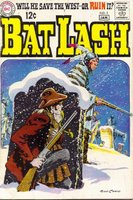
As the 1960s drew to a close, DC was under continuing financial pressure to raise prices due to inflation. As a result, many titles were discontinued in 1969: Angel and the Ape, Atom and Hawkman, Bat-Lash, Captain Action, Beware the Creeper, Metal Men, Secret Six, Spectre, Windy and Willy and the Hawk and the Dove. In fact this was the final issue for the title. Ditko and Skeates, the original creative team on the title were gone by this time; according to the GCD this issue was both scripted and drawn by Gil Kane, with inks by John Celardo. As the story begins, Hank and Don discover that their father being beaten by a hood, who apparently intended to kidnap him. Don stays with Dad while Hank impetuously chases the mugger, giving Kane the opportunity to do what he does best:
Smek? Unfortunately, the creep is tougher than he looks and he gets away. The next day, the boys arrive home from school to find that he's returned, and this time he managed to abduct Pops:
The lads try to track down the kidnapper in their own ways; Hank beats up hoods in an effort to find out who had it in for the judge, while Don does some detective work:
Both of them come to the conclusion that their dad has been kidnapped by the son of a man that the judge had sentenced to prison. Sure enough:
They don't really have much trouble kayoing the guy and rescuing their father, who of course kvetches about the danger they put him in:
The story ends on an ominous note:
As mentioned before, this was the final issue of the Hawk and the Dove. They made semi-regular appearances in Teen Titans for the next few years.

Tuesday, September 04, 2012

Perry White, Businessman First, Responsible Journalist Second

I've been working my way through the complete Action Comics run of the Silver Age, and stumbled on this panel:

Gee, Perry, I don't know if this qualifies as a sure-fire gimmick, but I've often thought that maybe you should hire a third reporter and another photographer, and not always send Clark and me out to cover the same story....

In Action #331, Lois bribes a pressman to run off one copy of the Daily Planet with the headline story that Clark Kent is secretly Superman.  However, the joke is on her and Perry, as the pressman is suddenly taken ill and his assistants print the entire run of the paper with that news.  Fortunately, Clark has an idea:
Hey, if it makes the Planet a couple of bucks, who cares if we sacrifice our credibility?

What I find so amusing about this is that Perry could easily be considered a stand-in for Mort Weisinger.  Think about it; Weisinger was always using gimmicks to sell Superman comics, from Imaginary Stories to fake covers, to dream sequences, to Red Kryptonite stories.  And, I might add, he was very, very successful at this, which undeniably made his bosses at DC quite happy.

Any more examples out there of Perry looking for gimmicks to boost circulation?  I am sure there are plenty.

Wednesday, August 22, 2012

When Did Superman's Heat Vision Start?

As many of you probably know, Superman's heat vision was not an early power. Both Superman and Superboy originally used "the heat" of their X-ray vision to melt things. This changed at some point fairly early in Weisinger's tenure. I am not quite sure why; was it because of the obvious problem that bullets were made of lead and thus not affected by X-rays? So I started going through the early Weisinger Action issues, looking for the changeover. What surprised me at first was how common the "heat of my X-ray vision" meme was in Superman. To give you an idea, it popped up in Action #254,, #255, #256, #258, #259, #262, #263 and #264, or in 8 of 11 issues. But after that it vanished for awhile, only appearing in Action #271. And even that appearance comes with an asterisk:
But in actuality that particular panel is being narrated by a fake Superman and Luthor henchman named Gypo. So it is far from certain that really represents a real instance of the heat of Superman's X-ray vision being used. On the other hand, it is fairly easy to pinpoint the first use of Superman's heat vision in Action; it appears in Action #275 (April 1961):
Okay, so in the second appearance of Brainiac, heat vision was established? But you know the problem; there are several other Superman mags to check, so I decided to start walking it back from April 1961, partially to see if there was an earlier appearance and partially to see if there was a more credible last mention of the "heat of my X-ray vision". There was no mention of Superman's heat from eyes power in Superman #144 (April 1961), but I did find this in Superman #143 (February 1961):
End of story, right? Not quite, however, for when I went forward to see when the first mention of Superman's "heat vision" came, I found mention of the heat of his X-ray vision in stories published after April 1961. The latest mention I can find now is from Superman #146 (July 1961):
The first mention of heat vision I can find in Superman issues comes from #148 (October 1961):
The transition from "heat of X-ray vision" to "heat vision" is pretty easy to track in Superboy. From Superboy #87 (March 1961):
While in the following issue (April 1961):
So it appears pretty obvious that the changeover came between the issues published in March 1961 and April 1961. Update: This is also one of those areas where you cannot trust the reprints. When I went to read the Superman story in Action #259, the closest issue at hand was the reprint in 80-Page Giant #1 (August 1964), where this sequence occurs:
But after noticing that there were several mentions of "heat of my X-ray vision" after this, I hunted down the original, and sure enough:

Thursday, August 09, 2012

Can't See the Fortress for the Keys...

When I wrote the last post, I looked ahead for the next few from Action #251 to see if there were any more appearances of the small (or large) key to the Fortress of Solitude.  However, when I slowed down to actually read those stories, I found something rather amusing.  In Action #253, Superman cautions Jimmy Olsen:

Okay, Supes, mum's the word. Except, in Action #252, the issue published just one month before that panel:
DOH!

Tuesday, August 07, 2012

1957-58-59: The Mort Weisinger Superman Era Begins

This is one of the most important dividing points in the Silver Age of Comics, and yet, when you try to draw it, you realize just how shaky the line is.  If we look at, for example, Action #230, the July 1957 issue in the Grand Comics Database (a terrific resource), we find the following under editor:

Whitney Ellsworth (credited); Jack Schiff (managing); Mort Weisinger (actual).
We know that Ellsworth was in Hollywood, pushing DC's properties for TV and movies, and that his involvement in the comics was presumably minimal.  Schiff probably ran DC's offices at the time, and Weisinger did the Superman books.  But....

Well, there are problems with even this chain of command.  First, both the Weisinger titles (the Superman line) and the Schiff titles (which included Batman, Detective, World's Finest and Blackhawk, among others) dramatically changed once the name on the indicia was adjusted to reflect the "actual" editorship of those books.

This indicates to me that Ellsworth still exercised some strong control over DC even from Hollywood.  Remember, this is in the days before email and when even fax machines were uncommon, so it's unlikely he could have been vetoing art.

Ah, but there's the rub.  The inability to veto art implies also that art goes through, and if we look at the DC Superman art before Weisinger's name officially appears on the indicia, we can see that art tended to go through in that era, whereas it got stopped once Mort was given official credit.

For example, consider this panel from Action #231:
As you can see, that bears only a slight resemblance to the Silver Age Jimmy Olsen. And that's not some fluke; Jimmy's appearance was only consistent in his own magazine.

It's pretty clear that Weisinger began exerting more control over Superman's appearances at least as early as Action Comics #241, which featured the first appearance of the Fortress of Solitude:
Reading the Superman stories in Action 230-240, I found no real continuity; each story was a one-off, and they could have been published in any order.  But starting with the above issue, there was a definite change, as the Fortress and the Bottle City of Kandor (which appeared in the following issue) became continuing plot points.   So it's tempting and natural to assume that Weisinger began to really take charge around this time.  But there are still problems.  A one-time mistake on the depiction of the key, for example?  Nope, it was often shown that way in the next few issues:


That's from Action #247, a full six months after the intro, and given that the key had been established a few times as looking nothing like that (for example):
Weisinger, a stickler for detail, apparently accepted the artwork shown for #247.  A similar problem arises with #249:


However, with #250, the editorial change became official; Weisinger's name first appears in the indicia of that March, 1959 issue.  That does not mean that the problems ended.  Action #251 showed the small key again.  But after that, things pretty much got standardized across the entire Superman line.  Oh, there were still some occasional bloopers, like this oddball version of Kandor from #253:
And, as I discussed many moons ago, Supergirl's skirt was occasionally colored red instead of blue.

So, my take?  I accept that Weisinger edited the line well before 1958, but that he did not take anywhere near as active a role as he would starting with Action #241.  After #250, he definitely made a more serious attempt to standardize the looks of characters and objects like the Fortress Key and the Bottle City.

Tuesday, July 24, 2012

When I'm the Evil Genius

I will not give my enemy 24 hours to get off Earth and never return. Previous posts in the "When I'm the Evil Genius" series.

Wednesday, July 18, 2012

Metal Men 1-10

I got the hankering to read a bunch of Metal Men issues in a row, and rather than try to cover the plots and such I thought it might be more interesting to talk about overall impressions from the run.

First, there is more continuity in this series of Metal Men issues than I remembered.  The stories don't always end with cliffhangers, but they often have unresolved problems that are covered in the following issue.  For example, in #2, Tina invents a robot Doc, who turns out to be evil.  She ties him and a plutonium robot who's about to explode to a rocket headed for the moon.  It blows up in flight, "killing" all three.  In the next issue:
So they go to the moon but they can't recover enough of Tina to revive here.  So he creates a new platinum robot, but this time Doc has "fixed" her responsometer:
Doc soon discovers the problem with perfect responsometers; they don't think for themselves:
His last command was to catch him, but she fails to bring him back to the surface, and he only survives because the other Metal Men save him. So he scraps the new platinum robot and they return to the moon and eventually find enough of Tina to revive her, gushing her love for Doc and all.

At the end of that story, Tin is lost in space, having turned himself into a can to capture a giant amoeba from the moon that came back with Tina.  So the next several issues involve the Metal Men rescuing Tin, first from space and then from the clutches of a mad robot queen on another world.

There is certainly plenty of bickering going on within the group; it is obvious that Robert Kanigher, who both wrote and edited the series was picking up on Stan Lee's efforts with the Fantastic Four.  Mercury's always riding Tin and Tina and Doc is constantly frustrated at her amorous advances towards him.

So that's two elements of the Marvel magic that are featured in the Metal Men.  What are the differences?

1. The pressure is never racheted up progressively.  Instead, there is a threat, then a resolution, then another threat and a resolution.  I've talked a bit about George M. Cohan's famous description of a three-act play: "In Act I, you get the hero up a tree.  In Act II, you throw stones at him.  In Act III, you get him down from the tree."  Kanigher always made sure to get the hero down from the tree before throwing stones at him.

2. The villains are, to put it mildly, ludicrous.  Here's the robot queen from #4 and #5:
and here's the villain from #8 and #9:
They're not really menacing, just kind of clownish.  And it does stretch credulity a bit that the Metal Men keep finding these other planets where there are robot rulers and attacking amusement rides.

The one really interesting set of villains is the Gas Gang, who appear in #6 and again in #10:
 Although there's really no particularly logical reason why chloroform, for example, would affect robots, who presumably don't breathe.

The series is not without its share of amusing moments.  For example, when one of Doc's model girlfriends mocks Tina:
The romantic tension between Doc and Tina is well-handled.  As readers we all wanted Doc to recognize Tina as his true love; however, realistically Doc has a very good point:


The educational aspect is frequently mentioned in the letters to the editor, but this mostly consists of mentioning the melting/boiling points of the various metals and Mercury's frequent observation that he's the only metal that's liquid at room temperature. Overall, I found the run entertaining and while silly at times it's not tiresome. I was not a fan of Andru and Esposito's art as a youngster, but I confess that it's grown on me over the years.

Monday, July 16, 2012

The Subscription Pics

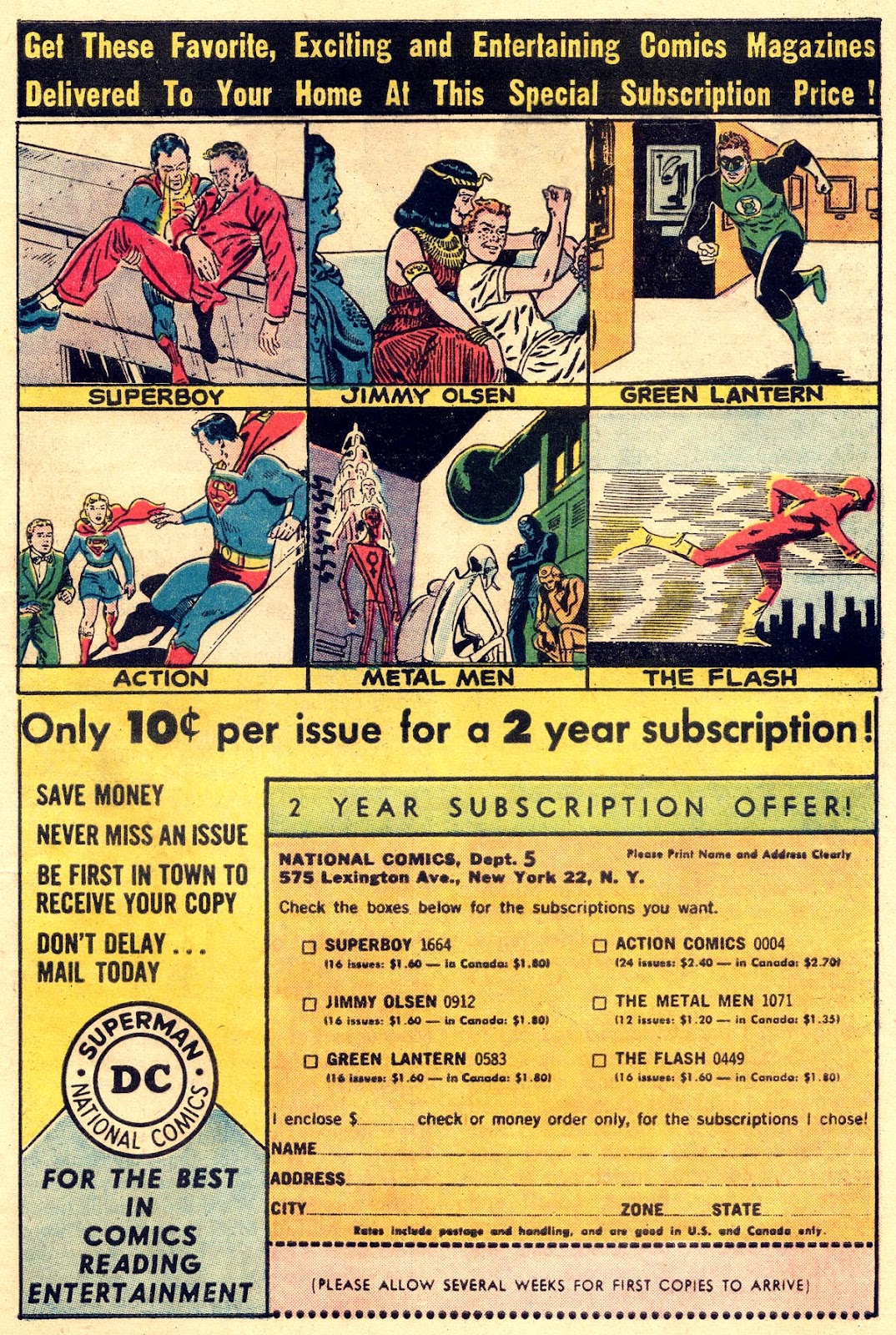
Probably not terribly interesting, but I remember seeing these pictures and wondering exactly which issues they were from, and so I thought I'd spend a little time figuring it out.  In Metal Men #4, I came across this ad for DC's subscriptions:
It's certainly a good deal; 10 cents an issue (by then the cover price was 12 cents).  I seem to recall that advertisers paid a higher rate for subscriber copies than just regular off-the-rack purchases, and of course DC got all the money instead of splitting it with the retailer.  However, since comics were mostly an impulse purchase, the actual number of subscribers was tiny compared to the overall readership.  In most cases, the subscriptions accounted for less than 1% of sales.

But that's not what I want to talk about today.  Instead, I looked at the little pictures advertizing the individual magazines.  As it happens, I had just read Metal Men #3 (Aug-Sept 1963), so I immediately recognized the panel shown there as coming from that issue:
Jimmy Olsen and Cleopatra?  I looked up Cleopatra's appearances by date at the Grand Comics Database, and found that she had appeared in Jimmy Olsen #71 (September 1963), and sure enough the pic shown above is a part of the splash panel for that story:
So it looks pretty obvious that they were choosing very recent issues for the pictures.  Sure enough, the shot of Green Lantern racing through the museum comes from GL #23 (September 1963):
Superboy using his heat vision on the man he's carrying?  You guessed it, from the September 1963 issue (#107) of his mag:
The Action Comics pic is a teeny bit tricky; it actually comes from the August 1963 issue (#303):
Same thing with the Flash; his action shot comes from #138 (August 1963):
Like I said up top, probably not terribly interesting or important, just something I was curious about.

Thursday, July 12, 2012

The Brainiac Story

To most of us kids, it seemed as if Brainiac was like Luthor; one of those villains who'd always been around.  It wasn't until later that I learned that he actually had originated in July of 1958, and thus was only a little over a year older than Supergirl, in comics time anyway.

His first appearance, in Action #242, is also famous for introducing the bottle city of Kandor, an enduring plot device for the rest of the Silver Age.  Here's how his passion for reducing cities was explained in that issue:
There are a couple of oddities, however.  First, why did he only steal one city from Krypton, but multiple cities (including at least Paris, Rome and Metropolis) from Earth?  And wouldn't there be issues with expanding Kandor and Earth cities on the same planet?  Either the Kandorians would all be super, or the Earthlings would be crushed under the heavier gravity.

Superman managed to escape, and restore the Earth cities to their normal size.  But when there was only one charge of the enlarging ray left, he was left with a moral dilemma; should he restore himself, or Kandor.  Fortunately for us, a rocket ship from Kandor, piloted by Jor-El's old college roommate made the decision, pressing the button to return Superman to his normal size.  Brainiac is under sedation for the 100+ year trip back to his home planet.

He returns in Action #275.  In that story, he beams Superman with a combination red and green Kryptonite ray, which mostly impacts Supes like ordinary Red K. He grows a third eye in the back of his head, which comes in handy as with three eyes shooting heat vision at Brainiac, he is able to dissolve the villain's force field. He sends Brainiac back into the past on some remote planet, reasoning that this will get him out of his hair for awhile anyway.

Excluding the oddball Night of March 31st story which I covered years ago, Brainiac's next appearance came just five issues later:
In this story, Brainiac recovers from the suspended animation that Superman had put him in, and zooms into the future.  Along the way he hears voices of crooks imploring him to set them free.  Here's an interesting one:
Entangles his foes in a web, you say?  But Brainiac doesn't need any stooges, and refuses to help them out.  This story does see the return of the bottles, and the shrinking ray, in which Brainiac traps Superman, Lois, Perry and Jimmy, along with Congorilla, who ends up saving them all.

His next significant appearance (Brainiac often appeared in cameo flashbacks whenever the Bottle City of Kandor was mentioned) was in Action #286, when he teamed up with some other villains:
But actually it's just a nightmare that Superman had when exposed to Red K.

His "next" appearance is actually chronologically one of his first.  See, some of Brainiac's henchmen kidnap little Kal-El on Krypton and bring him to Brainiac's home planet, given a name for the first time:
Well, it apparently didn't entirely wipe out the population, as he does have those two helpers.  Brainiac intends to hold baby Kal for ransom so Jor-El will give him his latest invention.  However, it turns out that Superbaby does have powers on Bryak, and thus wreaks havoc on Brainiac's weapons and treasure, so that they return him quickly to Krypton, vowing to have revenge on that planet.  Hence the shrinking of Kandor, which I now must assume was never intended to be restored to its normal size (since the citizens of that city would be super-powered too).

In Brainiac's next appearance, a startling new fact was learned about him: he is a computer!
That's pretty cool and unique, but it doesn't fit in with the tale we've been told before about the population of his home planet (which he ruled) being wiped out by a plague.  At this point, Brainiac simply serves the other computers, and while they have defeated any resistance by the humans that originally created them, they did not wipe out the population.

Armed with this knowledge, Luthor decides to free Brainiac from the prison planet where he's locked up, and to improve the computer:
Of course, there's no honor among thieves and once the operation is done, Brainiac decides he doesn't need Luthor.  Or does he?
And back on Bryak, Brainiac gets another nasty-gram:
Again, it doesn't quite fit the story we've been told about the plague destroying all the people of his homeworld.

Brainiac and Luthor team up to rob Superman of his powers and shrink him to the size of a small bird.  But while they're bickering over who gets to kill him, Superman escapes and sends a message to the Superman Emergency Squad in Kandor.  They arrive and make short work of the villains, but in the meantime, Brainiac has put Supes into a coma, from which the finest Kandorian scientists cannot rouse him.  Brainiac makes a deal; if Kandor lets him and Luthor go, he will release Superman from the coma.  Oh, and along the way, he hypnotizes Luthor into removing the secret timer, and forgetting about Brainiac being a computer.


After that, Brainiac pretty much becomes Superman's generic villain from space.  Oh, occasionally we hear about his twelfth-order computer brain, or his hatred for Kandor, but there's no real attempt to fill in the holes in the back story of Bryak, although I assume a lot of that has chanced since the end of the Silver Age.