Sunday, January 29, 2006

The Disappearance of the Catwoman

The Catwoman had been a regular foe of Batman's since her first appearance in Batman #1. While not appearing as frequently as the Joker, she did pop up in at least 19 stories between 1940 and 1954, so roughly once a year the readers could count on another Catwoman story. But Detective #211's The Jungle Cat-Queen was her final appearance for almost a dozen years.

What happened? I suspect that part of it was that the Catwoman was objectionable to the Comics Code Authority. Not only was she an attractive criminal, but she frequently got away from Batman (although not with her ill-gotten gains), as in this final sequence from that story:


In many of the earlier stories, Batman seemed to intentionally help the Catwoman escape. This of course was contrary to the Comics Code Authority:

General Standards Part A:

1. Crimes shall never be presented in such a way as to create sympathy for the criminal, to promote distrust of the forces of law and justice, or to inspire others with a desire to imitate criminals.
2. No comics shall explicitly present the unique details and methods of a crime.
3. Policemen, judges, government officials, and respected institutions shall never be presented in such a way as to create disrespect for established authority.
4. If crime is depicted it shall be as a sordid and unpleasant activity.
5. Criminals shall not be presented so as to be rendered glamorous or to occupy a position which creates the desire for emulation.
6. In every instance good shall triumph over evil and the criminal punished for his misdeeds.


Of course, the Catwoman clearly violated #5 and #6 regularly, and so she had to go. She disappeared (outside of story reprints in 80-Page Giant #5 and Batman #176) until 1966. And when she returned, it was in a surprising location: Lois Lane #70. Why there? Well, it was November of 1966. Batmania was in full swing, and Mort Weisinger may have decided to ride the wave by borrowing Batman's female nemesis.


After that it was only a matter of time before Catwoman appeared again in Batman #197, although DC decided to modernize her uniform:

Saturday, January 28, 2006

Monday, January 23, 2006

I'm A (Time) Travelin' Man

Most of the superheroes in the DC universe had some method or other of traveling through time. Batman had Professor Nichols, who initially appeared to project him and Robin into the past via hypnosis, a preposterous notion that DC covered up for years by throwing more and more scientific-looking instruments into the room.

Flash had his Cosmic Treadmill, a definite forerunner of the exercise machine gathering dust in many basements across America. The Atom had the Time Pool. Superman could just fly in a tight circle for awhile and he'd automatically go forwards and backwards in time.

For awhile DC even standardized the look of a time machine for their characters who had no other way to travel through the ages:


The basic glass sphere would remain constant for most of the Silver Age. Many of the machines had skids, like a helicopter, or else a tripod arrangement for stability when on the ground.

The crucial element of time travel that DC established first appeared in a Superboy story, The Impossible Mission, in Superboy #85. Superboy decided to travel back in time to save President Lincoln from John Wilkes Booth's bullet. But when he got back there, he encountered the adult Luthor, who had also traveled backwards in time for some plot. Luthor, thinking Superboy was onto his schemes, managed to paralyze Superboy with a piece of red Kryptonite. When the commotion arises at the Ford Theatre, across from Luthor's hotel room, Lex realizes he has helped to kill the greatest President the country ever had. Surprisingly he seems genuinely upset and guilt-ridden. But the lesson that Superboy takes from this escapade is that you cannot go back in time and change history. And for the most part, DC stuck with that rule for the rest of the Silver Age.

Friday, January 20, 2006

Secret Agent Man

Comic publishers have always dutifully scanned popular culture for clues as to topics that appear to interest teenagers. In the 1950s, comics were produced to capitalize on the appeal of Westerns at the movie theatre. When monster movies were popular, monster comics were not behind. And when spies and secret agents became hip in the mid-1960s, the publishers rushed to fill the demand.

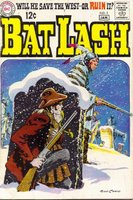
Marvel made a particulary strong entry into the secret agent genre with the paranoia-tinged Nick Fury, Agent of Shield series. NFAS took over the lead feature in Strange Tales that had previously belonged to the Human Torch (and briefly, Torch and the Thing team-ups) effective with issue #135, featuring a terrific cover by Jack Kirby:


(Note: Fred Hembeck has a cool takeoff on this cover and some memories of the NFAS Saga in the January 17, 2006 edition of his blog.)

Fury had been a character in the Marvel universe for several years already, albeit as a historical character. He was Sgt. Fury, leader of the Howling Commandos, a World War II fighting squadron. Now Marvel decided to age him a few years (but not quite the 20 that the calendar called for) and make him a secret agent.

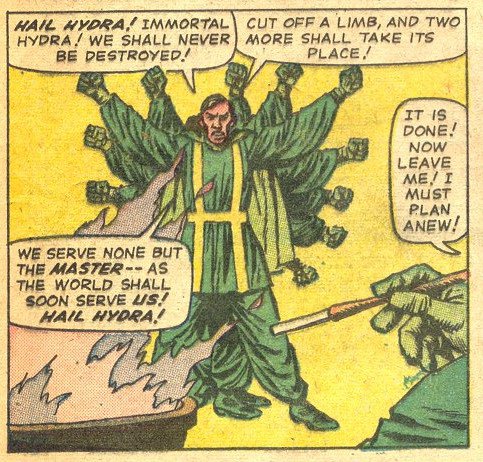
S.H.I.E.L.D. of course was a direct swipe of U.N.C.L.E. (which was probably a swipe itself of S.P.E.C.T.R.E.) and stood for Supreme Headquarters International Espionage Law-Enforcement Division. Shield's chief enemy was a group called Hydra, which mercifully does not stand for anything, but does have some cool rituals:


NFAS was blessed with great stories and artwork. After handling the introductory story in Strange Tales #135, Jack Kirby did layouts for the amazing Johnny Severin for the next few issues, followed by a year or so of rotating artists including Ogden Whitney (!). Finally in Strange Tales #151, a new artist was hired for the feature who would define Agent of Shield for the next few years: Jim Steranko. Steranko's style was unlike most comics artists of the time; he was heavily influenced by the psychedelic posters and album art of the late 1960s as this cover shows:


In early 1968, Marvel decided to quit doing anthology magazines. Strange Tales was changed to Dr Strange with issue #169, and Nick Fury Agent of Shield was given its own title starting with #1. Unfortunately the title struggled a bit on its own apparently, possibly because of the inevitable decline of the secret agent genre after the initial fad died down. The first twelve issues of NFAS were published on a monthly basis, but with #13, the frequency was changed to bi-monthly and the title only lasted to #15. A year later Marvel published three more issues but they were reprints of the early Strange Tales stories.

Monday, January 16, 2006

Early "Relevant" Comics

Although the more famous "relevant" comics came at the end of the Silver Age, there were several earlier attempts. Here's an amusing story from Superman #114, July 1957:


Not even Superman can avoid the taxman! In the story, Superman owes a billion dollars to the government, and must pay up by the next day. But every time he tries getting something valuable he finds a better use for it than paying the debt--hospitals need the radium he digs out of the ground, for example. In the end, a compromise is reached.

This is only one of several Silver Age stories I can think of that featured the emerging snares of the postwar era. For example, in Batman #91, the Caped Crusader had to deal with "Batman's Publicity Agent", an overagressive promoter. In the following issue, "The Fan Mail of Danger", Batman is forced to hire a secretary when his fanmail starts to pile up. There was also a story about Superman at some point where he had to purchase life insurance, and as a result the insurance company begins bugging him not to engage in so many risky events.

Saturday, January 14, 2006

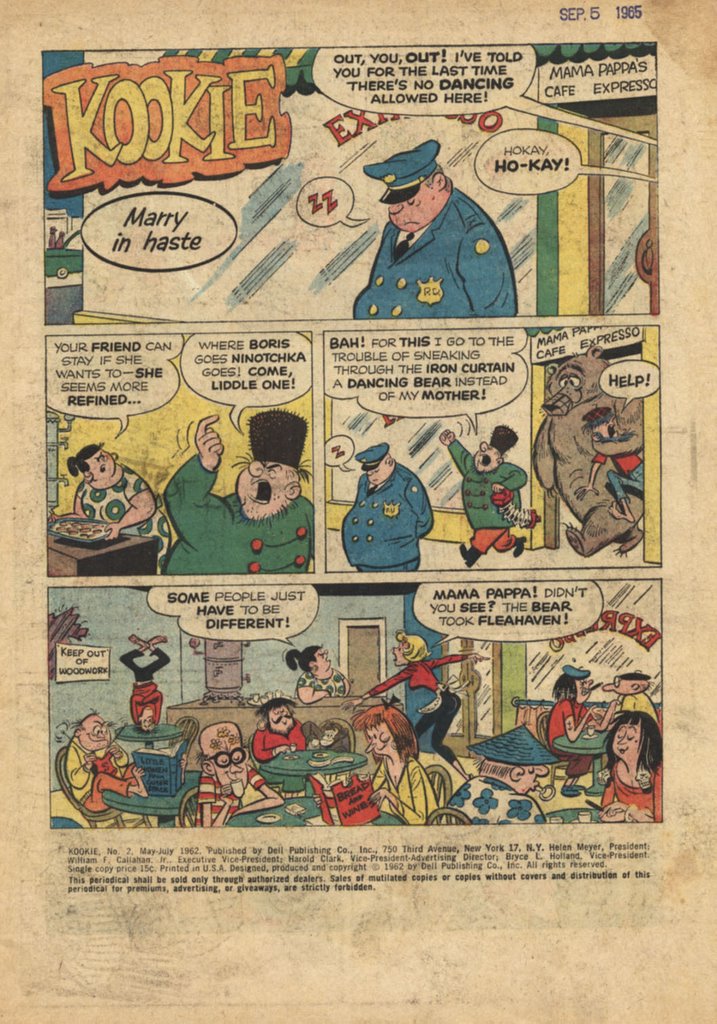
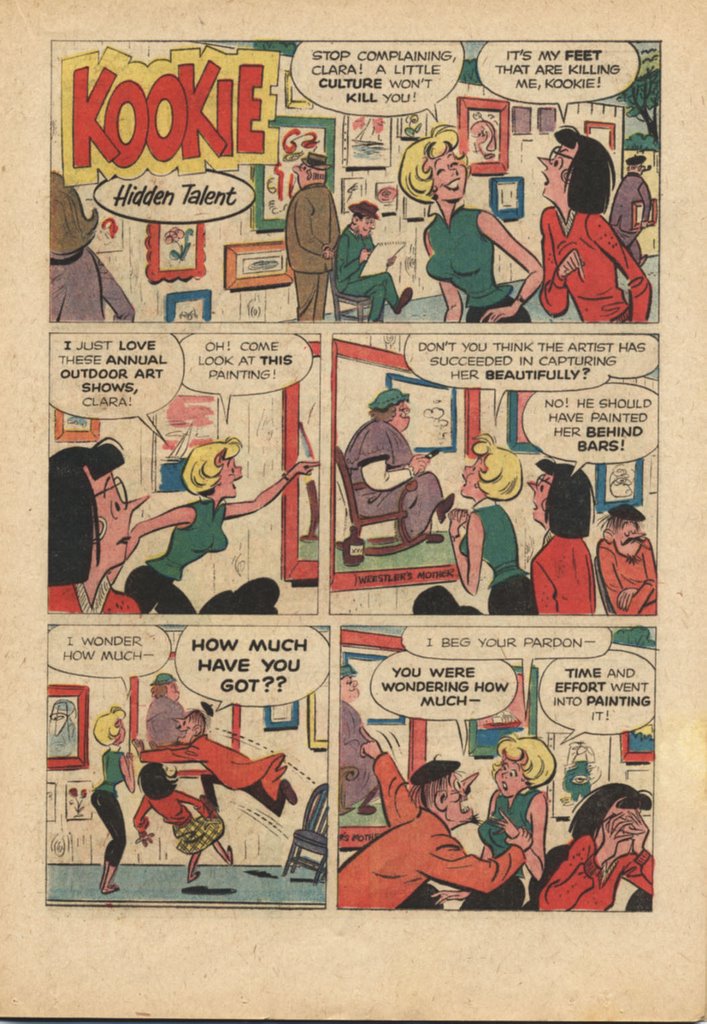
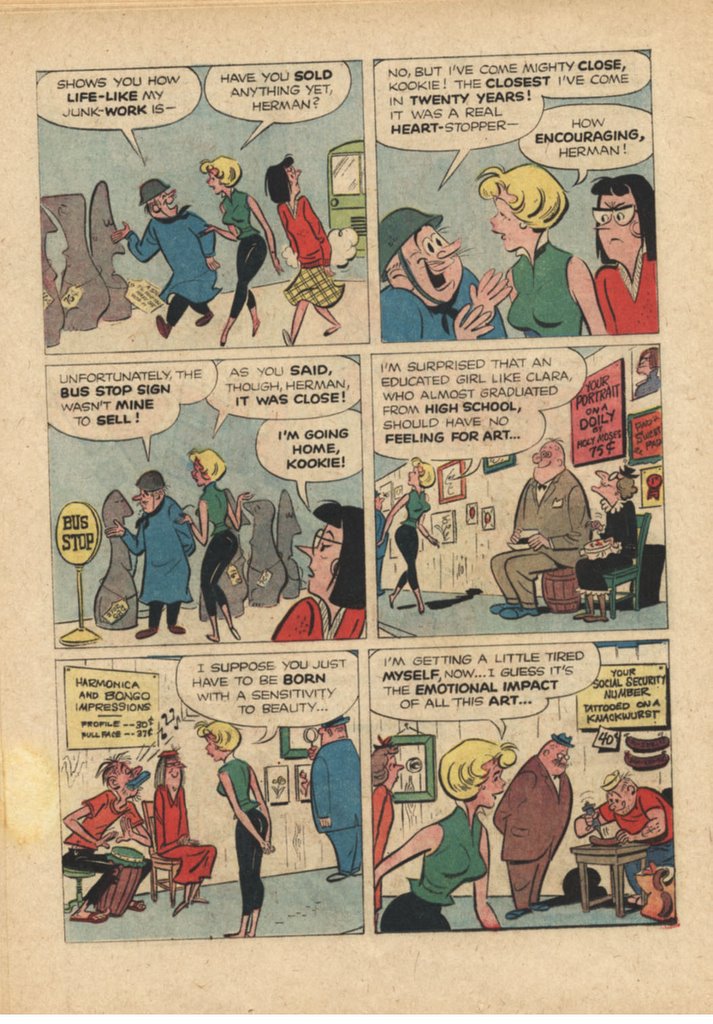
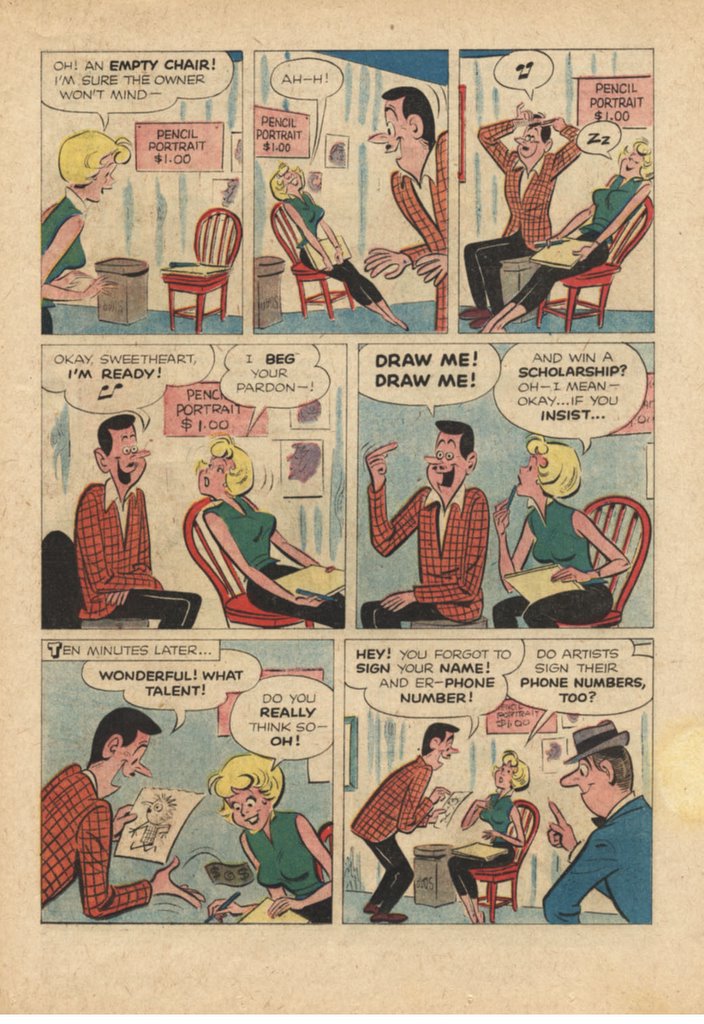
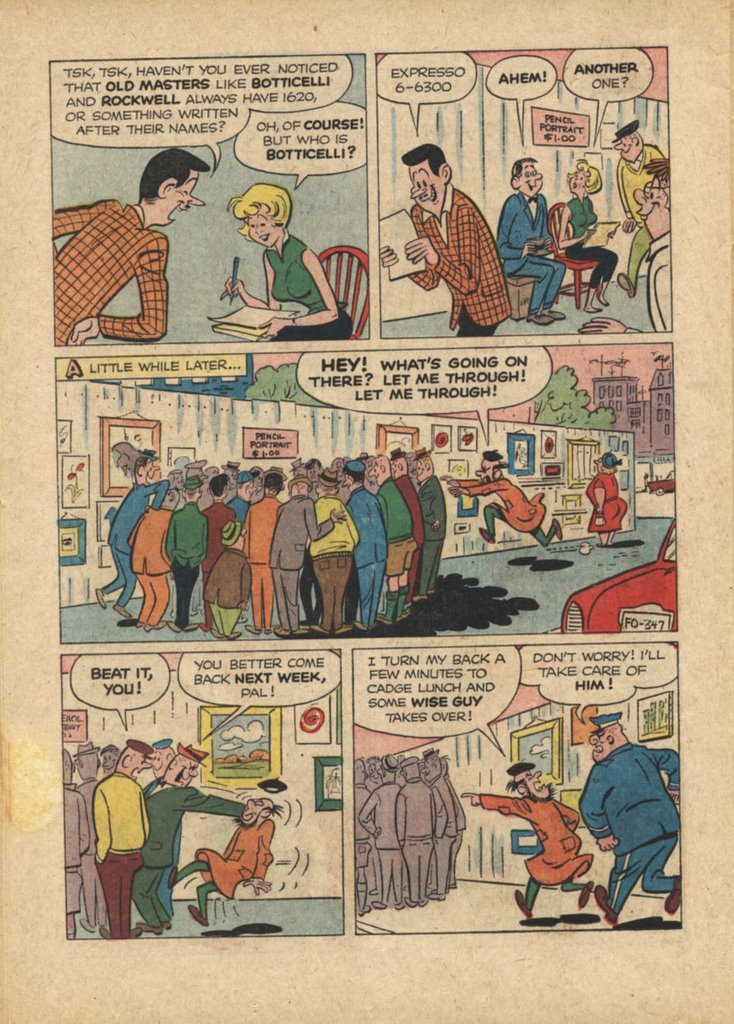
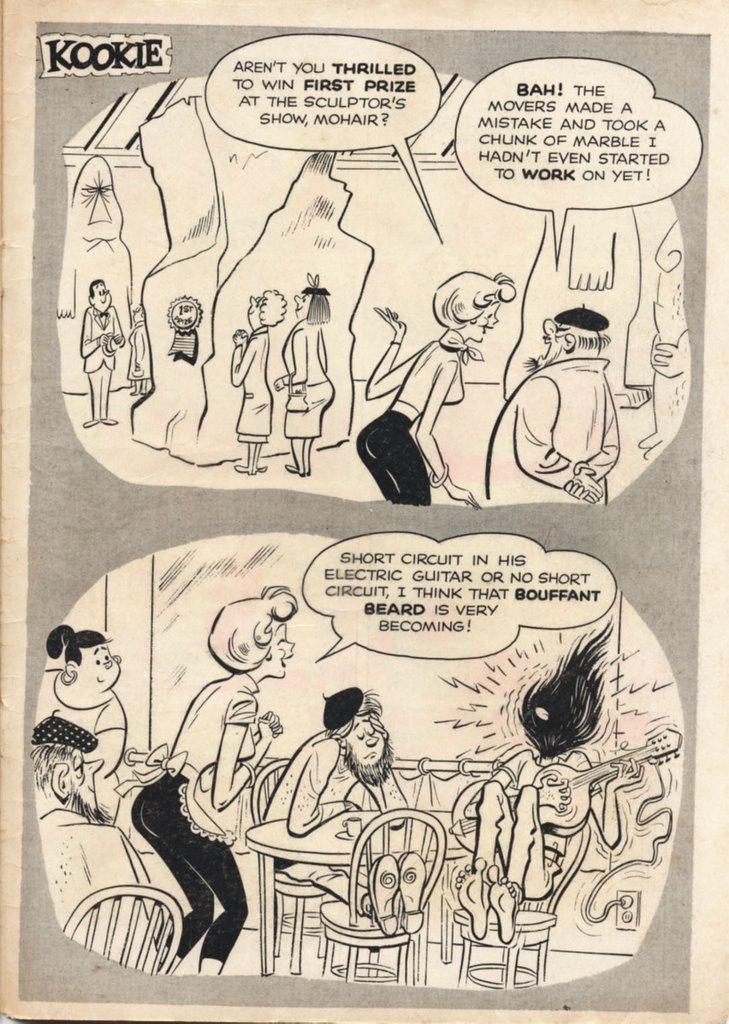
Kookie #2 Part 1--As Requested by Fred Hembeck

(Welcome fellow Fred Hembeck fans!)

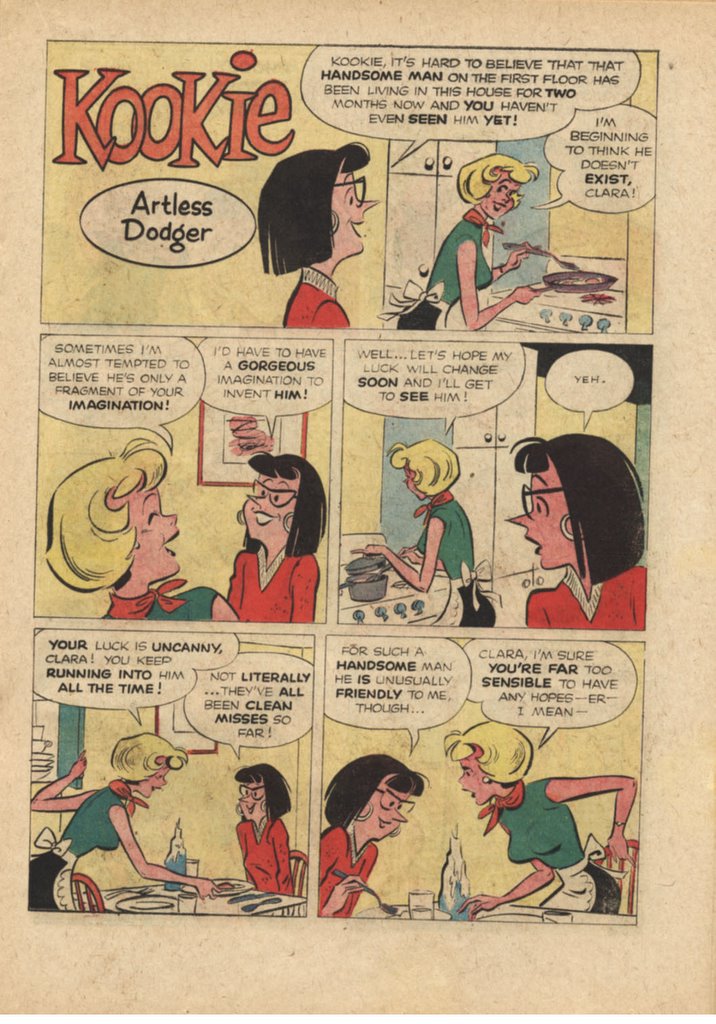
Fred Hembeck wrote eloquently about his appreciation for Kookie #1, an early 1960s good girl comic with a twist; the girl worked in Greenwich Village, at an espresso bar frequented by beatniks. You can read this terrific comic online here.

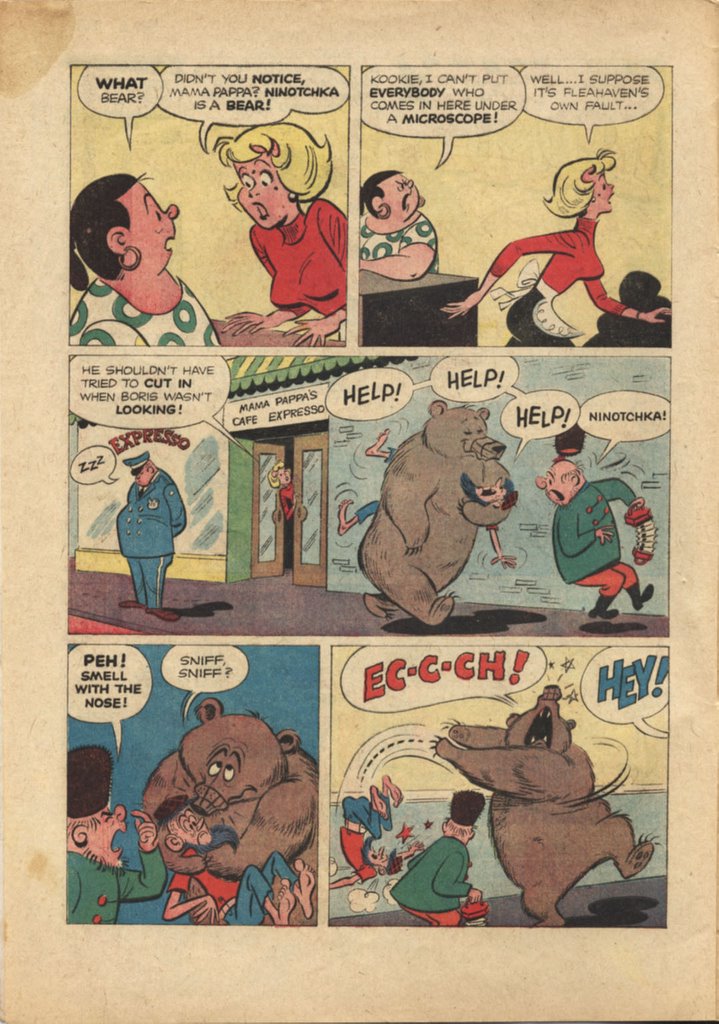
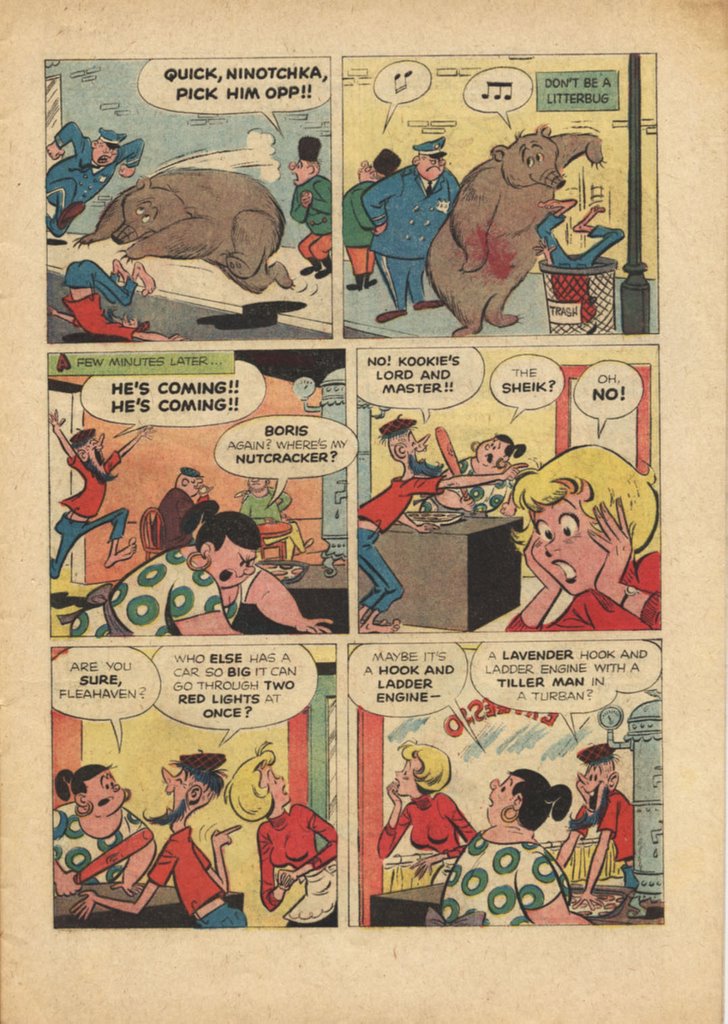
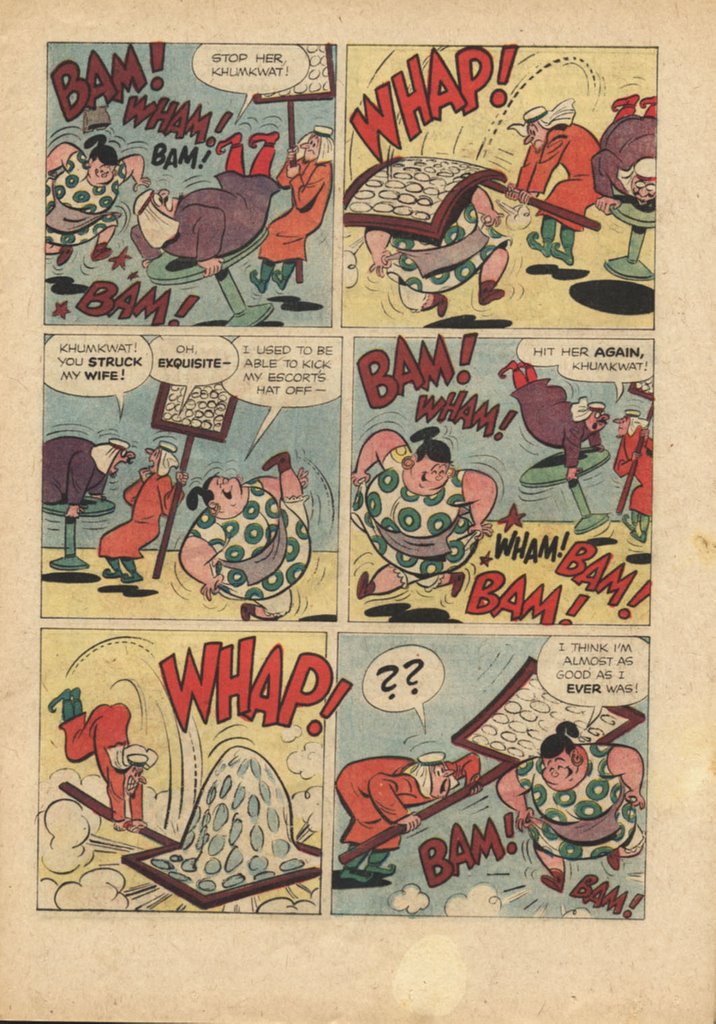
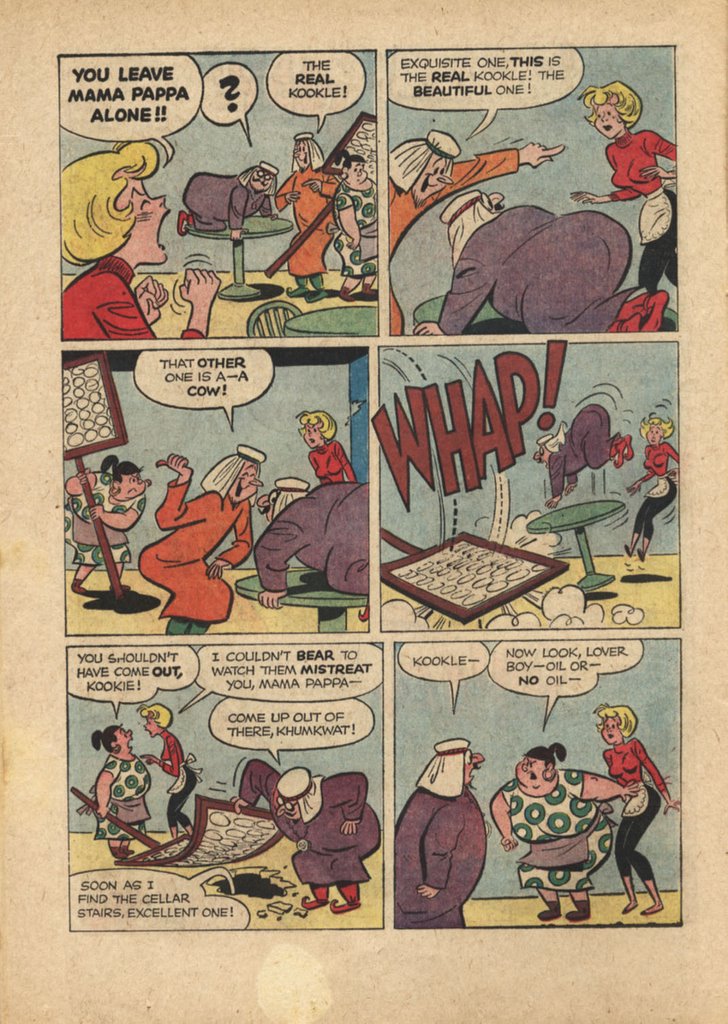
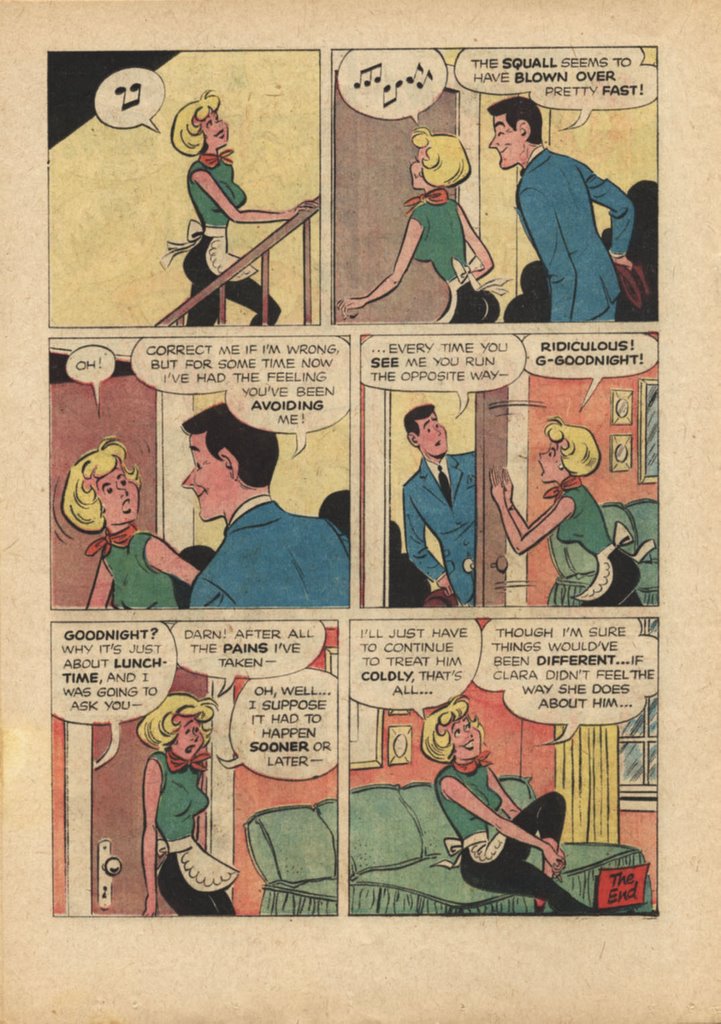
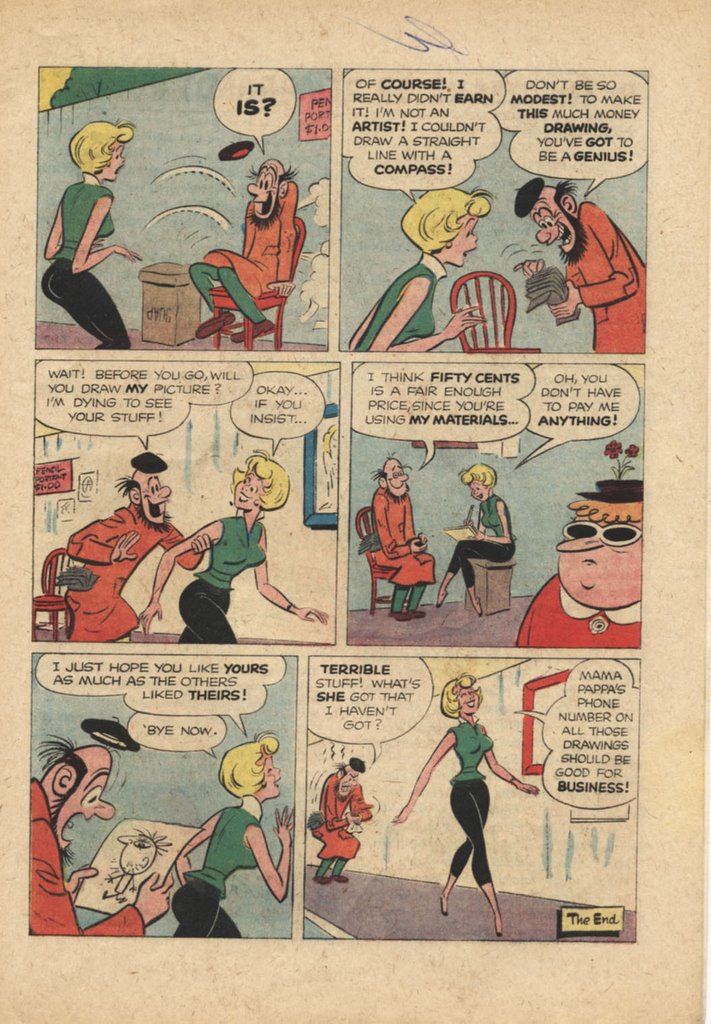
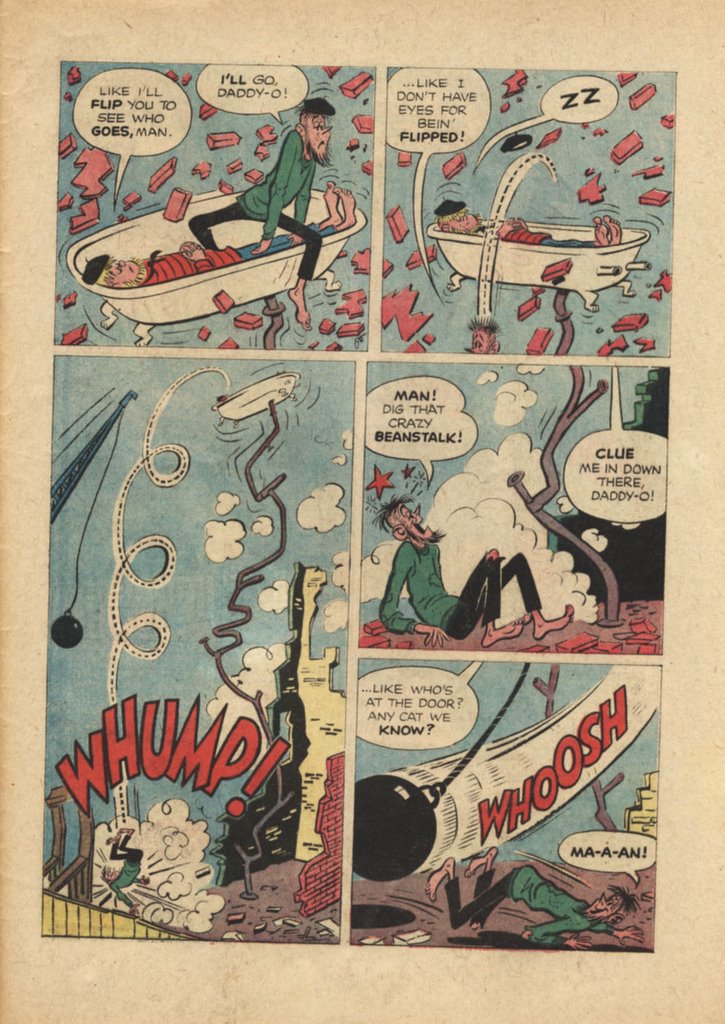
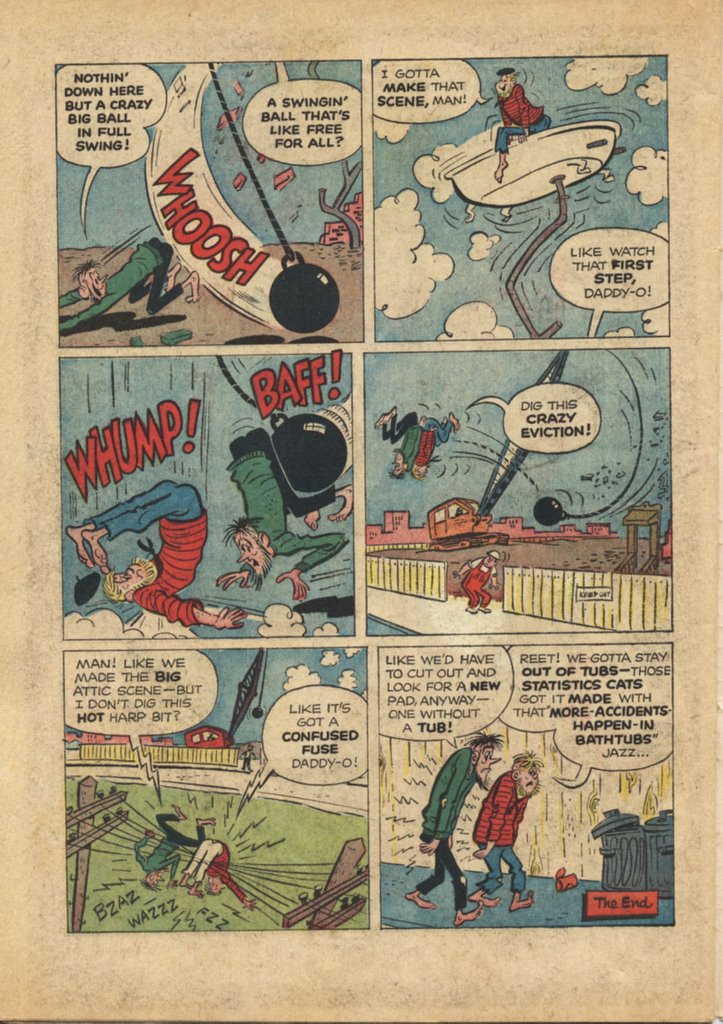
Fred also put out a request for somebody to post #2 online; this is my reply. The scans are not my own, I downloaded them from alt.binaries.pictures.comics a few months ago. The occasional snide commentary is all mine. You can click on each picture to expand it up to two times; at the second level of magnification it becomes more readable.


"Bring me the head of John the Beatnik!"


Kookie #2 Part 2--As Requested by Fred Hembeck


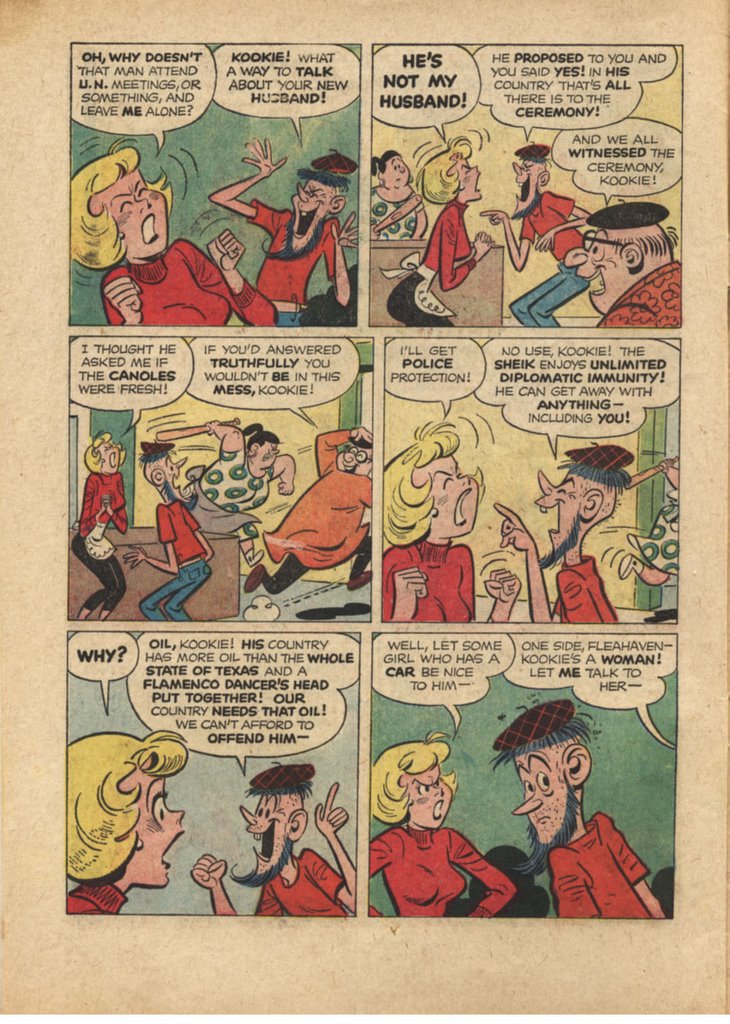
Who says comics aren't educational? Fleahaven gives us all a lesson in geopolitical realities here:


Kookie #2 Part 3--As Requested by Fred Hembeck

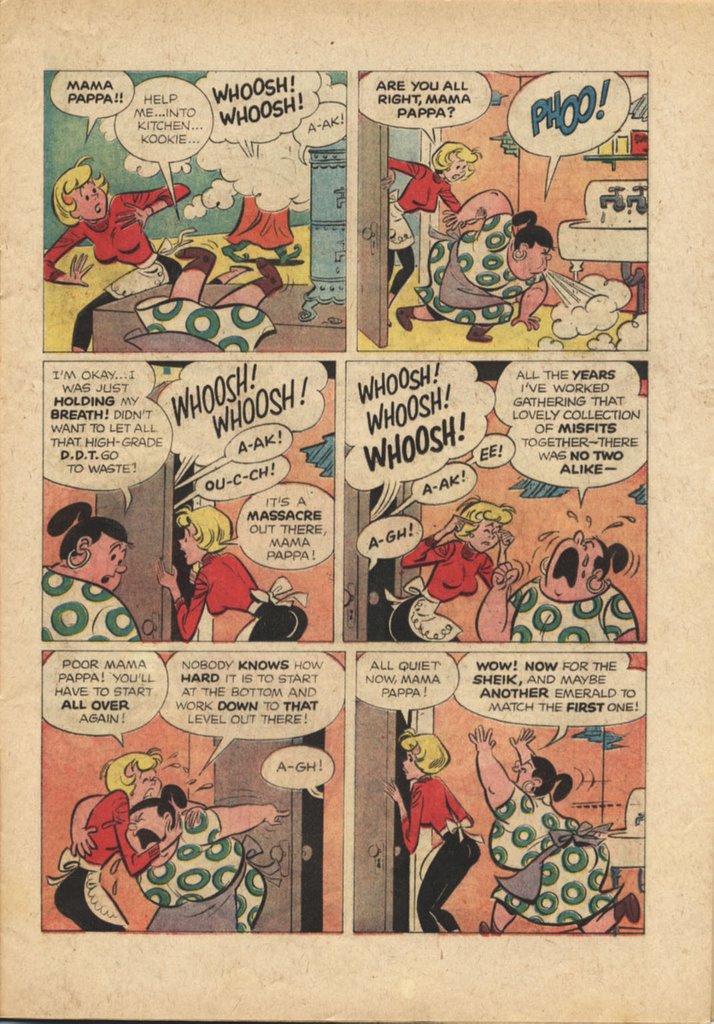
Mama Pappa's into inhalants?


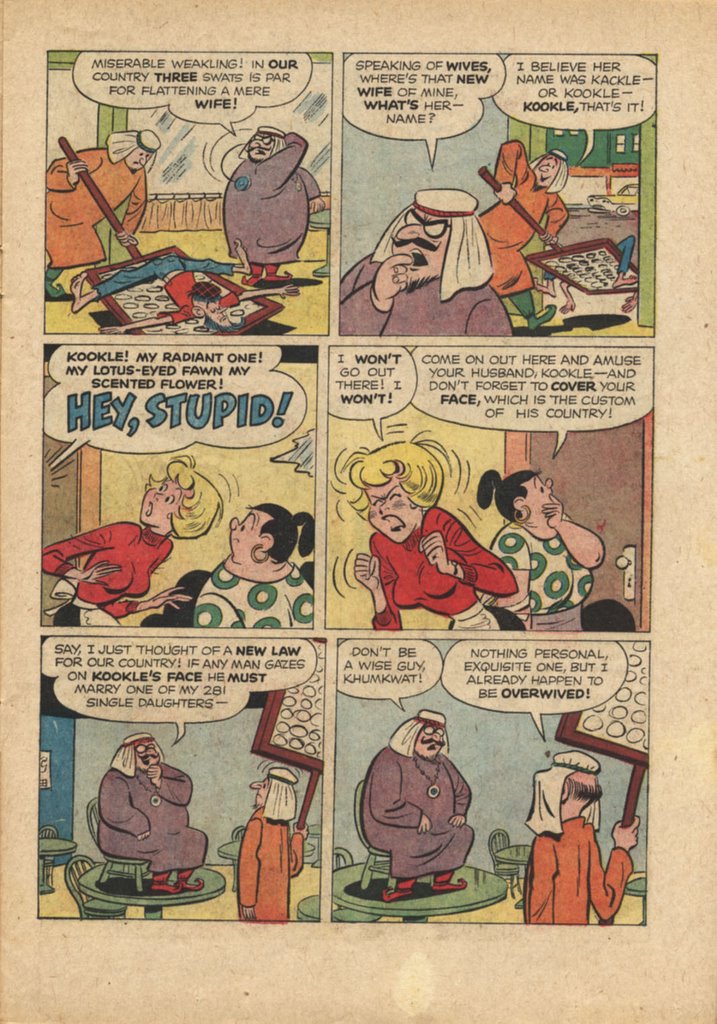
More education on the quaint customs of Islam and the treatment of women:


Kookie #2 Part 4--As Requested by Fred Hembeck


Kookie #2 Part 5--As Requested by Fred Hembeck


Kookie #2 Part 6--As Requested by Fred Hembeck


Kookie #2 Part 7--As Requested by Fred Hembeck


Kookie #2 Part 8--As Requested by Fred Hembeck


Kookie #2 Part 9--As Requested by Fred Hembeck


Thursday, January 05, 2006

Convenient Comic Cliches of the Silver Age

#1--If you're suffering from a mental disturbance, you should never be told that you've gone crazy. People around you should humor your delusions.


"Serious damage to her mind, you say, Doc? Like--err, if she were to say that I'm really Superman?"

Saturday, December 24, 2005

The Fantastic Four

In the early 1960s, Marvel Comics had become something of a joke. They published a small line of magazines that mostly featured monsters with names like Fin Fang Foom or Shagg or Shamoo. But Stan Lee, the writer and editor for most of Marvel's stories noticed the superhero revival going on at DC Comics and decided to copy it. The first attempt was the Fantastic Four, a team title that was something of a knockoff of DC's Justice League of America.

The first issue told the origin of the team. The FF was made up of four characters who had travelled in a space ship to the radiation belt surrounding the Earth. The radiation caused strange mutations to the four. Reed Richards, the scientific genius leading the team, developed the power of stretchability, much like Plastic Man and the Elongated Man. Ben Grimm, a test pilot, turned into the super-strong (and super-ugly) Thing. Sue Storm, Reed's girlfriend, turned invisible, while Johnny Storm, her younger brother, burst into flame as the Human Torch.

The use of radiation as an origin device was new as far as I know, although Marvel would use it several more times in the next few years. Spider-Man, Daredevil and the Hulk would all see their powers result from exposure to radiation in one way or another.

The other novelty of the Fantastic Four was that the members were not "all for one and one for all". They bickered among themselves, especially Ben, who blamed Reed for his transformation into the homely Thing.

Thursday, December 15, 2005

The Elongated Man

The Elongated Man first appeared in The Flash #112, April-May 1960. The Flash kept getting upstaged by this stretchable sleuth called the Elongated Man. Although EM had been a hero every time he appeared, the Flash wondered if he wasn't secretly behind a series of puzzling robberies. Who is the Elongated Man, and how did he come to be?

We are told in a flashback. Ralph Dibny had been an ordinary boy in the Midwest, when he was fascinated by an India-Rubber Man in the sideshow at a carnival. He vowed to learn how to stretch himself, but none of the carnies would tell him their secret. Then he remembered that all the stretching men had drunk a product called Gingold. By studying the product, he isolated the stretching ingredient. At first it didn't work on him, but then suddenly he began stretching wildly.

The Flash is suspicious of Dibny, but Ralph actually captures the thieves that had been ruining his good name, and they become friends. Of course, there had been stretchable detectives in the past, most notably Plastic Man, and there would be more before long--Elastic Lad and Mr Fantastic arrived in the next year or two.

The Elongated Man was created by Carmine Infantino. In his earliest appearances he wore a stretchable purple and blue suit with a domino mask. He appeared regularly in The Flash for the next couple years.

Things changed dramatically for the Elongated Man in 1964. DC had decided to fix the problem with Batman. There were two main problems: the art and the editing sucked. DC solved the first by adding Infantino to the Batman stable, while Julie Schwartz took over the editing chores.

The pot sweetener for Infantino was that the Elongated Man got his own feature in Detective Comics, starting with #327, the May 1964 issue. This was one of the very few times in the DC universe that a supporting character had graduated to his own feature; the prior ones that I can think of are Lois Lane, Alfred (briefly), Robin and Jimmy Olsen.

In Detective #327, Ralph Dibny and his new wife, Sue, were returning from their honeymoon in Canada. Ralph is now the "famous Elongated Man"; apparently the earliest superhero to maintain another identity, yet not keep it a secret. The Fantastic Four have an argument, but they never had secret identities, whereas Ralph clearly gave his up. Plus he's clearly one of the earliest superheroes to be married.

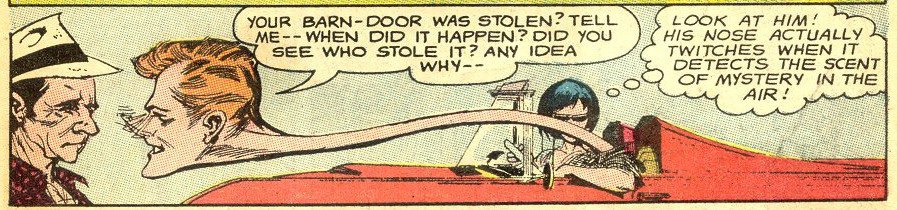
The pattern for the EM stories was established in that first appearance in Detective. Ralph and Sue are driving along, Ralph spots something suspicious and is off to investigate. The second story, in Detective #328, begins the tradition of Ralph's nose twitching when he scented a mystery:


The Elongated Man really hit the big time with Detective #331. For as long as Detective Comics had existed, it had always featured more than one story, and none of the other features had crossed over into Batman. But both those taboos were broken with "The Museum of Mixed-Up Men" in September 1964. Batman and the Elongated Man teamed up to defeat Boss Baron in a three-part adventure that consumed the entire issue. There was another crossover/full length story a year later in Detective #343's "The Secret War of the Phantom General". I don't believe there was another full-length story in Detective Comics after that until #500.

The next big change came at the end of Detective #350. Sue decided that her husband's costume was too boring, and gave him a new one, mostly red with black and yellow stripes. At about this time, the Batman TV show hit, and so the Elongated Man got read by a lot of people who otherwise would not have been reading a backup feature.

DC changed artists at Detective #357; Murphy Anderson and Sid Greene took over. Not sure what the story was there. For that issue only, Elongated Man's suit is primarily yellow. Perhaps a Reverse-Elongated Man? Or could the issue have been that the Silver Age Plastic Man comics DC had introduced made the uniforms too confusing?

The uniform changed again with Detective #359. Now it was purple with yellow and black. That was pretty much how it stayed for the rest of the run in Tec. Ironically the issue that finalized the uniform changes was also the one that doomed the Elongated Man's run in Detective, as it introduced the Barbara Gordon Batgirl. Elongated Man's last appearance in 'Tec was #383, so he appeared in 57 issues of Detective Comics. In Tec #384, Batgirl began an alternating feature with Robin.

I believe Elongated man next popped up in the Justice League of America during the mid-1970s.

Tuesday, December 13, 2005

Gay Batman?

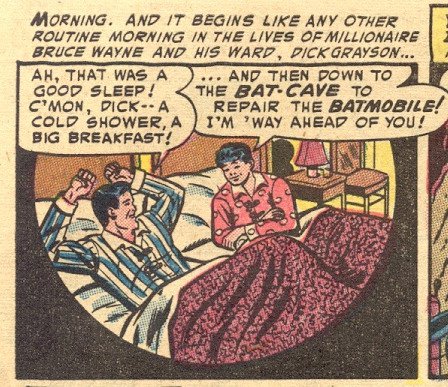
I'm pretty sick of this theory myself, but this is one of the odder panels in the Batman series (from Batman #84, June 1954):


Actually it just looks like a poor job of art by Sheldon Moldoff; a later panel makes it clear they are not actually sharing a bed:


Now, you can make something out of the fact that they're sharing a room in Wayne Manor, but it's just a literary device to skip a few panels of Dick hearing Bruce's nightmares and coming down the hall.