Monday, August 15, 2005

Batman And Guns

(Note to readers: This is a substantial reworking of the original post, which has now become the #1 result on Google for "Batman and Guns" and linked by many online forums. The original post was assembled over time and included numerous corrections appended to the text. Since this has become an authoritative source, I have decided to revise the entire post. Thanks to my commenters who came up with corrections and additions!)

One of the more famous elements of Batman's mystique has always been his refusal to use guns. Of course, those of us familiar with the early stories know that this was not always the case, and over the years the writers, artists and editors have frequently forgotten this key aspect of the character.

First up is Detective #32. This story is basically a take-off of the movie "Dracula". Bruce Wayne's girlfriend, Julie Madison, is under the spell of a vampire. Batman trails the vampire and its female assistant to their castle and shoots them each with a silver bullet:


The first time Batman was shown with a gun on the cover of a magazine is supposedly this image from Detective #33:
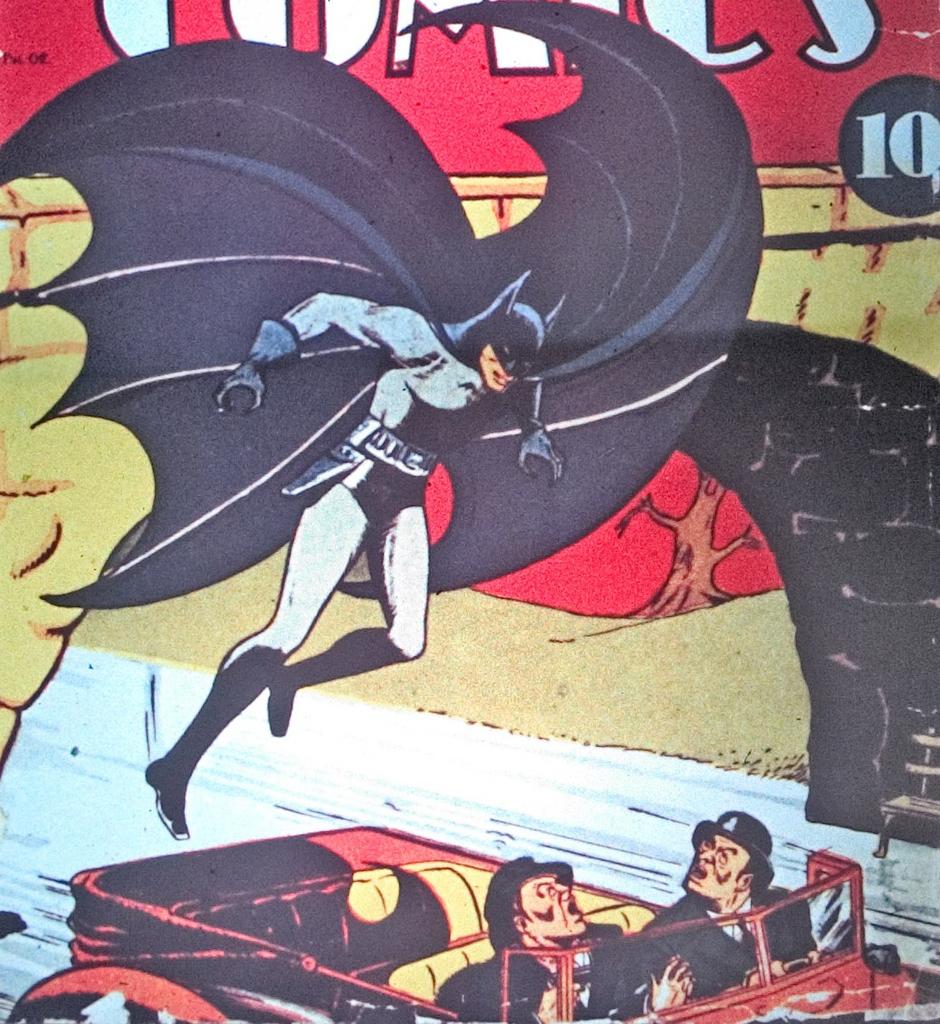


At least, it's usually considered a gun; to my eye it looks more like a knife on his belt. Detective #33 was also the first comic to present the now-familiar origin of the Batman:
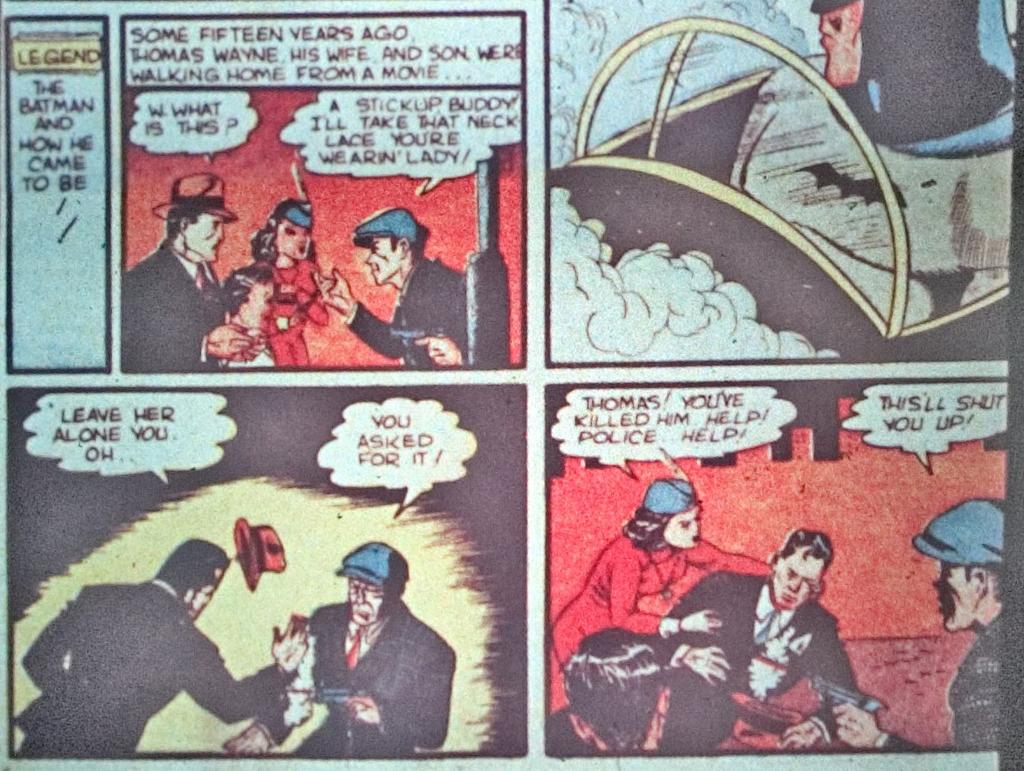


So the phobia against weapons is certainly understandable. But in the story, Batman uses a gun (apparently the one on his belt) to shoot at some "ray" machines:


And the ending of the story has a startling panel:


Batman did appear with guns on two World War II covers:


Clearly special cases, although the first one does show him firing a gun.

From Detective #35 comes the most extreme panel of Batman with a gun in the first 40+ years:


You can sense that's just a little bit too far, but this was the second superhero of all time, and the code of conduct that superheroes didn't kill hadn't been developed. Oddly, the splash shown above does not appear in the story and Batman does nothing else with a gun in this issue.

Batman used a gun in Detective #36, but it was to summon the police to pick up some thugs he had kayoed.

However, it is not explained where the gun came from.

The next major incident involving Batman and guns came in Batman #1. Hugo Strange had made monsters out of men by giving them a growth hormone. Batman tracks down the truck the monsters are riding in and:


Reportedly it was this sequence that resulted in an editorial edict against Batman killing. Both Batman and Robin had been fairly casual about tossing crooks off large buildings to their apparent deaths, and in a notorious sequence Batman had toppled an idol on some Chinese thugs in Detective #39. The sequence in Batman #1 was to be the last time that Batman intentionally killed someone, although it was far from the last time he used a gun.

The next time he used a gun, it was to wing a machine-gunner:


Get the editor's note: "The Batman never carries nor kills with a gun!" But he's happy to pick one up and cap a few rounds. ;)

In Batman #7, our hero was finally accepted by Commissioner Gordon, who gives an impassioned speech including mention of the gun ban:


Maybe the oddest bit with Batman and guns comes in Batman #21. A cattle rustler has kayoed Batman and fed him loco weed. When Robin and the local sheriff revive him, he steals a gun from the latter and:


For most of the next several decades, the only times Batman used a gun was for shooting something other than a person:


In Detective #65, Batman shows that whatever his opinion of firearms, he's still a crack shot:


However, in Detective #260's The Mystery of the Space Olympics, Batman is surprised when he shoots well to win a competition:


Here's an odd panel from World's Finest #39, where a mystery writer thinks he's deduced Batman's secret identity and confronts Bruce at his home. Why would a man whose aversion to guns is nearly phobic, have a brace of pistols mounted on the wall?


In Batman #55, Bruce Wayne and Commissioner Gordon are captured by mobsters, but they manage to turn the tables here:


Here's a similar theme from Detective #327 (May 1964) in Carmine Infantino and Julius Schwartz's first "New Look" Batman story:


Batman does the cliched "my pipe is a gun" routine here:

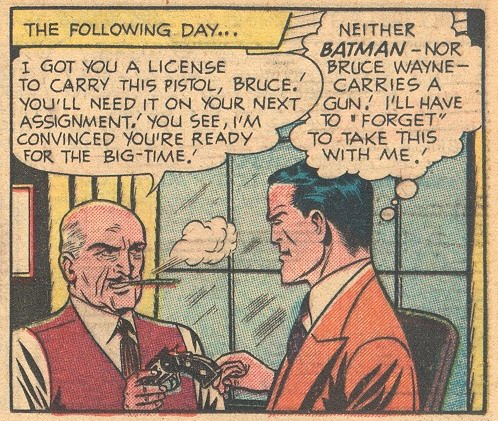
In Batman #65 Bruce Wayne takes a job as a crime reporter, but he's still determined not to use a weapon:


Of all the people Batman might shoot, taking a point-blank shot at Commissioner Gordon is probably one of the least likely, but it happens in Detective #121 (May 1947):
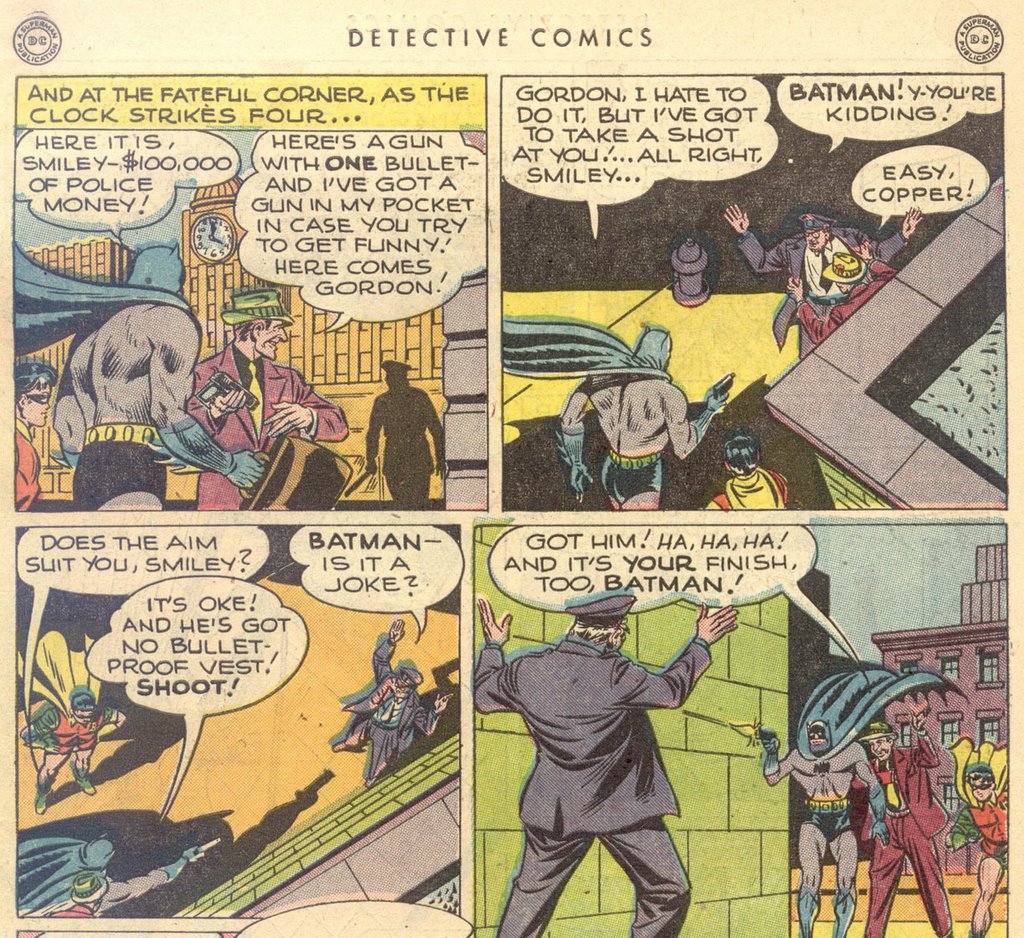


In the story Batman has wagered a bet-happy villain $100,000 of the cops' money that he will shoot a gun straight at Commissioner Gordon's heart. As it turns out, Batman has an invisible bulletproof glass shield between him and the Commish.

On the other hand, we might expect Batman to be willing to shoot at the Joker, and here's a rare example (from Batman #97) of our hero with a gun in the Silver Age:


We can see the Joker has a parachute, so he will not die.

In Batman #99, a reporter discovers an old newspaper clipping that appears to accuse Batman of shooting a crook:


Batman and Robin go back in time courtesy of Professor Nichols to discover what really happened. After foiling an attempt to rob a train, Batman is chosen as the local marshal:


But a little later, a new marshal shows up with a very similar name, resulting in the headline:


In Batman #129, a letter writer asked:


In Detective #404, Batman uses a rifle to shoot some dolphins:

Dolphins? Yep, in the story the dolphins are carrying plastic explosives designed to blow up the yacht of a shipping magnate.

From Detective #256 comes another example of Batman refusing weapons:


Although in other stories like this example from Batman #4, Batman discusses the need to be proficient in all types of weapons:


And here with Robin #2 (Jason Todd):


But apparently not with knives, as this panel from Batman #57's famed Ride, Bat-Hombre, Ride states:


Here's the only other panel I could find of Robin shooting a gun so far:

Hard to tell what's really going on there; looks like Robin's supposed to be shooting a skeet-shooter, which of course looks little like the rifle he's shown using there.

Batman turns down a gun from a pretty famous source here:

Detective #417 includes this scene: But the crook is right; the guy in the suit (a George Plimpton type) writes about what it's like to be some famous athlete or personality, and unfortunately Batman (who's in on the impersonation) forgot to inform him about the "no guns" rule. Hat Tip: comicsdork. Batman uses a gun-like laser in this story from Brave & Bold #78:


Along the same lines is this "sonic gun" used on the Man-Bat:


Detective #444 came with this grabber of a cover:


It was all apparently a complicated plot by Talia and her father, Ra's Al Ghul, to get Batman wanted by the cops so he would accept their offer to join them. Micro-circuitry automatically fired the bullets, which contained a narcotic that simulated death. Thus Talia wasn't really dead and Batman hadn't really fired the gun at her.

From Detective 453 comes this example of the prohibition of the use of guns carried to a ridiculous extreme:


Why would he refuse to shoot a gun into the floor? As it happens, instead of doing that he hurls the gun into the TV screen.

Batman #301 featured this startling cover:

 It's a very convoluted story; suffice to say that Batman took the rap for murdering the man on the cover (a crime boss) in order to protect others.

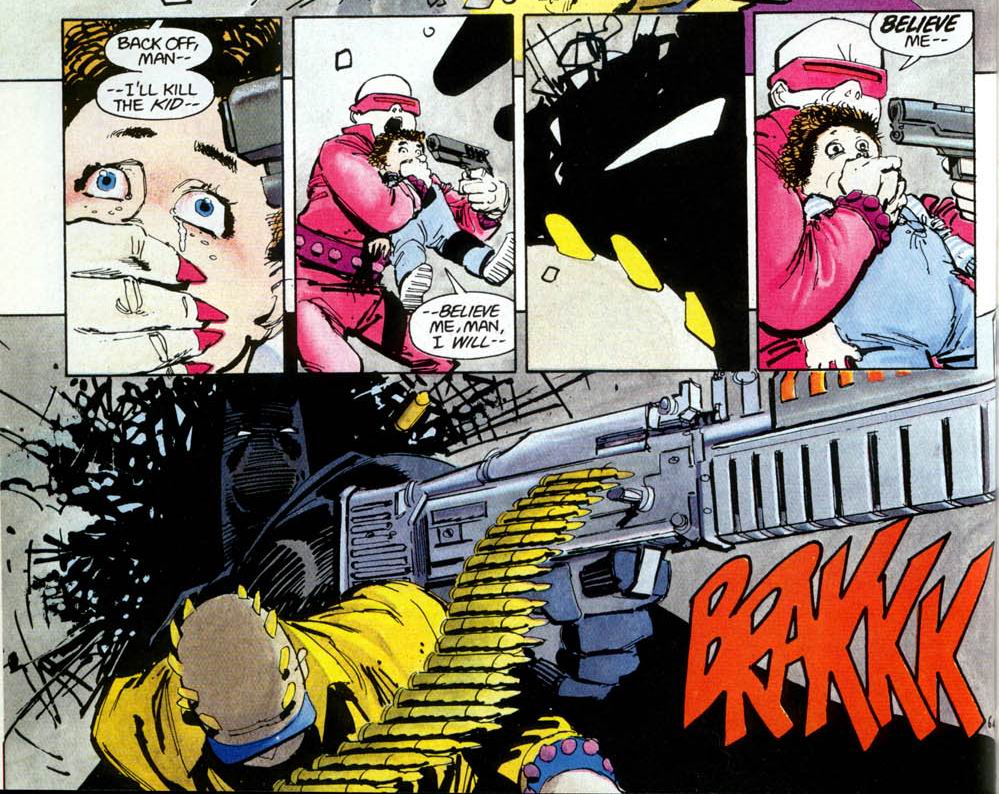
In the mid-1980s, Frank Miller's influential but bleak Dark Knight Returns series included this scene where Batman responded to a kidnapper threatening to kill an infant:

Detective #575-578 featured the Batman Year Two storyline, in which our hero considers arming himself. Each of the covers featured Batman with a gun; I'll show only the first:


In the modern era, editors, writers and artists all have continuity guides to prevent their making a mistake, right? In Detective 627 (the 600th issue since Batman's beginning) this sequence appeared:


A major no-no.

The cover of Detective #710 shows Batman with a gun again:


In the story, the greatest assassins in the world have descended on Gotham to get revenge for a dying old man. Batman defeats a sniper on a rooftop, only to find that another killer is on a ship, ready to kill a bunch of people, in sniping range but otherwise unreachable. What can he do?

He's the goddamn Batman:


From the hip, no less. Cute story, but a bit too obviously set up to force Batman to shoot. Later, Alfred regrets that Batman didn't get the gun for the collection room but Bruce is not interested:


In the newest (January 2009) DC comic, Final Crisis #6, Batman confronts Darkseid:


This of course sets the stage for the death of Batman (at least as Bruce Wayne). Apparently.

Some of the stories mentioned in this post can be purchased here:

Saturday, August 13, 2005

Batman 1956

Issues Covered: Batman #97-#104 and Detective #227-238

Significant Stories: Many. Detective #227 continues where #226 left off, showing us this time Barrett Kean, the master makeup artist who taught Batman his amazing disguise tricks. Detective #235 presents The First Batman, a story in which Thomas Wayne dons a Batman uniform to fight crime decades before his son. It contains a brief retelling of Batman's origin, complete with the bat flying through the window.

But the most significant story has to be The Batwoman, from Detective #233. Kathy Kane (name chosen in homage to Bob Kane) became a major character in the DC universe for the next eight years. A former circus performer, she had inherited a large fortune from an uncle and decided to dedicate herself to crime-fighting alongside Batman. Unfortunately she was a little over confident and in the end, Batman succeeds in unmasking her. She agrees that if he could do it, so could the underworld, and thus she'd never be safe. At the end of the story she retires (but not for long).

The 1955 trend of having other Batmen appear continues. Barrett Dean poses as Batman in Detective #227 and Thomas Wayne is The First Batman in #235. Detective #232 brings us The Outlaw Who Played Batman. Robin gets the multiple treatment in "Batman Junior" from Detective #231, and Detective #237's The Search for a New Robin.

In Batman #99, the Penguin makes his only appearance between 1954 and 1963. In fact, I believe that the Joker (who appeared often) was the only pre-code villain to make appearances in new Batman stories during those years.

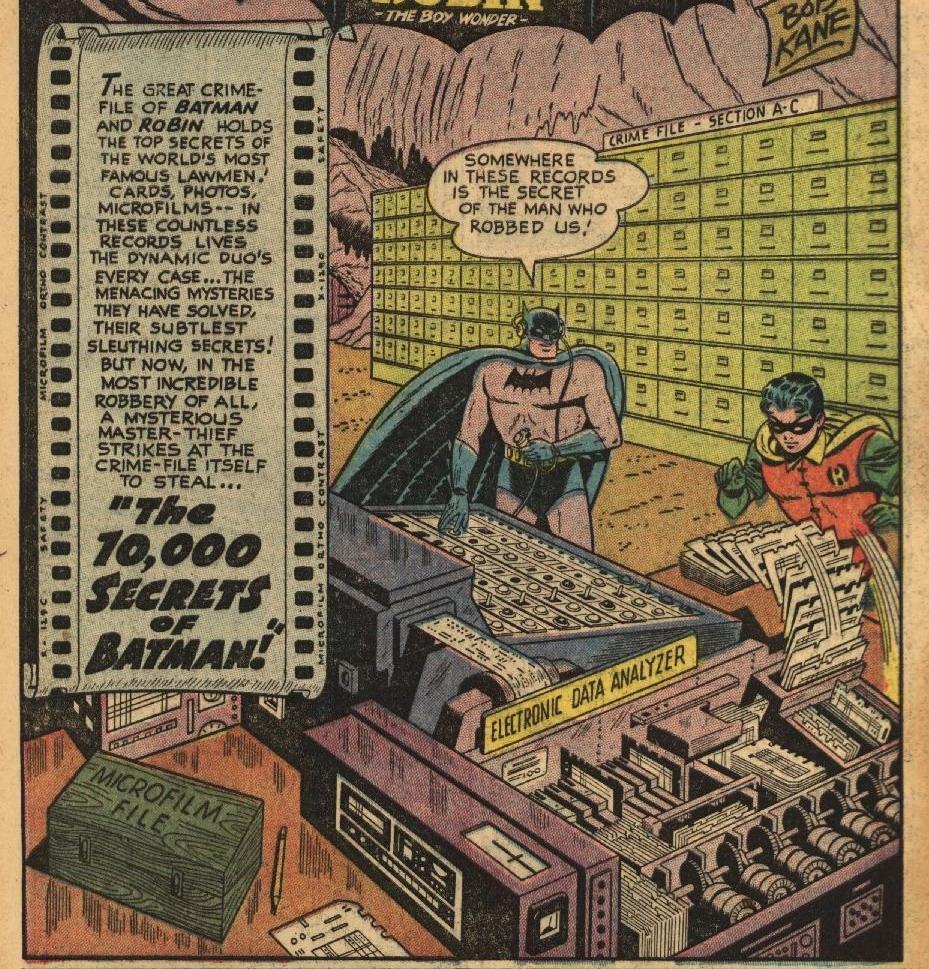
Other Trends: Batman continues to make use of the latest technology. In Detective #229's 10,000 Secrets of Batman, we see a good example of what I like to call "Pocket-Protector Batman":


The machine shown is a card sorter; together with the cards it makes a relational database. In the story they use it quite a bit:


Artwork by the inimitable Dick Sprang, IMHO the greatest Batman artist ever. This is a significant early example of computers in comic books.

Other great stories: Batman #98 has The Return of Mr Future. Jules Verne journeys with Batman into the future to save the world from his most dangerous invention. That same issue features Desert Island Batman, a classic of the "tontine" Batman stories. A tontine is an pooled investment where the last living member inherits the shares of the others; who will be the last one left? There are many examples of this type of story but this one is particularly ingenious, in that five millionaires (including Bruce Wayne) are shipwrecked on an island by crooks who demand a ransom of a million dollars apiece. Batman goes into action, revealing that he is one of the five men, and the balance of the story concerns the (logical) elimination of each man as a potential Batman, until only Bruce Wayne is left. Batman #101 includes a terrific story, The Great Bat-Cape Hunt Batman loses his cape, which contains the secret of his real identity. It is subsequently found by several people who go on to perform daring feats, inspired by the cowl. This is a plot swipe from the all-time classicThe Secret of Batman's Utility Belt, which appeared in Detective #185.

Batman's celebrity continues from 1955, with Batmantown, USA, in Batman #100. The small town of Plainville decides to spice up the local tourism trade by renaming itself after the caped crusader. In The House of Batman, from Batman #102, a mystery benefactor creates a downtown base for the Dynamic Duo, which ends up being converted into yet another Batman museum. Bathound gets a bit of the red-carpet treatment in Bathound, Movie Star from Batman #103. Batman #104 includes Robin's 50 Batman Partners which includes The Batman Exposition, a special fair dedicated to the Dark Knight. And in The Outlaw Who Played Batman from Detective #232, Batman appears in a major motion picture. Intriguingly, it's played like a modern reality show, with Batman supervising the choice of actors to portray him.

Tuesday, August 09, 2005

Batman 1955

During 1955, Batman appeared in Batman #s 89-96, Detective #s 215-226, and World's Finest #s 74-79. The Superman/Batman teamups had started in World's Finest #71, and those are somewhat apart from the regular Batman stories, so I will deal with them in a separate post.

Number of stories: 36, with three each in the Batman issues and one per issue of Detective.

Significant stories: Detective #226 contains When Batman Was Robin the first story to attempt to tell of the days between the time Batman's parents were killed and when he actually became the Batman. As a teenager, Bruce Wayne idolized Detective Harvey Harris. There's a bit of a flub in that Bruce says "My parents were abroad that summer...." However Bruce is portrayed as a young man of maybe 17 years old, and in all of the versions of the origin I can remember, Bruce is a lad of 8-10 when his parents are killed.

Bruce hires Harris to teach him detective skills. However, concerned that the detective may try to warn him off his intended career, Bruce decides to protect his identity by wearing a Robin costume. Harris indeed teaches Bruce a great deal.

This story continues a trend that had started in Detective #205, of the stories beginning to fill in a little of the past, to focus on Batman's history, a trend that would continue in 1956. In Batman #94's The Sign of the Bat Batman's origin is told in an abbreviated form that includes the bat flying in the window.

Detective #218 contains Robin Senior and Batman Junior, arguably the first of the weird transformation tales that would plague the series in years to come. Robin is hit with an aging gas, while Batman suffers the effects of a youth gas. Effectively the two change roles with Robin the sensible and mature crimefighter while Batman is impulsive and mistake-prone.

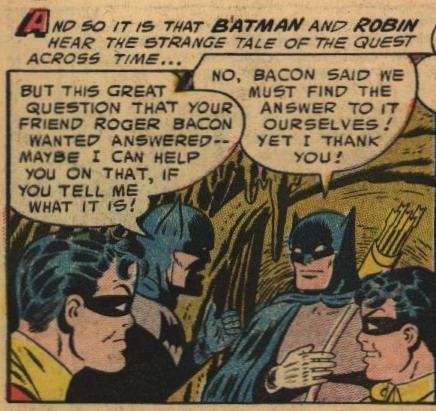
Best Story: Without a doubt, The Mystery of the Second Batman and Robin Team from Detective #220. Roger Bacon, the preeminent scientist of 1255 has found ancient scrolls which reveal that Batman and Robin had visited ancient Greece and Rome. Reasoning that these unusually garbed men must be from the future, he decides that time travel must be possible, and has invented a means to do so. He sends into the future two of his brightest pupils. On the assumption that in 1955 all men must dress as Batman and Robin do, he clothes them as the Dynamic Duo.

Well, of course this duplicate Batman and Robin manage to cause some incredible mix-ups in Gotham City of 1955. But what really sets this story apart is the "Great Question" which Bacon has sent his students forward in time to learn the answer to. In classic comic fashion the Great Question is referred to several times in the narrative.


Now sometimes these "big secrets" which are revealed at the end are easily guessed, and sometimes they're something that was no big deal, and sometimes they're interesting. But they're seldom profound, like this:


Multiple Batmen and Robins seemed to be the order of the day. In addition to the two stories noted above, Detective #215 brought us The Batmen of All Nations, a kind of UN summit of men from around the globe who had been inspired by Batman to fight crime in their own countries. In Detective #216 the Batman of Tomorrow, Brane Taylor of the year 3054 made his second appearance. Bruce Wayne injures his arm, and to make sure that Vicki Vale doesn't see Batman favoring that arm, Brane takes his place. In Detective #222's The Great Batman Swindle, we learn that apparently Batman is secretly a rotating group of four men, who alternate, and/or retire when their injuries are too great or they die. Of course, it's all a con job to try to get wealthy men, supposedly invited to become one of the next Batmen, to part with some of their fortune for a "genuine Batmobile" and "Batplane" that the crooks never intend to deliver. Batman #94 featured Alfred the Butler as The New Batman. And Detective #224 saw yet another fake Batman--this time The Robot Batman.

Additions to the Batman Family: Ace, the Bat-hound makes his first appearance in Batman #92. A dog that was injured defending his master is found by Batman and Robin. They fashion a mask for him and he helps them find his master's kidnappers. At the end of the story, the dog is reunited with his master. Ace had a modest continuing role in Batman stories from then on until 1964 when he was jettisoned with almost all of the Batman family in the debut of the "New Look" Batman.

Oddities: Batman began to be treated by the public as something of a celebrity during this year. Batman's Publicity Agent, a Hollywood-style pitchman, appears in Batman #91, promoting Batman as the savior of Gotham. In Batman #92, the Caped Crusader is menaced by the Fan Mail of Danger, and in #96 he conducts tours of The Bat-Train, an exhibit of Batman-ology on wheels, which is of course modestly similar to Detective #223's The Batman Dime Museum. In Batman #96, a traveling troubador pens The Ballad of Batman.

Monday, August 08, 2005

Ten Things I Like About Comics, Part V

(This has been Crossposted to Brainster's Blog, in a condensed version).

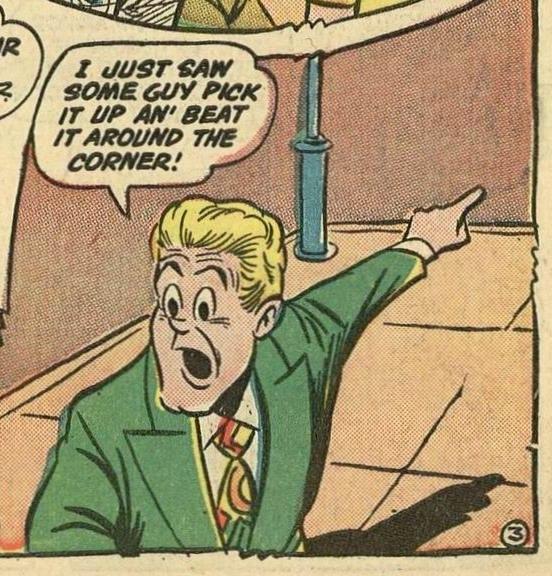
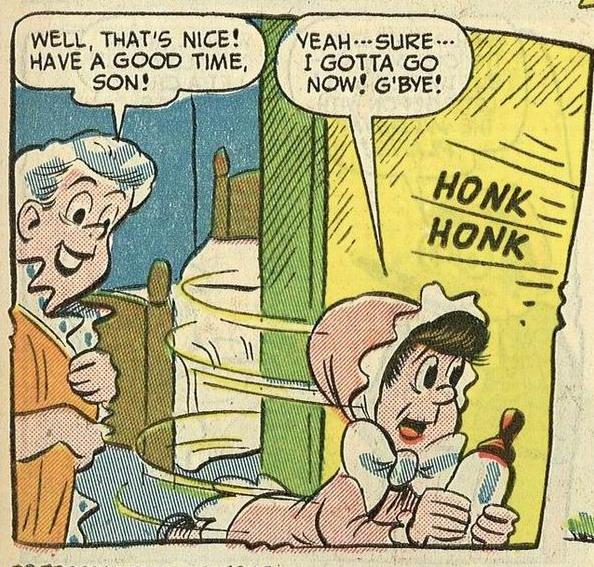
This is Cookie O'Toole. (You can click on the pictures to enlarge them).


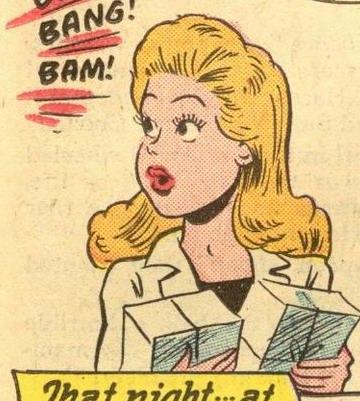
He lives in a typical small town in America with Mom and Pop. Mom's pretty much the sole sane person in the comic. Dad, on the other hand, falls for every get rich quick scheme that comes down the pike.


Cookie's steady gal is Angelpuss. Va-va-voom!


Every story needs a villain. In the Cookie stories, it's usually this fellow:


Zoot is a sneaky ne'er do well compared to the good-hearted Cookie, although much the nattier dresser and clearly from a wealthier background.

Fortunately Cookie is aided by his best pal, Jitterbuck Jones. Jitterbuck is prone to coming up with great ideas, which frequently involve Cookie in drag.


The main thing I like about Cookie is the mayhem. Cookie stories all feature people doing absolutely crazy things. As one of my friends commented, it's amazing this comic didn't catch the eye of 1950s anti-comic crusader Fredric Werthmam, because it seems to be a rare issue that doesn't have cross-dressing, adult babies and mannequin fetishes; all in a perfectly harmless G-rated setting.


Cookie first appeared in Topsy-Turvy Comics #1, in April 1945. He next popped up a year later (an eternity in comics time) in his own book. There were 55 issues published of Cookie, with the series finally coming to an end in August of 1955.

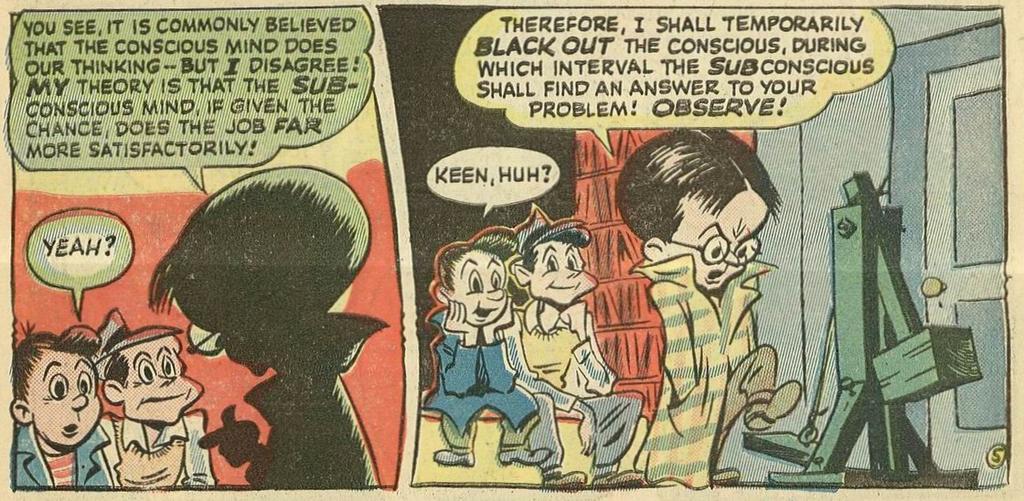
One of the charms of Cookie, much like the Simpsons, is the clever use of the (fairly large) cast. At Harelip High, where the younger members are enrolled, there's his teacher, Miss Bibblesnicker, and Principal Lockjaw. Cookie's scientifically-inclined friend is the Brain, although his inventions tend to be a little unpredictable.


Cookie's chubby buddy is Hep, who seems to take a particular enjoyment in beating up Zoot at appropriate moments. To add more dynamics to the situation, Angelpuss's father (Mr Witherspoon of the Witherspoon Tool Company) is Cookie's pop's employer, and Mom does have some social aspirations for the family at times.

A typical Cookie story might start out with our hero in search of money for the dance. Where it goes from there is anybody's guess. When Cookie does get a job, it usually turns out to be something frustrating and demeaning, from which he is inevitably fired. Then Jit comes up with a hare-brained scheme, which goes off track due to nefarious activities of Zoot, and results in Cookie's dad losing his job as well. Then somehow Cookie comes through in the end as a hero, and Mr Witherspoon always hires Dad back. Although it sounds formulaic, it's really well-done with always a genuine affection for the characters (except for the odious Zoot).

Saturday, July 23, 2005

The Scientofascism of Silver Age DC Comics Part I

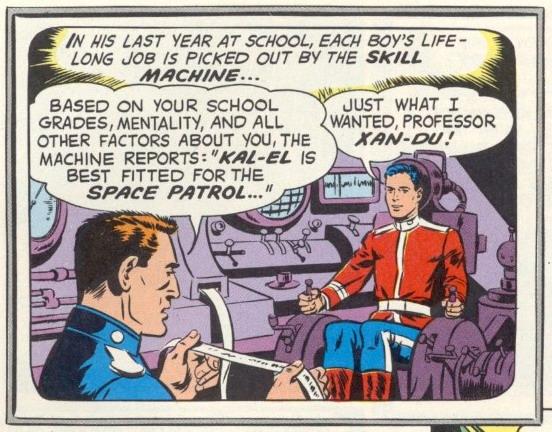
One of my all-time favorite Superman stories is the three-parter from Superman #132, where we learn what would have happened to Kal-El had Krypton survived. Some of the technology obviously sounds good:


But this part is positively creepy:


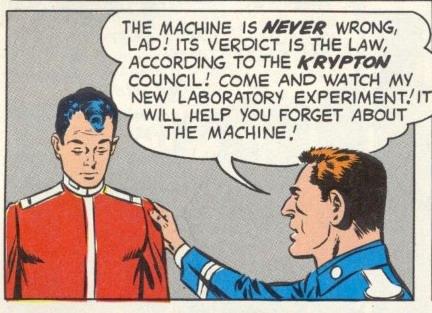
But it turns out that Kal's slated for dispatcher duty, not a space-jockey. And there is no appeal:


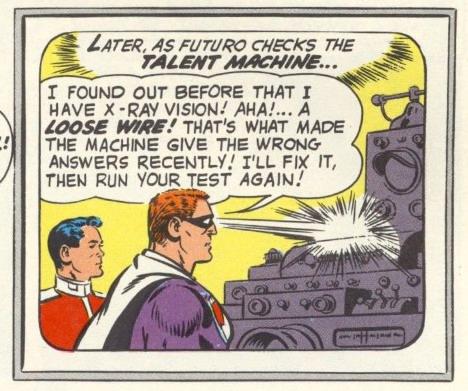
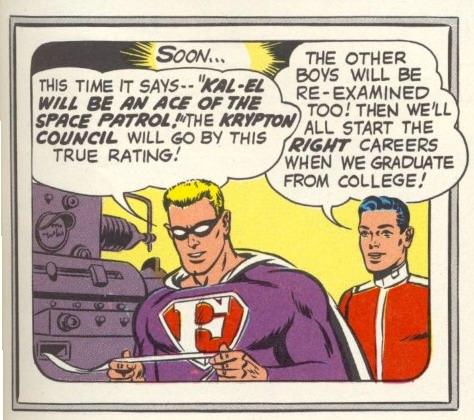
Well, you know it's kind of the scientific way of doing things--figure out what the aptitudes of the various students are and point them towards a career. Except for the obvious problem--what if the computer screws up?


Hilariously the machine gets fixed by the Kryptonian Superman, and of course everybody's still willing to abide by the results:

Adam Strange Cliches

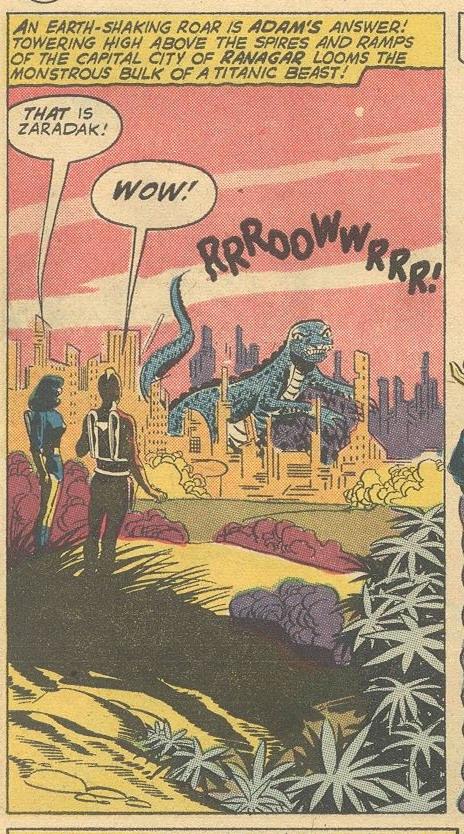
DC introduced Adam Strange in Showcase #17, (Nov-Dec 1958). He was an archaeologist, who, in an attempt to escape bloodthirsty natives, jumped a 20-foot chasm and suddenly found himself trasported across millions of light years of space to Rann, an alien world remarkably populated by humans, including the lovely Alanna and her scientist father Sardath.

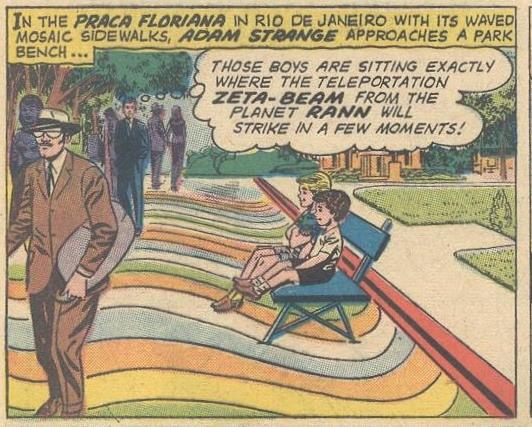
It turned out that Adam had been picked up by chance by the zeta beam, a ray that Sardath had been sending towards Earth periodically. He arrived on Rann just in time to save it from some disaster or other, and after a few weeks the zeta beam would wear off, sending him back to earth. Fortunately, he always seemed to know the locations where the next few zeta beams would hit.

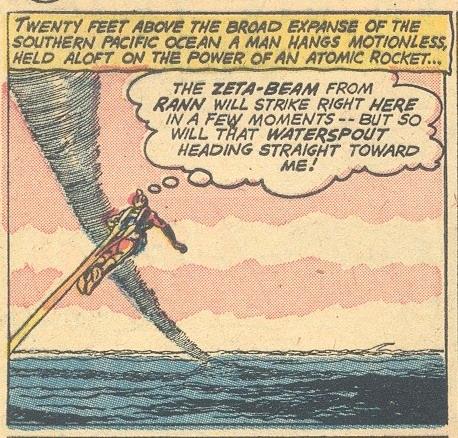
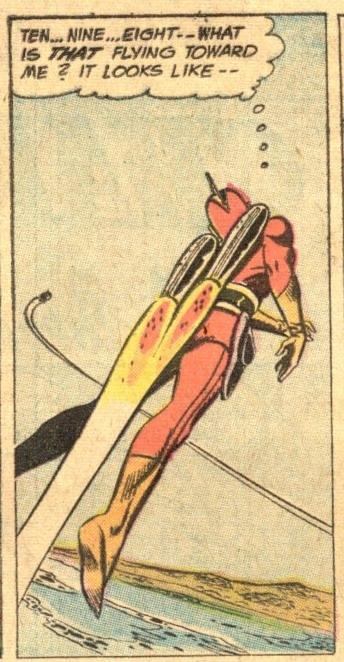
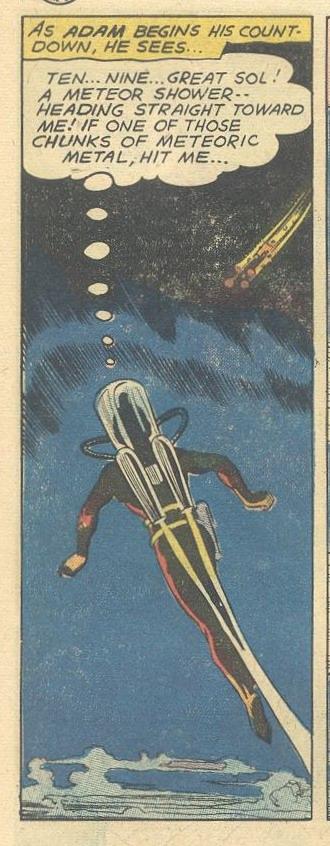
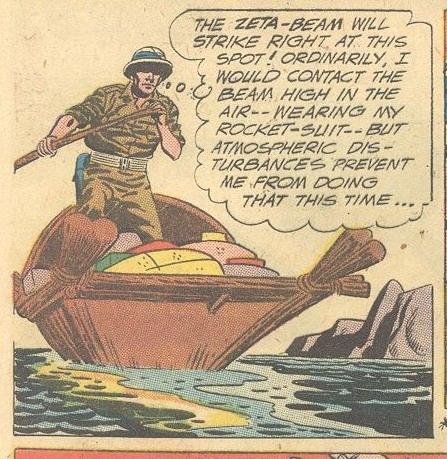
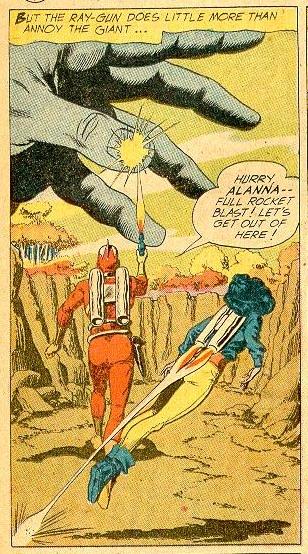
Although the series was excellent, I'm going to focus today on the ways it was a little cliched. For example, in every episode it was required that Adam deal with some problem catching the zeta beam:


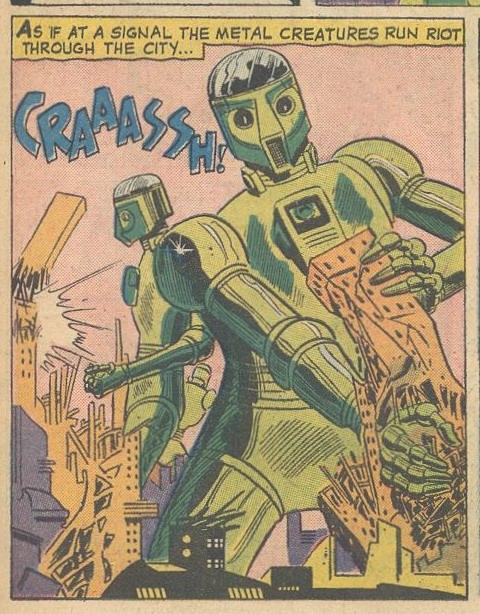
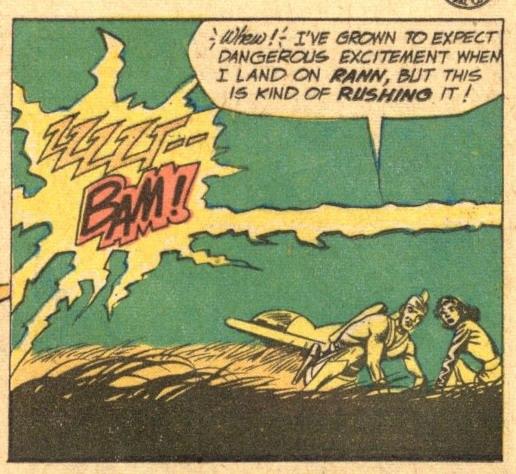
And inevitably it seemed that whenever Adam arrived, some crisis would hit Rann either just before or shortly after:


Indeed it was this latter cliche that led to one of the major problems with the series. More on that in a later post.

Monday, June 06, 2005

The Early Legion of Superheroes

The first appearance of the Legion was in Adventure #247, April 1958. Superboy is startled when several young people reveal that they know his secret identity. It turns out that they are superheroes from the future who have traveled back to Smallville to visit history's greatest hero.


They offer to induct him into their club, but insist that he pass a test first. The test is to defeat any of the three members of the Legion in a contest of heroic deeds. Unfortunately, every time Superboy gets ready to compete, his abilities are needed elsewhere, so he loses every contest. The Legion members regretfully inform him that he has been rejected. Despite being devastated, Superboy says, "No hard feelings", and turns to leave. Fortunately for him this was the last test. It turns out that the Legion members had caused the incidents requiring Superboy's attention to see if he would do his duty first before pursuing the honor of being inducted into the club. Very similar ending to #240, where Jor-El sends a robot to Earth to test Superboy's abilities. At the end of that story, the robot tells Superboy he has failed and must agree never to use his powers again. Superboy agrees at which point the robot reveals that was the final test. In this first story, there are only three named members of the Legion (Cosmic Boy, Saturn Girl, and Lightning Boy, whose name would later be changed to Lightning Lad), although Brainiac 5 obviously appears on pages 5 and 11 of the story.

In Adventure #267 the Legion returns. This time they interrupt Superboy's efforts to do good deeds and quickly turn Smallville against him. He leaves for space, but finds himself trapped by the Legion on a word devoted to Superboy's heroism. It turns out the Legion has seen pictures of the "future" which indicate he will go bad and destroy US military installations in five years. Interestingly, there is no real discussion of the propriety of "preventive detention". In the end, it turns out that the reason for the destruction was at the orders of the US President.

In Action #267, Saturn Girl, Lightning Lad and Cosmic Boy appear again, this time meeting Supergirl (whose very existence was unknown at the time). This is the first time they appear in the costumes that they will wear for the rest of the Silver Age. Saturn Girl had worn a green and yellow outfit in Adventure #247 and had brown hair in Adventure #267, while Cosmic Boy had a purple outfit in the latter issue instead of the pink duds he wore later. Oddly, the Legion members claim to be the children of the Legion members who had appeared in the earlier stories, although this notion quickly went by the wayside. In several places this story is a rehash of the Adventure #247 story, with Supergirl expressing delight and surprise at the exact same things that her cousin had a few years earlier.


This is the first official appearance for Legion members Colossal Boy, Chameleon Boy and Invisible Kid. Unfortunately for Supergirl, when she performs her initiation feat, she passes too close to a chunk of red Kryptonite, which turns her temporarily into an adult and thus makes her ineligible for the teen-aged Legion.

Sunday, June 05, 2005

Good Article on Ditko

It's in Salon, so you have to put up with an ad to read the whole thing, but it's worth the effort.

Sixties hipsters thought that Ditko's urban realism and trippy visions meant that he was one of them. They couldn't have been much more wrong. Around the time that Ditko fell out with Marvel Comics in 1966, he became fascinated with Ayn Rand and objectivism, and his work started to take on a severe and increasingly strident right-wing tone.

Not sure how old Douglas Wolk is, but he's probably not remembering how left-wing everything seemed to be getting in America in the late-1960s. Ditko's comics were indeed a little strident, but they were a lone voice of sanity in a youth culture that was increasingly flirting with communism, moral relativism and nihilism. I have some scans of Ditko's work in this period including the terrific Blue Beetle issue that might as well be a primer for the works of Ayn Rand.

Monday, May 30, 2005

Problems with the Silver Age Superboy

Originally there was no Superboy. Clark Kent's childhood was not discussed in any great detail in Action Comics #1, with only one panel showing the infant's strength to the amazed doctors in the orphanage.

But in More Fun Comics #101, (Jan/Feb 1945), DC decided to start telling the back story of Superman as a boy. After a brief run, the series shifted over to Adventure Comics, where it settled in for over 15 years as the cover feature. A few years after that, Superboy was given his own magazine as well, which lasted even longer.

It turned out (impossibly) that Superboy had been world famous himself. Impossibly, because of course in the early Superman stories he was a man of mystery whom nobody had ever seen before. Now we were being told that schoolchildren around the world knew his name. But this was only the beginning of the tangled knot.

Over the years, DC had developed many familiar situations for Superman. For example, he would often be faced with the problem of appearing as Superman and Clark Kent at the same time. In the late 1950s, obviously inspired by science fiction of the time, he invented robots that could take either of his places. Naturally there was a tendency to backdate this into the Superboy stories, regardless of whether it made sense, given the era in which the Superboy stories were supposedly occuring. If Superman's in 1955, then Superboy is in the early 1940s, certainly no later than 1945.

Similarly, DC "grandchilded" into the Superboy stories some of his later friends and enemies. Lex Luthor was a buddy of Superboy as a teen and only turned bitter when an experiment gone awry resulted in him losing all his hair. Master Mxyzptlk popped up in Superboy #78 (Jan 1960). Both these stories of course contradicted the original appearances of those villains in Superman stories.

More serious problems developed as a result of time travel. Time travel is always an interesting plot device and you will note that most of the DC heroes of the Silver Age had one method or another of traveling through time. Batman could be hypnotized by Professor Nichols, the Flash had his cosmic treadmill, the Atom his time pool, Superman could fly in circles, and for the rest of the DC crew there were the ubiquitous glass bubbles.

In Adventure #247, DC introduced the Legion of Superheroes, a future group of do-gooders who invited Superboy to join them. So far so good. But later on in Action #252, they decided to create Supergirl, a young cousin of Superman who survived the explosion of Krypton. Naturally she had to join the Legion of Superheroes as well. Which meant that in the future, Superboy and Supergirl would team up. But why then had Superman acted surprised when his cousin arrived; wouldn't he have known since his teen years that Supergirl would come to this planet? The editors quickly explained that Saturn Girl placed a post-hypnotic suggestion in Superboy's mind that resulted in him forgetting about Supergirl when he was in the past.

A further error was made in Adventure #253, when Robin comes back in time to save Superboy from a booby-trapped clock. He tells Superboy of his future, including his teamups with Batman. Again, these stories are wildly contradicted by earlier tales.

Ferro Lad's Last Words


One of the more famous deaths in the Silver Age. Ferro Lad was the creation of Jim Shooter, then a teenaged wunderkind comic writer. As a superhero, Ferro Lad wasn't much to speak of; he could turn his body into iron. This gave him great strength and near invulnerability, but that's about it. He sacrificed himself in order to transport a bomb to the heart of the Sun-Eater.

Wednesday, May 18, 2005

Liberal Media Bias at the Daily Planet?

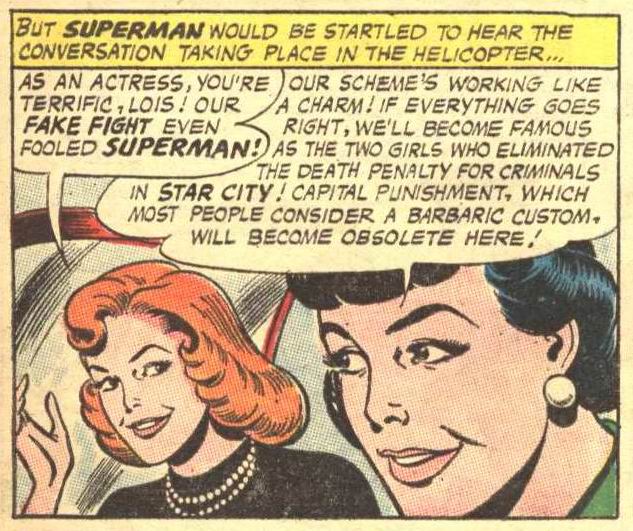
In October 1963, DC Comics published Lois Lane #44, which exposed the Daily Planet for the liberal rag that it is. The story "The Death of Lana Lang" starts out with Lois and Lana battling it out for the affections of Superman. Lois threatens to kill Lana. However, they apparently patch things up and fly off in a helicopter, where they reveal their true plan:


So they pretend that Lois had killed Lana, who secretly hides out on Vulture Island while the trial is on-going, and plans to rescue her friend at the last minute by coming forward to prove she had not been killed after all. Lois is indeed sentenced to death. Of course, as is almost cliche in these stories, something goes wrong (Lana has a boating accident while returning from the island and is knocked unconscious), and it looks like Lois will actually be executed. Fortunately Superman saves the day (with a little help from mermaid Lori Lemaris), and at the end, Lois and Lana celebrate as the "barbaric custom" is banned in Star City.

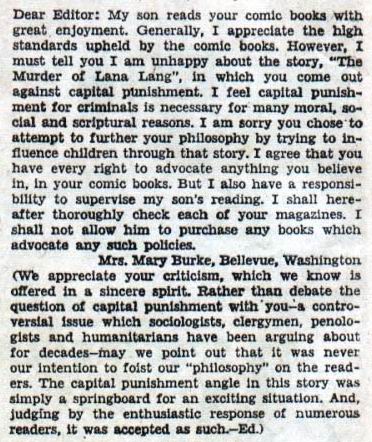
However, DC did not get away with it scott-free. Check out this letter to the editor, which appeared a few issues later:


I agree to a certain extent with both the editor and Mrs Burke on this one. I do think Lois' opposition to the death penalty was largely just a plot device to create an interesting story. However the bit about "most people" considering capital punishment a "barbaric custom" does seem a bit over the top.

Monday, May 16, 2005

Silly SA Cover of the Day


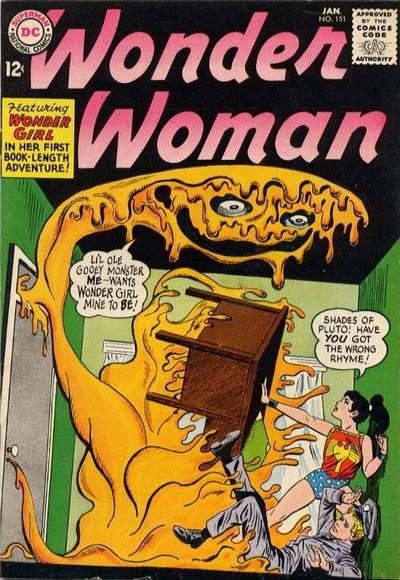
Lousy poetry, lousy artwork and a monster that somehow fails to terrify. This is the absolute nadir of the Wonder Woman series. Although the Diana Rigg secret agent takeoff was a bit of a stretch, at least it has the virtue of being more interesting than this nonsense.

Thursday, May 12, 2005

Differences Between DC Comics of the 1950s and 1960s

DC published 3,397 comics in the 1950s and upped that to 3,579 comics in the 1960s. Despite the reasonable similarity in overall numbers, DC published dramatically different lines of comics in the 1950s versus the 1960s.

I broke the titles down into various genres: Superhero, Adventure, Science Fiction, Crime/Detective, Comedy, Western, Funny Animal, War, Horror, Teen and Romance. DC published far more Superhero books than any other genre. There were 849 Superhero books in the 1950s, or almost exactly a quarter of DC's total output. Following the Superhero revival of the late 1950s-early 1960s the Superhero genre exploded with 1,628 comics in the 1960s, over 45% of the total.

Funny Animal, which had been the second largest genre for DC in the 1950s with 533 issues, crashed all the way to 63 books in the 1960s, the lowest output of any genre for that decade. But what there was, was choice: The Fox & the Crow, a terrific series. Trivia quiz: Can you name the DC title that had one issue in the 1940s, one issue in the 1960s, and was published for the entire decade of the 1950s? Answer at end of post.
Crime/Detective was zeroed out after accounting for 172 comics in the 1950s (Gangbusters, Big Town, Mr District Attorney). Western also had a precipitous fall, from 297 issues in the 1950s to 89 in the 1960s (with most of those coming from Tomahawk).

Genres showing improvement in the 1960s included Romance (243 comics in the 1950s to 460 in the 1960s) & War (379-477). However, War titles were on the decline after 1965, dropping from 56 that year to 31 issues in 1969.

Science fiction was nominally unchanged, with 167 issues in the 1950s and 169 in the following decade. But by the end of the 1960s Mystery in Space had been cancelled and the two Sci-Fi mags published by DC were dedicated to reprints.

Comedy was also on tottering legs. The long-running DC titles in the 1960s were Jerry Lewis and Bob Hope, two film stars who had reached the end of those phases of their careers. Hope's comic was jettisoned in 1968, and Lewis would follow a few years later. Teen titles, which had never been a big part of DC's lineup as that market was dominated by Archie, declined by 50%.

Trivia Answer: Peter Porkchops' first issue was dated Nov/Dec 1949, and his last issue was Oct/Dec 1960.

Tuesday, May 10, 2005

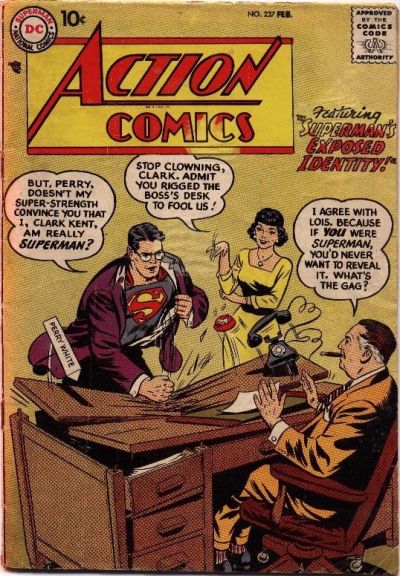
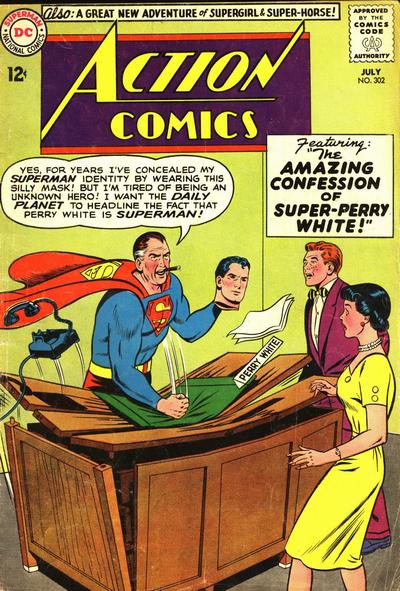
Desk Abuse at The Daily Planet


I'd sure like to be the guy selling desks to the Daily Planet; looks like Perry White's desks alone could put the kids through college.

Thursday, May 05, 2005

Classic DC Sagas of the 1960s

DC had several continuing storylines during the 1960s:

Batman versus the Outsider (Detective #328, #334, #336, #340, #349 and #356). Batman is menaced by a new foe who seems to know all his secrets.

Zatanna's Search for Her Father (Hawkman #4, Detective #336, Atom #19, Green Lantern #42, Detective #355, Justice League of America #51. Zatara, who debuted in Action #1 along with Superman, has disappeared and his daughter is trying to find him. Over the course of about 2-1/2 years Zatanna would show up in one magazine or another chasing down a clue to her dad. Finally she enlists the aid of the entire JLA.

Following the opposite path was Dr. Light (JLA #12, Atom #8, Green Lantern #33, Flash #171, possibly other stories?). He originally battled the JLA, then lowered his sights a little and decided to pick off the individual members rather than the entire group.

More Information Than We Needed

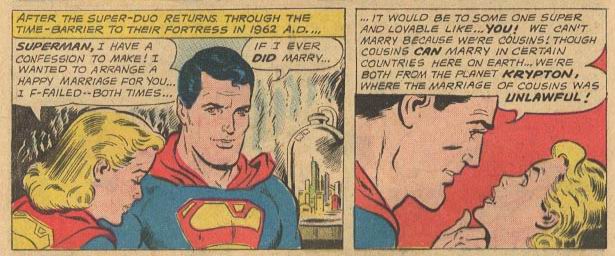
Here are a couple panels from a rather bizarre story in Action #289. Supergirl decides to play cupid for Superman in this story, but each time she sets Superman up with a gal, something goes wrong. Finally she confesses, and Superman lets us know where Krypton stands on cousins marrying.


Note: You can always click on a picture here to see a larger version.

Although generally a model of propriety, DC did a couple of really weird ones where you gotta wonder sometimes what they were thinking--did an artist pull one over on them? Check out the cover on this one:


We all know what kind of super-feats she has in mind. And yes, Lois, it certainly looks like Superman's excited, and covering it up with the Daily Planet.

Tuesday, May 03, 2005

Goofy Covers


This is one of the sillier covers out there. Note that Wonder Woman's comment does not add anything to our understanding of the story. She could almost add, "And he's going down the up escalator!"

Sunday, May 01, 2005

The Martian Manhunter Part II--Key Issues & Events

In Part I of my post on J'onn J'onzz, the Martian Manhunter, I discussed some of his early exploits and powers. In this post I'll focus in on some key Detective issues in his history.

First, obviously, is Detective #225, where MM makes his first appearance, discussed extensively in the prior post.

In Detective #246 we are given our first introduction to lovely redhead (later blonde) Diane Meade. She is a trainee police officer but also the daughter of the Police Comissioner. As a trainee she makes Detective Jones miserable, since she's always asking questions about his methods, and he can't reveal he's using his Martian powers. At the end of the case, Jones muses to himself about the sparkle he noted in Diane's eyes when she looked at him.


A pretty interesting ending to the story, eh? Remember, this is about 1957, a period when race relations were a major issue. Although J'onn is not black, he is "colored", and he certainly has some black-appearing features. I may be reading a little too much into that--sometimes a Martian is just a Martian.

In the early adventures, J'onn J'onzz mostly worked in his human identity, changing only to a Martian appearance while invisible. However, in Detective #273 he was forced to reveal his Martian identity, when a criminal from Mars kayos him with a gas that prevents him from using his Martian powers anymore while invisible. Since he must be visible to fight the Martian crook he appears in public in his Martian costume.

Note: In all probability this sudden restriction on J'onzz's powers was necessitated by his upcoming admission as a charter member of the Justice League of America. Detective #273 came out in November of 1959; the JLA's first adventure was in Brave & Bold #28, Feb-Mar 1960. Since the stories in the JLA would be focused on the characters as superheroes it was necessary for the Martian Manhunter to come out of the closet.

In Detective #275, Diane Meade finally returned. This time she was portrayed very similarly to Lois Lane, eternally suspicious about whether John Jones was secretly the Martian Manhunter. She appears in #282 as "The Girl with the Martian Powers" and in #284 as attempting "The Courtship of J'onn Jonzz". After that she becomes more or less a regular, appearing frequently, if not in every story.

In Detective #301, two significant events happened. First, Detective dropped the third feature story, expanding the size of the Martian Manhunter story from 7 pages to 12. And second, J'onn J'onzz returned to Mars for the first time. This may also have been partially caused by his exploits in the Justice League of America, which regularly traveled to distant planets; it was becoming a little hard to believe that J'onzz could not make it back to Mars with the help of his JLA buddy Superman.

A major change in the feature came with Detective #311, which introduced J'onzz's other dimensional buddy Zook. Zook had some wild powers of his own, including the ability to change his temperature from freezing cold to boiling hot, and to change his shape at will. He could also read minds with his antennae. Although able to talk he was portrayed as having the mind and affectionate nature of a small child.


As the picture above hints, Zook was something of a cloying, saccharine character. Although similar to the pets that many DC heroes had at one point or another, there was really nothing quite like him.

Detective #326, the last issue to feature the Martian Manhunter, introduced the Idol Head of Diabolu, a transparent plot device that guaranteed continuing stories. The idea was that once opened, the Idol Head would release an evil upon the world every full moon. This of course guaranteed monthly adventures for the Martian Manhunter, who would have them in a new location as the lead feature in House of Mystery, starting with that comic's issue #143. In addition, that issue saw the apparent death of John Jones, thus cutting him loose from the detective job.