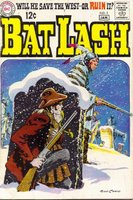
Monday, July 28, 2008

Trivia Quiz #2 Answers

1. By what term did Marvel refer to DC Comics in the Silver Age?

Answer: Brand Echh, as first pointed out by Kryp44. Cultural reference: TV commercials of the time often compared the sponsor's product to a rival product from "Brand X". In tests, we were advised, consumers largely rejected Brand X.

2. In retaliation, by what term did a DC comics reader suggest that Marvel Comics be referred to as?


Commenter Michael Rebain remembered that one.

3. It is well-known that five DC superheroes survived intact from the early 1940s continuously into the Silver Age without a reboot: Superman, Batman, Wonder Woman, Green Arrow and Aquaman. What other non-DC superhero made it through continuous publication from the early 1940s into the Silver Age?

The only other (comic book) superhero to survive all the way from the 1940s to the dawn of the Silver Age was this guy:


Plastic Man's last Quality issue was published in November 1956. DC acquired the rights to the character when they purchased Blackhawk and a number of other mags from "Busy" Arnold, although they did nothing with Plas until his appearance in a Robby Reed story.

4. Name the superheroes and supervillains who had the same name in the DC and Marvel Universes. Only counted if each appeared in the Silver Age at some point; neither Tarantula, for example would qualify.

There are probably others, but here are a few: The Enchantress (noted by Michael Rebain), Hercules (noted by Steve C.), the Sandman, the Vulture, Electro, and Thor.

5. True Or False: Amazing Spiderman never outsold Batman in the Silver Age for an entire year.

Surprisingly, perhaps, the answer is false. When Batman sales crashed as Batmania died out, the title actually slipped below ASM in sales in 1969.

Friday, July 25, 2008

Friday Trivia Quiz #2: Comic Wars

1. By what term did Marvel refer to DC Comics in the Silver Age?

2. In retaliation, by what term did a DC comics reader suggest that Marvel Comics be referred to as?

3. It is well-known that five DC superheroes survived intact from the early 1940s continuously into the Silver Age without a reboot: Superman, Batman, Wonder Woman, Green Arrow and Aquaman. What other non-DC superhero made it through continuous publication from the early 1940s into the Silver Age?

4. Name the superheroes and supervillains who had the same name in the DC and Marvel Universes. Only counted if each appeared in the Silver Age at some point; neither Tarantula, for example would qualify.

5. True Or False: Amazing Spiderman never outsold Batman in the Silver Age for an entire year.

Thursday, July 24, 2008

Thursday Linkage

Beaucoup Kevin is providing coverage of the San Diego Comic Convention for those who are not there.

Dial B for Blog is doing a 16-day celebration of the Batman. One oddity of the success of the 1960s Batman series is that for awhile, the Dynamic Duo found themselves sharing cover space on teen mags with rock idols of the time like the Beatles and Herman's Hermits.

Mark Engblom reveals the story behind the Original Hulk. Kinda looks like an oversized Baron Zemo to me.

Avi Green has a must-read on heroes that become villains and why it's a terrible idea. I could not agree more with this:

That aside, what we have here is something I hadn't seen in discussion for awhile - the idea that heroes only become interesting when they're villains. This, in my mind, is cheap and degrading, but it also runs a considerable risk of making it hard for old and new audience members to apprieciate the older material when they're later being hit by the whole notion that these heroes of yore are suddenly becoming villains today.


That's not something that people had to deal with back in the Silver Age of comics; villains occasionally turned into heroes (Quicksilver, Black Widow, Scarlet Witch, Hawkeye), but never the opposite. Well, almost never.

The Legion Omnicon catches a Silver Age reference to Spiderman in a Legion of Superheroes story. This kinda highlights a post I'm working on about the comic book wars of the 1960s.

Monday, July 21, 2008

Trivia Quiz #1 Answers

Good job, all five questions were answered by commenters:

1. After Green Arrow announced his first resignation from the Justice League due to an unspecified threat, what did his fellow JLA members do after accepting his decision?

Answer: They all decided to dress up as Green Arrow themselves to see if they could draw out whoever was threatening the Emerald Archer, although one of them had a slight "wardrobe malfunction":


Terrific memory by Michael Rebain, who not only noted the answer, but the exception.

2. How did "Snapper" Carr get his nickname?

Answer:


Cultural reference: In the late 1950s the beatniks had a shtick of snapping their fingers rather than applauding.

3. Who was the first new member inducted into the Justice League?

Answer: Green Arrow was the first new member inducted into the JLA. One odd difference between the JSA and the JLA is that in the JSA, members were "retired" when they graduated to their own magazines; hence Superman, Batman, the Flash and Green Lantern were fairly inactive in the JSA for a few years. The JLA was supposed to be for characters who had graduated to their own magazine, although there were exceptions right from the start; Aquaman and Martian Manhunter did not have their own mags at the time.

4. Among the five original members of the JLA (not counting Batman and Superman), who was the first to not appear on a cover?

The Martian Manhunter did not appear on the cover of JLA #7, although he did appear in the story. Good job by Joe Bloke!

5. Who was the first superhero to decline admission to the JLA?


Spanish DC was the first to answer this one correctly (as well as #2 and #3).

I will try to make these trivia questions a regular Friday feature.

Sunday, July 20, 2008

The Franchises

There are only a few comic characters of the Silver Age who qualify as "franchises". That is, they were so successful that they spawned spin-off series that were successful in their own right.

One of those characters was the mightiest human being who ever lived. Another was the lowliest private in the Army. A third was a freckle-faced teenager. And the last was "a poor little rich boy". It's kind of an odd mixture; two people who lived lives we could never dream of, and two "everyman" types.

Archie was the undeniable comics franchise of the Silver Age, producing a staggering number of spinoff mags: Little Archie, Archie & Me, Archie's Madhouse, Archie's TV Laugh-Out, Betty & Me, Everything's Archie, Jughead, Jughead's Jokes, Life with Archie, Reggie & Me, Reggie's Wise Guy Jokes, in addition to the Archie comics that started in the Golden Age, like Archie, Betty & Veronica, Pep, Laugh, etc.

Superman, of course, had been a franchise character almost since his introduction, spawning his own mag, World's Finest, and Jimmy Olsen and Superboy in the Golden Age, while that latter character took over the lead in Adventure Comics. He added Lois Lane to his regular appearances, and was the designated character to introduce DC's line of Annuals. While he did not generate as many new titles as the other characters in this post, what he did generate sold amazingly well: In 1962 the top four titles in sales were Superman, Superboy, Lois Lane and Jimmy Olsen, and the only Superman-related title to finish out of the top ten was Justice League of America (which was 11th, and generally did not feature Superman on the cover or in the story at the time). In 1965, the top six titles in sales were all Superman-related.

Marvel did not have a franchise character/feature in the Silver Age, although they had two that would eventually earn that designation--Spiderman and X-Men would eventually start branching out into more and more books. You can make a teeny-tiny argument for Millie the Model, but I'd rather not.

Harvey was the only publisher to have two franchises: Richie Rich and Sad Sack. Richie Rich's own book only launched in 1960 (he started in 1954 as a backup in Little Dot), but within a few years he had launched Richie Rich Dollars & Cents, Richie Rich Millions and Richie Rich Success Stories. In the 1970s the number of Richie Rich titles continued to spiral upwards as every valuable item in the world from Gems to Gold and Silver became the inspiration for another magazine.

Sad Sack was similarly successful in launching new titles. Sad Sack & the Sarge, Sad Sack Laugh Special, Sad Sack's Funny Friends, Sad Sack's Army Life Parade and Sad Sack World all had long runs starting in the Silver Age.

Any others? Donald Duck can make an argument, but Uncle Scrooge was a well-established magazine before the Silver Age started, and the Beagle Boys and Gyro Gearloose didn't last long enough to qualify. Batman, like Spiderman and X-Men was a franchise feature waiting to happen; I don't think you can count his late and tentative (at the time) takeover of the Brave and the Bold.

Update: Snard points out a good one in the comments: Casper the Friendly Ghost. Casper had his own book and spun off long-running titles like Spooky, Wendy the Good Little Witch, Casper and Nightmare, Casper Ghostland.

Friday, July 18, 2008

Friday Trivia Quiz #1: Justice League of America

1. After Green Arrow announced his first resignation from the Justice League due to an unspecified threat, what did his fellow JLA members do after accepting his decision?

2. How did "Snapper" Carr get his nickname?

3. Who was the first new member inducted into the Justice League?

4. Among the five original members of the JLA (not counting Batman and Superman), who was the first to not appear on a cover?

5. Who was the first superhero to decline admission to the JLA?

Thursday, July 17, 2008

Joe Friday from Mars?

This is an excellent post on one of the under-rated characters of the Silver Age of Comics.

John Jones was very much like Detective Sergeant Joe Friday, with a bit of Phillip Marlowe and a science fiction twist. Like pulp detectives, crooks routinely got the drop on Jones in the second act, roughing him up to add tension before the final turnabout.

Wednesday, July 16, 2008

Femme Fatale

Marvel introduced many memorable female characters in the 1960s. One of the more interesting was the Black Widow. She first appeared as an opponent of Iron Man, in Tales of Suspense #52 (April 1964).


As you can probably guess, she's a Russian spy, assigned by the Kremlin, to kill Vanko (the former Crimson Dynamo), Tony Stark, and Iron Man. She is accompanied by Boris, a hulking brute of a man, who kayos Vanko, brings him back to a Soviet sub, then returns to Stark's plant to wreak havoc in the Crimson Dynamo's old outfit.

Meanwhile, Tony's got designs on the Widow:


He heads back to the factory when he learns of the destruction going on there. At first he is overcome by a sucker move from the Dynamo (because he does not know Boris is inside the suit. Both he and Vanko are now on the sub. Fortunately he is able to recharge his batteries from a light plug, and rescues Vanko. Iron Man and Boris fight it out once again at the plant, but Vanko derails the battle by killing both himself and Boris with an unstable ray. The Widow escapes in the confusion, but now she has failed:


We next see the Black Widow in TTA #57, this time teamed up with Hawkeye, making his first appearance. Hawkeye is a former trick archer at the carnival, who decided to become a superhero after seeing Iron Man get accolades for saving people on an out-of-control ride. However, he bumbles a bit and the cops confuse him for an accomplice of the first thief he encounters. Fortunately for him, the Widow happens to be driving by and rescues him:


She suggests some accessories for his arrows, and Hawkeye, being already madly in love with her, agrees to defeat her enemy, Iron Man. Of course, he is not aware that she is a communist spy.

Hawkeye and Iron Man battle it out, with Iron Man eventually emerging victorious. Hawkeye tries a demolition blast arrow on Shellhead, but it ricochets and hits the Widow. Hawkeye escapes with her, planning to nurse her back to health.

She next appears with Hawkeye in TOS #61. By now he realizes that she's an enemy of the USA, but she soothes him with lies:


He attacks Stark's plant again, but is dismayed to learn that the boss himself keeps all the plans in his head. He barricades himself inside with Pepper Potts (Stark's secretary and secret love). The Widow goes to help him out, but she is captured by her Soviet masters, who haven't forgotten her earlier failures. As the story ends, Hawkeye escapes capture, but Natasha is on her way back behind the Iron Curtain.

She returns in TOS #64. Stan refers to Kruschev's fall from power here and shows that Natasha is on the verge of becoming a good character:


But that commie rat brings out her parents and threatens them unless she does as he orders. So now she joins the ranks of villains who are only doing it for a good reason. She picks up a new uni and a web-slinging device for swinging through the city:


She returns to Hawkeye, and they kidnap Pepper Potts and Happy Hogan. Iron Man shows up and we have the basic battle. This time an acid arrow seems to be winning the day for Hawkeye, but Iron Man decides to behave like a cad:


I'll attack his weakest link, the girl? Not very heroic! But sure enough, Iron Man blasts her with "a transistor-powered electrical bolt", causing Hawkeye to break off the combat to rescue her. You can make the argument that by kidnapping Pepper and Happy, the Black Widow had forfeited any right to chivalry, but it's very hard to fit in with this new notion of the Widow as moving towards the hero class.

The next chapter of the saga took place in Avengers #16 (May 1965). Hawkeye appears at Avengers headquarters, hoping to join the team. And just to show that he's not a bad guy, he announces himself by tying up Jarvis and shooting a smoke arrow into the room:


And for possibly the only time in the Marvel Silver Age, a bunch of heroes actually refrained from getting into fight given an excuse. They listened as Hawkeye explained about how he never meant to be a bad guy, he was just misunderstood. He fills us in on Natasha here:


Well, that's a heckuva a boyfriend, not bothering to hang around the hospital and instead heading off to join the Avengers. Amazingly Iron Man says "I believe you, Hawkeye," and before you know it he's giving the bowman a copy of the Avengers' rulebook. As it happens, in the same issue Quicksilver and the Scarlet Witch join the group, while Iron Man, Giant Man and the Wasp exit stage right, leaving only Captain America as the only "good guy all along" in the group.

So matters continued until Avengers #29. Apparently the Black Widow did not die, but she might as well have:


This time, her commie masters want her to destroy the Avengers. Given that she's been unsuccessful in the past at eliminating even one of the (former) members, that seems a pretty difficult task. She recruits the Swordsman and Power Man, two villains who have battled the Avengers in the past. She also attempts to get Hawkeye to betray his comrades, but despite his continuing infatuation with her, he senses she's brainwashed and refuses.

The Swordsman and Power Man kidnap Cap and bring him back to the Widow's mansion. At first, the Scarlet Witch and Quicksilver are captured as well, but they are freed by Goliath and the Wasp, and manage to turn the tables. But as the villains are about to escape, Hawkeye has a chance to stop them with one of his arrows. However, he is unwilling to risk harming the Black Widow and the bad guys get away.

In Avengers #30, we learn that the brainwashing is wearing off. The Black Widow senses an affection for Hawkeye, and a distaste for the two thugs that she's palling around with. Meanwhile the Avengers have located their new hideout, and Hawkeye demands to be allowed to battle the trio alone.

He manages to defeat the Swordsman, but is having difficulty with Power Man when suddenly Natasha comes to her senses:


So now her transformation from evil commie to good capitalist is complete. She helps out in the following storyline which features a hate organization called the Sons of the Serpent:


She appears briefly at the end of Avengers #35, throwing some pottery at Hawkeye because he ran off on a mission without her. In the following issue, he sponsors her for membership:


But as Cap notes, they're a little busy trying to figure out where Pietro has disappeared. So they debark for the tiny European country where Quicksilver and the Scarlet Witch grew up, with the Widow tagging along. She helps out, eventually winning the battle, but only by threatening the life of another, which is strictly against the Avenger Code. Fortunately nobody observes this other than Hawkeye, who isn't about to squeal on his girlfriend.

In Avengers #38, Natasha gets a call from Nick Fury. SHIELD needs her services as a spy behind the Bamboo Curtain. She blows off Hawkeye and the Avengers, who still haven't managed a formal vote on her acceptance. In #39, we learn that she has been accused of stealing top-secret atomic plans. Of course, we know that she's working for SHIELD and the charges are phony, but Hawkeye and the rest of the Avengers don't.

Over the next few issues we get brief looks at Natasha on her Far Eastern mission. She is captured by the commie rat who brainwashed her, and subjected to the new Doomsday Device called the Psychotron, as they have figured out she worked for SHIELD. At the end of Avengers #42, Hawkeye and the others learn that she's been captured.

But if they are to get her back, they will have to defeat the Red Guardian, a Soviet version of Captain America, who has a stunning secret connection to the Black Widow:


And in the following issue, the Red Guardian sacrifices his life to save Natasha.

It was perhaps inevitable that Marvel would put their two arachnid-based characters against each other, and it happened in ASM #86 (July 1970). We learn of a rather Diana Riggish new look for the Widder:


The story is a typical Marvel intro battle; one side is deceived by early success into believing it has the upper hand, but suddenly they learn that their opponent is stronger than suspected. In this case, it was another of Peter Parker's mysterious ailments which caused him to appear weak, but as he shrugged off the effects...

This was an intro for the Black Widow's own series in Amazing Adventures, where she shared the mag with the Inhumans (much as Iron Man and Captain America had shared Tales of Suspense, and the Hulk and Submariner had shared Tales to Astonish, until all four graduated to their own titles in 1968). Although the Black Widow series only lasted 8 issues and is mostly forgettable, it did have one important aspect; it marked the first work by Gene Colan on the character.


As you can see, it also marked the beginning of a more "adult" aspect to the series. Colan's association with the character would continue in late 1971, when the Black Widow started teaming up with Daredevil for a memorable four-year run.

Coming soon by popular demand: Still more fishnet, featuring the Black Canary.

Saturday, July 12, 2008

When I'm the Evil Genius...

I will not savor this glorious moment:


Click for the rest of the "When I'm the Evil Genius" series.

Friday, July 11, 2008

Our Bald Future

One of the more amusing things about the Silver Age DC are its visions of the future. Obviously the technology is interesting, but they also pushed for a particularly interesting evolution:


The folliclely-challenged shall inherit the Earth!

Wednesday, July 09, 2008

Zatanna and Zatara

There were two major stories in the DC Silver Age that crossed over into several titles. Nowadays these "events" are commonplace, but back then it was something very new.

Zatara had been a mainstay of DC comics in the Golden Age, actually appearing alongside Superman in Action Comics #1. He even made two cover appearances in Action #12 and #14. He appeared regularly in Action and World's Finest right up until 1949. His shtick was that he was a magician who could cause amazing things to happen by commanding them. But the key was that he had to speak his orders backwards:


In 1949, Zatara was eased out of his roles in Action Comics and World's Finest. In the former, it does not appear that he was removed to make way for a new character, but rather he was dropped and some of the existing features (notably Vigilante and Tommy Tomorrow) picked up some extra pages.

So things stood for almost fifteen years. Then, in Hawkman #4 (Oct-Nov 1964) we got an update. While investigating an oddball appearance of two items at the museum they run, Carter and Shayera discover a pair of women speaking very strangely:


In their spaceship, they do some detective work and:


Zatanna explains that she's looking for her missing father, Zatara. We learn that before he disappeared he was trying to capture an evil Oriental lama, and also that he battled against a "sinister being called the Druid."

Using the Absorbascon, a Thanagarian device that can learn any knowledge on Earth, Hawkman discovers that nobody on the planet knows the whereabouts of Zatara. Zatanna thanks them for their help, and continues on with her quest.

Her next encounter with a superhero went unannounced at the time. I have previously discussed Detective #336, which featured "Batman's Bewitched Nightmare". In the story Batman faces a witch who is helping some crooks with their larceny. At the end it is revealed that the Outsider was using them for his own purposes. But it turns out that the witch in the story was Zatanna, minus the fishnet stockings and good looks:


She returned in Atom #19 (June-July 1965). She believes that her father has vanished into a microscopic world inside his book of magic. Zatanna and the Atom shrink down to subatomic size and encounter the Druid mentioned in Hawkman #4. He captured Zatara by absorbing all his magical energy. Then he banished him to another realm.

At first, it appears likely that Zatanna will suffer the same fate:


But the Atom gets the brilliant idea of Zatanna tricking the Druid by using fake "magic" (i.e., a simple card trick). The Druid absorbs the fake magic and it sends him into a catatonic state. Unfortunately this means that Zatanna still can't find out where her father is.


The series continued in Green Lantern #42 (January 1966). Zatanna has discovered the secret entrance to Ys, a mirror world of Earth that is "steady-state", where nothing ever changes. A warlock on that world has tired of the lack of excitement, and decides to bring Green Lantern there so that he can steal the power ring and conquer our world. They defeat him, but he refuses to reveal where Zatara is unless GL hands over the ring. GL agrees and we learn that Zatara had been in Ys, but he had escaped by taking a crystal ball that the warlock intended to use to travel to Earth. Fortunately before GL hands over the ring, Zatanna places a hex on it, causing the warlock to freeze in place. Her quest continues.

Zatanna next appeared in Detective #355 (September 1966), this time popping into an Elongated Man adventure. She is looking for a missing tripod which was stolen from a store. She forces the thieves to come to her, not realizing that they were engaged at the time in a battle with the Elongated Man. The pair of them team up against the crooks and the storeowner (who turns out to be a criminal as well). At long last, Zatanna is ready for the final battle:


The saga ended in Justice League of America #51 (February 1967). Zatanna summons Batman, Green Lantern, Atom and Hawkman to their JLA headquarters, along with the non-member Elongated Man.

We learn that she wants to thank them for helping her rescue her father. This creates a complex plotline as the story shifts back and forth from the present to the past. And of course it sorta gives away the ending, which makes it an odd plot design.

We learn at last that Zatanna was actually the Witch in Detective #336, thus tying her into the Outsider series in Batman. She got into trouble here:


It's a classic "Don't do it!" moment if ever there was one, but driven by her desire to find her father, Zatanna does. The spirit delivers Zatanna to "the land of Kharma", where she is beset by magically created creatures. She summons duplicates of the five heroes of the story to help her defeat them. But still the hordes come, and Batman figures it out:


Wow, pretty risky maneuver there, but we know he's right, and even if he isn't he's just a duplicate of Batman. With the spirit banished from Zatanna, we discover that the magic user fighting her was her own father. You see, Allura had cursed Zatara for imprisoning her in that sword, with a spell that would have destroyed both father and daughter should they meet. Hence Zatara's disappearance and attempts to prevent Zatanna from reaching him. But with Allura defeated, the curse no longer exists and we get the happy ending:


Obviously way ahead of its time, the series suffered from crossing over into many titles (as do all such stories) despite the continuity of editor (Julius Schwartz) and writer (Gardner Fox). The odds of a significant portion of the comic-reading cohort of the time having a complete collection approach zero, and of course at the time the idea of compiling the story into a trade paperback never occurred to anybody.

And the gimmick of saying your words backwards is annoying to readers, who have to stop and translate. The evil Oriental lama never appears in the story (after the mention in Hawkman), and although there were hints that the story will crossover into the Flash (at the end of the Atom tale), that never happened.

Still, a very entertaining saga.

Coming up next: Yet more fishnet stockings!

Monday, July 07, 2008

Great Moments in Botched Perspective

I pointed out a couple months ago, the 3/4 shot where an onlooker to the panel provided us with a visual clue so that we could determine the relative distances and sizes of objects in the background. But what happens when that perspective gets botched somehow? Here are a couple of classic examples:

Yes, come back Bob! I don't love this four-foot tall guy standing behind me in the bathrobe! One of the problems here is that it's hard to tell who's the freak; the guy could be normal-sized and the woman could be a giant.

In Jimmy Olsen #61, he encounters a rather diminutive Lucy Lane:

And no, thinking his girlfriend has become three feet tall is not what's making Jimmy question his sanity.

Commenter Ralph C. pointed out a couple of months ago the odd little man in the background of this panel from Action #239:

I'll add more entries to this post as I find them. If you have some good ones, let me know!

Update: Here's a silly one from Lois Lane #3 (Aug 1958). Superman has been turned into a baby in Lois Lane #3, and she's convinced that she'll catch Clark Kent looking similarly infantile. But instead there's this:

The perspective certainly makes it appear that Clark is significantly shorter than Lois, although the gag ending tells us that we're supposed to be amused at Clark's clothing despite finding him significantly taller than Lois.

Saturday, July 05, 2008

How Many Ways Is This Wrong?

Oh, my lord:


How do you make one of the greatest villains in history a hero? Granted, Stevenson was always a little ambivalent towards Silver, allowing him to escape with a portion of the gold at the end of Treasure Island. When I first saw this I assumed that the CCA had told Charlton, "Yes, you may have a pirate comic book, provided the pirate is lovable." But apparently it was based on a movie and subsequent TV series as you can see from this poster:


Here's a brief clip from the movie:


Looks like a faux swashbuckler a la the Crimson Pirate.

BTW, take a closer look at that cover. Notice something missing?

Friday, July 04, 2008

The Lesser-Known Heroes of the Silver Age: Jigsaw

There was a core of about 20 superheroes who had a significant number of adventures in the Silver Age. For DC, it was Superman, Batman and Robin, Wonder Woman, Flash, Green Lantern, Aquaman, Atom, Martian Manhunter, Green Arrow and Hawkman. Marvel had the Fantastic Four, Spiderman, Iron Man, Thor, X-Men, Hulk, The Avengers, Daredevil, the Sub-Mariner, Dr. Strange and Captain America.

But there were plenty of other superheroes who lasted only a few stories and then disappeared. Almost all comics publishers tried their hand at superhero comics at some point in the 1960s. During the height of Batmania, this was especially the case, as superhero comics seemed to fly off the stands while other genres tended to languish.

Harvey was probably feeling the pinch more than other publishers. As I have noted earlier, the baby bust in the late 1950s was reducing the pool of young comic readers by 1966. And the kids who were old enough to read Harvey's titles were all going straight to Batman. So they decided to fight back with a few superhero characters. Jigsaw debuted in his own magazine in Sepember 1966.

Colonel Gary Jason is an astronaut who experiences unexpected trouble while reentering the earth's atmosphere:


He gets sucked into the cone of debris, where his capsule is destroyed. Fortunately it's a probe from aliens on the moon, who put him back together. More or less:


At first he's grateful just to be alive, but it's not long before Ben Grimm syndrome sets in:


Especially when he discovers he has freakish powers. Despite the interesting design, this turns out to be basic stretchability along the lines of Mr Fantastic. But his girlfriend and the US government react to him as if he was Freaky Freak McAlienFreak. He's so upset that when he visits his science fiction writer buddy, he forgets his own name:


And his alien friends, who look like robotic chickens:


The real villains turn out to be the Pulots, an alien race that looks remarkably like humans, at least in #1:


Although by #2 that's gone by the wayside:


Overall the series (which ended with that second issue) is pretty dull. The artwork is passable but not elevating. Jigsaw has nothing really unique to recommend him; I suppose he serves as a decent introduction to the superhero genre for the young readers that Harvey appealed to at the time.