Monday, October 29, 2012

The Aliens

This post was suggested by an emailer named Darell.

I have talked previously about the terrific Gold Key series, Magnus, Robot Fighter.  In the back of each of the Magnus comics was a four-page serial called The Aliens.  The series started with the contact with Earthmen:

After an initial mistaken impression that the aliens were firing at them, they decide to head for home.  But then they realize that they can't do that without risking that the aliens will follow and discover Earth.  The aliens grasp the problem as well:
This is the basic plot of one of the most famous science fiction stories of all time, First Contact, by Murray Leinster.  The dilemma was resolved by having the two species swap ships after wiping out all information that could identify their home planets.  However, that wouldn't make for much of a serial, so in The Aliens, the solution is:
This creates two parallel stories, with one following the captain of the Earth ship (Johnner) and his half-alien, half-human crew heading back to Earth, while the other ship returns to the alien's homeworld.

Over the next several issues, we see the aliens and the Earthmen developing a bond and trust for each other as they help the other species out of difficulties:

While this provides good characterization, it does have one drawback: there is not much conflict.  Oh, sure, there's the obligatory story where one of the Earthmen has an irrational prejudice towards the aliens, that is unsurprisingly resolved when an alien saves his life.  So it seemed to me that the serial started to bog down a bit, until they arrive back at Earth, where the aliens are surprised to discover:
The colonists from Venus had been taken over by another alien intelligence and were infiltrating the Earth.  This provides the conflict the series needed:
Note the slur.  There's something else being talked about here, under the surface.  Over the next several issues, the Earthmen and the aliens battle the Venusians and attempt to discover their plans.  The scripting and artwork on the series was done by Russ Manning, who was also doing the same chores on the Magnus feature.  Check out this gorgeous page:
Overall the series is entertaining and well worth reading.  It has been reprinted several times, most recently by Acclaim as Captain Johner and the Aliens.

Thursday, October 25, 2012

A Robot Did What?

I don't know why, because I've always been an avid reader, but for some reason, while reading comic books of the early 1960s or before, I tend to ignore the text features that appeared in many of them.  But today I happened to be reading Magnus, Robot Fighter #2, and I saw that the text story was entitled "The World of Robots... Today!"

It describes the many robots at work around at the time (1963) including thermostats, parking meters, etc., and points out that they may not be recognized as such because they don't resemble the hulking iron giants of science fiction movies and TV.  So far, so good.  But check out this closing passage:

Whaaaaat?

Update: Do I have the best readers and commenters ever?  Richard Bensam  points out this article in Slate on the way the story evolved (a misfired gun which wounded nobody becomes "his robot shot him"), and David Kilmer contributes this page from an Ogden, Utah newspaper which shows how sensationalized the story became.  I particularly love the photo of Alpha with the dancing girls.  Of course, the iron club and the "fact" that the inventor was killed are more recent additions to the myth.

Diane points to a story by the Binder brothers (Otto and Earl) which also has a similar plot:
Soon afterwards, a heavy object falls on Dr. Link by accident and kills him. His housekeeper instantly assumes that the robot has murdered Dr. Link, and calls in armed men to hunt it down and destroy it.

Tuesday, October 23, 2012

Clark Kent Calls It Quits?

In current comics, of course.

Clark Kent quits the Daily Planet in Superman #13 — and he doesn’t go quietly. He resigns in front of the whole staff, reports Brian Truitt, “and rails on how journalism has given way to entertainment.” (The Daily Planet is now part of the multimedia corporation Galaxy Broadcasting.)
 Well, jeez, Clark, if you were concerned about journalism, you shouldn't have given your consent to some of Perry White's hair-brained circulation gimmicks.

Note as well that the story on Clark Kent both at Romenesko and USA Today indicate that the takeover of the Daily Planet by Galaxy Broadcasting is some new plot development.

The Daily Planet has also been moving more toward the real world, too, with the newspaper becoming part of the multimedia corporation Galaxy Broadcasting.
Actually Galaxy Broadcasting has owned the Planet since the first issue of Superman (#233) under Julius Schwartz's editorship, way back in January 1971:
So long ago that not only did he smoke a cigarette inside an office building, but he smoked it from a cigarette holder! Which, by the way, strikes me as nearly as big a clue that he's a villain as if he were wearing a monocle.

Update: Further discussion by hobbyfan here.

Monday, October 22, 2012

My Greatest Adventure #81

This is the second MGA issue featuring the Doom Patrol. As you can see, the "freaks and outcasts" theme that Arnold Drake was copying from Marvel is still underway:
They also carry on the bickering in the Marvel style.  Incidentally, Stan certainly didn't invent the concept of heroes arguing amongst themselves; in fact that predates the comic books entirely.  I'm not sure if it goes back earlier, but Doc Savage's two lieutenants, Ham and Monk fought constantly.  Note as well that Cliff is referred to as "Automaton"; that didn't last long as he was redubbed Robotman shortly afterwards.

While rescuing a trapped submarine, the Doom Patrol learns of the major plot point in this issue:
Rita destroys the monster as shown on the cover.  But curiously, Cliff didn't see the monster. This seems like just an oddity at the time, but when they battle a snow-giant we learn that it is significant:
To Neg-Man and Rita's irritation, Cliff fails to help them defeat the monster. What is wrong with him that he cannot see what is so obvious?  Cliff blames the Chief for somehow messing up his brain when he transferred it to the robot body.  The next clue comes via big-screen TV:

A guy with a monocle and a Van Dyke beard named Dr Janus.  I'm guessing he's the villain of the piece.  He claims that living beings (intended to be the first wave of the invasion) were discovered in a meteor several years ago, which everybody remembers except Cliff:
The newspapers confirm the existence of the living beings.  But despite this, the Chief suddenly has a brainstorm.  What if, instead of being the only crazy person, Cliff is the only sane one.  Suppose something about his robot body is preventing him from having the hallucinations that are afflicting the rest of the populace?

And sure enough, when we check in with Dr Janus, we find that is the correct explanation:
The plot point of an escaped Nazi war criminal was a very common one in popular culture during the 1960s.  In fact, I covered a Lois Lane story with that exact theme less than a year ago.  And, no coincidence, that villain also wore a monocle.

The Doom Patrol heads to the town with the Meteor Crater, which is now a ghost town as the local mine had petered out.  But in the abandoned newspaper office:

Yep, Janus somehow managed to plant fake file copies in all the newspapers in the world.  But the poster gives the Chief an idea.  What if he drew a fake beard on an old picture he has in a photo album?  Sure enough, it reveals that Janus is actually the escaped Nazi.

Meanwhile, the media have arrived along with Janus, who promises they will see another invader.  Sure enough, a giant dragon appears.  But this time Cliff walks up to where the hallucination supposedly is confidently.  Realizing his mistake, Janus changes the hallucination to show Cliff being killed by the dragon.  Forgetting that it's all an illusion, Rita goes giant-size and attacks the dragon.  Of course:
But he manages to escape from her grasp and uses a high-voltage wire to interfere with Janus' broadcast, breaking the spell.  Neg-Man captures the Nazi, and Automaton destroys the hallucination machine.

The backup story is fairly entertaining, about some explorers who eat the fruit of a tree which regresses their evolution so that they become the "missing link".  Rather than delve through the plot entirely, I thought I'd just show some panels by Alexander Toth:

Toth's artwork is highly prized by collectors, something I'll have to remember if I ever put this issue up on ebay.  Personally, I prefer his detailed Golden Age work to the more loose Silver Age style.

Sunday, October 14, 2012

Stan Lee's Guide to Creative Insults

Or, who says comics aren't educational?  Stan seemed to have an inexhaustible thesaurus of put-downs, aspersions and invectives:

I can tell you for a fact that was the first time I ever heard the word "dolt", and it was certainly a useful addition to a teenager's vocabulary.
Clod was not unknown to me, but prefaced with "worthless, insufferable" really makes it work as a taunt.
Okay, so maybe he overused "insufferable".  But did you know that an escutcheon is the shield on which a coat of arms is displayed?  It can also be the distribution of pubic hair (!) although I doubt that's what Stan meant in this case.

Doom, of course, was the Doctor of Disdain, the Sultan of Scorn, the Ottoman of Opprobrium.  But many other villains mastered the alliteration of aspersion as well:

However, that's not to say that the Marvel heroes were incapable of creative contumely:
I'm looking around for an example of my personal favorite insult; "costumed cretin" but not finding it quickly.  Anybody?  Anybody?  Bueller?

Update: Another classic, courtesy of Flodo:

Update II: Costumed cretin as mentioned by an anonymous commenter, from Avengers Annual #1:

Sunday, October 07, 2012

The Trouble With Robots

One of the central themes running through DC comics in the Silver Age was a reverence for science combined with skepticism for applied science (i.e., technology).  Few plot points illustrate this better than the continual problems that Superman (and Superboy) had with his robots.

They were originally created to help Superman out of jams, particularly in situations where both Superman and Clark Kent had to be somewhere at the same time.  However, they were unreliable at best, often shorting out due to electrical disturbances, or sunspots.  And at times they were unavailable for other reasons:

And on more than one occasion, they nearly revealed his secret identity:
At least twice, his robots went rogue.  Ajax, a robot who was transformed into an android by members of the Superman Revenge Squad in Superman #163, apparently went off the reservation and tried to kill Superman, although it turned out that he was just pretending to do so to fool the SRS squad.  And when Superman tried to create an android of his own in Superman #174, it turned out to be mistake-prone and attempted to take Superman's place by convincing Clark Kent that he had never really been super.

But nothing reveals Superman's trouble with robots more than the story in Action #299, surely one of the wackiest in the entire Silver Age.  He receives a robot named LL-35 from the planet Jax that is supposed to be much smarter than even Superman himself.  LL-35 makes a suggestion:

Here are the robots he builds according to the instructions:
Kryptonite vision, you say?  I can't imagine how that could possibly backfire on Superman.  Unless, that is, some aliens tampered with the robots' loyalty tapes:
Well, that's pretty unlucky.  And for the next several pages, the robots torment our hero, using Red Kryptonite to turn him into an elastic man, and later giving him three faces:


Superman doesn't even get out of this using his wits; instead he gets lucky.  See, this was all taking place on an alien planet, where every day, a fallout dust disintegrates metal:
Any other examples of Superman's robots causing headaches for him?

Monday, October 01, 2012

Those Pagan Kryptonians!

A rather surprising response from Weisinger, who generally portrayed Krypton as far more advanced than Earth. Of course, you can see the problem; if he responds that they had some different kind of religion (or no religion at all), he's implying that's superior. So he almost had to come up with the answer that he did.

It does raise an interesting point, though. Surely Clark was brought up in whatever religion the Kents practiced, most likely some form of Protestantism. And yet his creators and longtime editor and publisher were all Jewish (which is probably why, after the Golden Age, there were almost no stories that mentioned Christmas or any other religious holiday).

Wednesday, September 26, 2012

Letting the Hulk Out of the Bag

As I have discussed in the past, the secret identity thing could be considered a fate not quite as bad as death. That is, because even the dullest reader in the Silver Age pretty quickly realized that the main hero in a comic never died no matter how close he came (or somehow came back to life after a brief period of time), the secret identity reveal became something that could credibly happen and cost the hero quite a bit as he would either have to retire or create a new identity.

Of course, the problem is that editors back then did not want to create new identities for their established heroes. Oh, they might tease us with it occasionally, and sometimes (e.g., with Superman) more than occasionally, but the story would end in one of a few ways: the discoverer would be conned into thinking that somehow he had gotten it wrong, would suffer amnesia, or would die by the end of the story. On exceedingly rare occasions, the discoverer would turn out to be trustworthy and keep the secret.

Even Marvel was not above using the secret identity revealed "teaser":
In that instance, Peter Parker had the flu and fought so terribly that everybody who watched the removal of his mask ended up believing that he had just pretended to be Spiderman. That's why Tales to Astonish #77 stands out as something new:
And it was no tease; inside, Rick Jones, convinced that Bruce Banner is dead, reveals his secret to Major Talbot:
And not only did Major Talbot not die, but Rick went on to tell Betty Ross, Banner's girlfriend:
You know the old joke? Two people can keep a secret if one of them is dead. Well, with Rick and Talbot and Betty knowing about Bruce Banner being the Hulk, it isn't long before the word gets pretty widespread:
Even the President finds out:
And so the Hulk becomes the first superhero to have his "secret" identity widely revealed.

Note: The Fantastic Four and Doctor Strange never really had secret identities (although in the Strange Tales series it is strongly implied that nobody knows Johnny Storm is the Human Torch), and the Elongated Man decided to let everybody know his real identity of Ralph Dibny voluntarily.

Tuesday, September 18, 2012

Hawk and the Dove #6

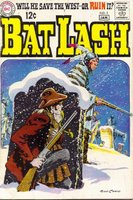
As the 1960s drew to a close, DC was under continuing financial pressure to raise prices due to inflation. As a result, many titles were discontinued in 1969: Angel and the Ape, Atom and Hawkman, Bat-Lash, Captain Action, Beware the Creeper, Metal Men, Secret Six, Spectre, Windy and Willy and the Hawk and the Dove. In fact this was the final issue for the title. Ditko and Skeates, the original creative team on the title were gone by this time; according to the GCD this issue was both scripted and drawn by Gil Kane, with inks by John Celardo. As the story begins, Hank and Don discover that their father being beaten by a hood, who apparently intended to kidnap him. Don stays with Dad while Hank impetuously chases the mugger, giving Kane the opportunity to do what he does best:
Smek? Unfortunately, the creep is tougher than he looks and he gets away. The next day, the boys arrive home from school to find that he's returned, and this time he managed to abduct Pops:
The lads try to track down the kidnapper in their own ways; Hank beats up hoods in an effort to find out who had it in for the judge, while Don does some detective work:
Both of them come to the conclusion that their dad has been kidnapped by the son of a man that the judge had sentenced to prison. Sure enough:
They don't really have much trouble kayoing the guy and rescuing their father, who of course kvetches about the danger they put him in:
The story ends on an ominous note:
As mentioned before, this was the final issue of the Hawk and the Dove. They made semi-regular appearances in Teen Titans for the next few years.