Wednesday, November 08, 2006

Goldilocks

I've talked briefly about Thor in the past, but now it's time to discuss him in a little greater detail. Thor is the Norse god of thunder. His initial appearance in Marvel was in Journey Into Mystery #83. JIM was one of Marvel's horrible "horror" mags, which featured stories like "I Unleashed SHAGG Upon the World!" and "I Found RRO... The Thing from the Bottomless Pit!"

Don Blake, a lame physician, was on vacation in Norway when he discovers a plot by alien invaders from Saturn. He is spotted by the Stone Men, and runs into a cave. There he discovers a small staff, which is fortunate because he has lost his cane. But when he strikes the cane against a boulder blocking his way, he transforms suddenly into the Mighty Thor!


Thor has many powers. He is virtually invulnerable and fantastically strong. But even more important is his mighty hammer (the staff transformed), which makes it possible for him to fly and which destroys almost anything it's thrown against and returns automatically to his hand like a boomerang. It can also cause lighting and storms.

But of course with this power comes a weakness. If the hammer leaves Thor's hand for 60 seconds, he reverts to Don Blake, the lame physician. As always in the Marvel universe, there is also a love interest. Nurse Jane Foster secretly loves Dr Blake, and he adores her but worries that she could never love a weakling like him.

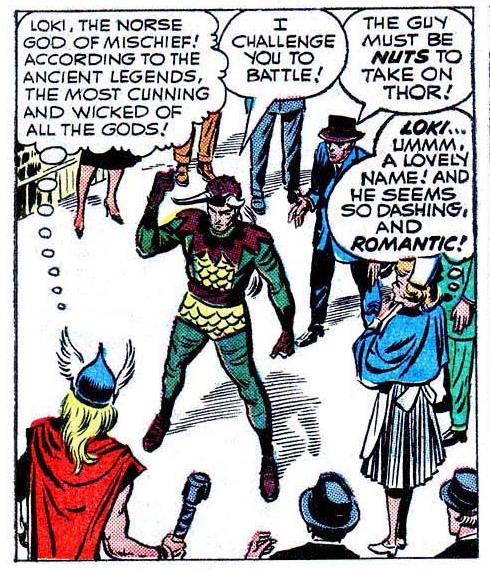
Initially Thor battles fairly traditional enemies for superheroes: Aliens intent on a hostile takeover, communist dictators and assorted crooks. But quickly a supervillain worthy of Thor's interest was discovered; his evil brother, Loki, the God of Mischief. Loki first appeared in JIM #85, and was returned quite often in the early issues: He is featured in JIM #88, 91, 92 and 94 as well as Avengers #1.

The characterization of Nurse Jane Foster in these early issues stinks. She's the typical 1960s Marvel eye-candy airhead. We see her thinking about how much she loves Don Blake, but she has an eye for Thor (not realizing that they are actually one and the same). And the first time Loki shows up, he's quite a prize as well:


This is all too typical of Marvel at the time. Girlfriends/love interests existed mostly as potential hostages for villains and were generally placed in traditional women's occupations: nurses like Jane Foster and secretaries like Karen Page, Betty Brant. Compare that with DC, which had Lois Lane as a reporter, Vicki Vale as a news photographer, Jean Loring a young attorney and Carol Ferris running an aircraft factory.

Tuesday, November 07, 2006

Robby Reed Unveiled!

In the final (for now) post on Dial B for Blog. His blog is incredible; undeniably the finest comics blog on the net.

Sunday, November 05, 2006

More DC Scientofascism

As we have discussed in the past, if there was a religion in the DC Universe back in the Silver Age, it was science. In a way, this is probably a natural outgrowth of the postwar era, as it seemed that technology, government and industry were forging ahead to move us into the glorious future. But it looks just a tad creepy with the benefit of hindsight.

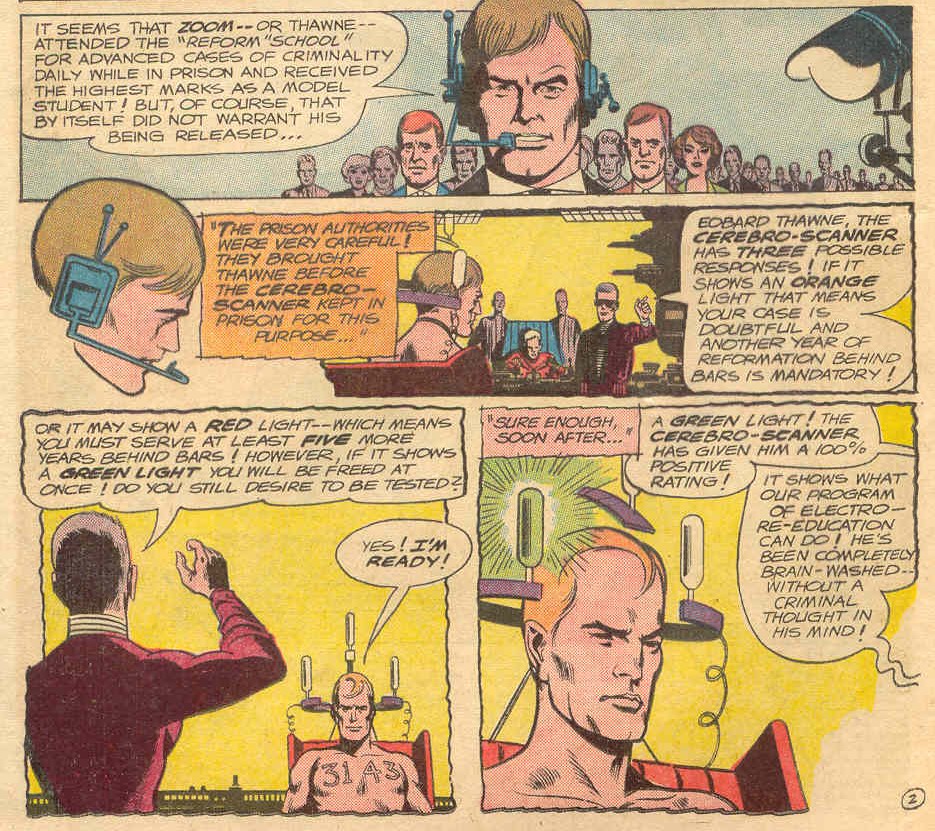
For example, consider this bit from Flash #153, the June 1965 issue. Professor Zoom, aka the Reverse Flash, aka Eobard Thawne has apparently reformed thanks to the "electro-reeducation" provided by prison authorities in the year 2465:


Of course as often happens in these stories, there is something wrong with the machine. In fact, Professor Zoom has tampered with the Cerebro-Scanner to make sure that he will pass the test despite not having gone straight at all. As was the case in Superman #132, once the machine is repaired, nobody stops to think, hey, maybe we shouldn't be setting murderous crooks free just on the basis of them passing a test.

Wednesday, November 01, 2006

Challengers Part II

I didn't have the time or the inclination to read all of the Challengers series at this point, so I thought it might be entertaining to jump ahead five years and check the changes.

Challengers of the Unknown #31 contains a retelling of the Challengers' origin with new details. We learn that before the fateful flight, Rocky had defended his wrestling championship despite an attempt by the mob to influence the bout.

More unbelievably, Prof Haley was reintroduced as a rich delinquent. Uh, how did he get the nickname "Prof" then? He reforms after helping rescue an ancient statue from the deeps via his skin-diving ability.

Red Ryan, who had originally been introduced as a circus daredevil (only to have Kirby ignore that aspect of him), was now reincarnated as a mountain climber, and electronics expert. He builds a radio tower on a mountain with the money of a rich patron to educate the poor people of a valley in South America. However, it turns out that the patron really intended to use the tower to transmit propaganda and become a local dictator, fortunately prevented by Red.

Ace Morgan was a pilot who had contracted to carry high explosives for miners in his plane, but was forced to toss them out when they broke loose. He manages to hit the mountain in a place that reveals a vein of ore, so the miners are happy.

However, as the four men fly in Ace's plane, they feel like failures for one reason or another, especially when the plane conks out and they must crash land in a forest. Given a second chance, they feel like they are living on borrowed time, and resolve to do something more with this second chance at life.

This origin retelling is contained within a larger story where a mysterious stranger claims to have rescued the Challengers from their plane. Thus they were not really saved by "fate" as they had long believed. Their rescuer, a Mr Clayton, presents evidence. He is in a jam and needs the Challengers to help him reassemble an ancient statue. It turns out the statue's actually a giant robot that has two arms missing which when assembled will give him incredible power. But the Challengers eventually realize Mr Clayton did not really save them and defeat his robot.

Comments: Interesting but uneven origin retelling by DC.

Challengers of the Unknown #32 contains two stories. The first one features Volcano Man, who had previously appeared in Challengers #27. In the second story we learn that the Challs had picked up an alien pet whom they called Cosmo. He seems to have almost unlimited mental powers, so much so that he dwarfs the rest of the team. Looking back I see that Cosmo first appeared in Challengers #18, and had made a couple intermediate appearances. In this story, they discover his original alien owner, who is happy to let them keep the pet since it is proving of so much use. Perhaps typically for DC, this ended up being the last time Cosmo appeared in the Silver Age Challengers; probably for the reason noted above; he was just too powerful and made it too easy for them to get out of tight scrapes.

My previous article on the Challengers is here.

Monday, October 30, 2006

The Atom Man

Marvel was not the only comics company to notice the success DC was having with its Silver Age heroes. Gold Key Comics decided to try their hand at the superhero biz with an entry called Dr Solar, Man of the Atom, which debuted in October 1962. Dr Solar was a research physicist working on project that attempts to convert energy into matter. Unknown to him, Rasp, another scientist working at the same facility, is secretly an agent for a villain named Nuro. Rasp tries to get on Solar's project, but is rejected in favor of Dr Bently. After trying to kill Solar and failing, he sabotages the nuclear reactor so Bently is exposed to a lethal dose of radiation. Dr Solar finds Bently dying, but apparently survives the radiation himself. However, it is later discovered that he had not survived so much as transformed:


Note the green color; the Hulk had debuted about a half-year earlier. Not sure if changing color is really a side-effect of radiation poisoning or if this is just a little copying.

The action takes place in Atom Valley and there is a love interest; a pretty blonde Gail Sanders whom Dr Solar had known back at college. Oddly, although she does not know what happened to Dr Solar (who now must stay in a lead-lined office), when talking to him through a lead window she makes no remarks about his green skin.

Meanwhile, we discover that Dr Solar has the ability to generate enormous heat, like a miniature sun. However, this rapidly drains him of energy and he must expose himself to the atomic pile to regenerate. Dr Clarkson, head of the laboratory where Dr Solar works, is the only person who knows his secret.

By the second issue, they had mostly dropped the green coloring, although it does appear occasionally. We learn of new powers; Dr Solar is capable of generating "lightning-like rays" with his eyes. He is also capable of changing his body into a wave of energy and flying through the air.

In the fourth issue we learn that he has "radar-like vision". In Dr Solar #5, he gains a superhero costume:


It actually looks a little more red than pink on the covers.

Dr. Solar lasted for 27 issues before finally folding in 1969. He made a brief comeback in the early 1980s for another four issues under the Whitman Comics line.

Saturday, October 28, 2006

The Avengers Part II: Ch-Ch-Ch-Changes!

One advantage that DC had over Marvel in the early 1960s (although it would change by the end of the decade) was that their characters seemed frozen in time. Thus it was no great challenge for writers and artists on different mags to portray Batman.

Not so with Marvel's characters, and the Avengers demonstrated this as early as their second issue. Hank Pym's Ant-Man was replaced in this story by Hank Pym's Giant Man. In addition, the Hulk decided to leave the team.

By the third issue, Iron Man had exchanged his all-gold outfit for the gold and red combination which has mostly endured (with minor changes) to this day. And in the fourth issue.... well, let's just say that things changed for good.

The second issue featured the Space Phantom, a shape-shifter who could banish any human that he imitated to a place called limbo. He imitates all of the Avengers in turn, but eventually he makes the mistake of trying to mimic Thor, the Thunder God, and is banished to limbo himself as a result.

One oddity about Avengers #2 is that it contains an obvious boner. Rick Jones, who is shown living in the Southwest in both Avengers #1 and #3, appears on the streets of New York and confronts the Hulk (really the Space Phantom).

In Avengers #3, the Hulk teams up with the Submariner to fight the Avengers. Obviously this is a major comic, and yet it is dwarfed by the following issue.

Captain America returns! It is one of those interesting coincidences that in Fantastic Four #4, Stan Lee brought back the Submariner, a major Marvel character of the Golden Age, and in Avengers #4, Captain America, the biggest Marvel character of that era returned.


Cap helps the Avengers in another battle against the Submariner and in the end was offered and agreed to join the team. We learn that Bucky, Cap's sidekick, had died at the end of World War II, although we don't learn the identity of the man responsible for his death (yet). He seems interested in pursuing a friendship with Rick Jones much like that he'd had with Bucky back in the Golden Age.

Avengers #5 featured a pedestrian one-off battle with a former foe of the Mighty Thor, the Lava Men. But in Avengers #6, we first meet Baron Zemo, who is responsible for Bucky's death. He had been working on a super adhesive for Hitler's war machine when Captain America destroyed the factory. In the process, Zemo's mask, which he'd worn to prevent reprisals against him from the common folk, became permanently glued to his face.

Zemo returns in Avengers #7, this time assisted by the Enchantress and the Executioner, a pair of immortal villains who had previously appeared in a Thor story in Journey into Mystery. Banished from Asgard, they hook up with Zemo for different reasons. The Enchantress convinces Thor that the Avengers have gone bad and they are his enemy.

Up to this point, the Enchantress has seemed like a character caught between good and evil, much like other Marvel characters who eventually reformed. But we can sense the evil coming to the fore in this sequence:


Is this the first genuinely evil female in the Marvel universe? I can't think of another one.

Tuesday, October 24, 2006

The Avengers

It is well-known that Marvel started the Fantastic Four as a way to cash in on the superhero team craze that the Justice League of America was creating over at DC. However, the team that actually seemed more like a knockoff of the JLA were the Avengers. Consider that the the JLA and the Avengers both featured existing characters in their respective universes, while the FF featured three new characters and one revival of a Golden Age superhero (the Human Torch). Both the Avengers and the JLA included a teenaged "honorary" member (Rick Jones and Snapper Carr).

In Avengers #1, Loki wants to get revenge against Thor for getting him banished to a barren isle as ordered by Odin. He decides to utilize the Hulk in this effort. By faking a bomb on a train trestle, Loki deceives the Hulk into destroying the trestle. Fortunately for the train, the Hulk rectifies his mistake in time, but the humans still believe that the Hulk was responsible for the near accident.

Rick Jones, the Hulk's only friend, sends a shortwave message intended for the Fantastic Four, asking for their help, but Loki diverts it so that Dr. Don Blake receives the SOS. Unknown to Loki, though, the Ant-Man and Iron Man have also received the summons, and they independently make their way to the Southwestern United States.

Thor realizes that Loki is behind the illusions and heads to Asgard. Meanwhile, the Ant-Man and Iron Man have located the Hulk, who is disguised as a circus strongman. Thor battles Loki and eventually subdues him, returning to Earth. He interrupts a fight between Iron Man and the Hulk, proviing that Loki was responsible for the near accident involving the train.

As they are about to leave, Ant-Man suggests that they form a regular fighting team, and the others agree:


The Avengers would undergo the most dramatic changes over the next few years of any superhero team in the Silver Age. Stay tuned for more!

Sunday, October 22, 2006

The Identity Crisis Superhero of the 1960s

Was the Mighty Thor. While vacationing in Norway, the lame doctor Don Blake discovers an invasion of Earth by the Stone Men of Saturn. They chase him into a cave, where he discovers a cane. When he taps it on the ground it transforms into a powerful hammer while he himself changes into the Norse God of Thunder. Hey, it made for a very quick costume change, which was useful for a comic hero of the 1960s.

Over time, it was explained that Thor actually was the famed Norse god and that he had a family including his father, Odin and his evil brother, Loki. Of course, this made things a bit confusing for readers; wasn't Don Blake the real person and Thor just a superhero identity? Where did Thor go when he tapped the hammer on the ground and changed back into Dr. Blake? Eventually things got so mixed up that Marvel actually asked its fans to help them figure it out, and here, from a letter published in Journey Into Mystery #111 is the explanation that Stan Lee decided to use:

Thursday, October 19, 2006

Blogroll Surfing

Dial B for Blog has a terrific post on The Final Chapter from Amazing Spiderman #33, frequently cited as one of the highlights of the Silver Age. My post on that issue is here.

Booksteve's Library has a post about Green Arrow and the Red Feather Kid. I believe that the Community Chest mentioned in that ad is probably the forerunner of today's United Way. Of course these days Community Chest is only mentioned when playing Monopoly.

Speaking of Community Chest, Phantom Lady seems to have one in this post over at the new digs of the Fortress of Fortitude.

Four Color Media Monitor has a long and thoughtful post on Captain Anti-America (as he should have been known circa 2003). I don't engage in a lot of serious commentary over here, but one of the reasons I focus on Silver Age comics is that it's the last era where superheroes were heroes, not alcoholics and wife-beaters and Chomskyites.

Some cheesecake from the 1970s over at The Legion of Superheroes Blog.

Tuesday, October 17, 2006

Living On Borrowed Time

That was the schtick of the Challengers of the Unknown. Ace Morgan, a test pilot, Prof Haley (Hale in #1), a skindiver, Red Ryan, a circus daredevil, and Rocky Davis, an Olympic wrestling champion. After they survive a plane crash unhurt, they decide to band together and take on dangerous assignments because, after all, they shouldn't rightly be alive anyway.

The series marked the (brief) return of Jack Kirby to DC Comics. Kirby had been influential with DC in the early 1940s, creating several long-running series like Boy Commandos (originally a Detective Comics backup strip, who later expanded into their own book which lasted a full 36 issues and the Newsboy Legion, who held down the lead feature in Star Spangled Comics for several years.

The Challengers first appeared in Showcase #6, the Jan-Feb 1957 issue. They made three more appearances in #7, #11 and #12, before graduating to their own title in Apr-May 1958. They were the second feature to make the jump from Showcase to headlining a magazine after Lois Lane, but before the Flash.

One of the more interesting facets of the Challengers was that they started out with book-length tales. This was unique for DC comic books of the time, which always had at least two stories and usually had three. Kirby broke the stories into four parts and had splash panels on each part, very much like what he would do with Fantastic Four a few years later. Oddly enough, though, when the series moved into its own title there were generally two stories in each issue.

June Walker (later June Robbins), a highly regarded young scientist was an honorary Challenger. Of course, like many other DC features the Challengers would eventually attract a bunch of subsidiary characters.

The Challengers initially had rather bland purple uniforms that basically looked like a sweatsuit, although that would change twice before the Silver Age was finished. They went to an ugly yellow and red combination with an hourglass (symbolizing borrowed time) in Challengers of the Unknown #43, then to back to purple suits with yellow striping on the arms and legs in #70, one of the last original issues.

One interesting facet of the early Challengers was the use of "modern" science. In Challengers #1, a Dr Evil-type steals a rare transistor. In #2, we see what a good calculator looked like back in 1958:


The series was edited by Jack Schiff, and as with all Schiff's titles suffered from a surfeit of monsters, dinosaurs and weird transformations.

Sunday, October 15, 2006

Dr Strange Part II

Dr Strange returned in Strange Tales #111. This story introduces his arch-rival, Baron Mordo. Mordo is another former student of the Master, the Tibetan monk who taught Dr Strange the Mystic Arts. His ecoplasmic form compels the Master's servant to poison him, and hectors the Master to give him all his secrets if he wishes to remain alive. Fortunately Dr Strange arrives and saves the day. This is a very short story (only five pages), and the last Dr Strange for a few issues.

Dr Strange returns in Strange Tales #115, in "The Origin of Dr Strange". Stephen Strange (the first we learn his given name) was a skilled but arrogant and money-hungry surgeon. A car accident leaves the nerves in his hands damaged and he becomes a drifter. When he hears of a man who can supposedly cure anyone, he seeks out the Master in Tibet. However, the Master is not willing to help him because his motives are selfish, but he does offer to tutor Strange in the magic arts.

Strange is introduced to the Master's other pupil, Baron Mordo. Mordo is trying to kill the Master. Mordo casts a spell preventing Strange from warning the Master of his danger. Strange realizes that in order to defeat Mordo, he must learn black magic himself.

The next appearance is in Strange Tales #116. Dr Strange faces the villain from the first story, Nightmare, who has worked out a way to bring sleeping humans into the dark world he inhabits.

Ditko's artwork is again perfect for the moody, mystical story:


Dr Strange manages to rescue the sleeping men from the clutches of Nightmare, but not without considerable risk to himself.

This was also the last issue of Strange Tales not to feature at least a mention of the Dr Strange story on the cover.

For the previous Dr Strange post, click here.

Tuesday, October 10, 2006

I'm Late to This Party

But Dial B for Blog, which is always terrific, has a superb series on Ira Schnapp. Who was Ira Schnapp? One of the most important men in the history of comics. This is highly recommended!

Sunday, October 08, 2006

"Imaginary" Stories

In the early 1960s, Mort Weisinger, the editor of the Superman line of comics (including Action, Adventure, Superman, Jimmy Olsen, Lois Lane, and World's Finest) began to allow his writers to script what were called "imaginary" adventures. Of course, all superhero comics are "imaginary", but these stories allowed the writers to break some of the rules that were required with such successful continuing characters. We could see what might happen if Lois Lane married Superman (or Lex Luthor) while the next issue could completely ignore that wedding, because it had been clearly labeled an imaginary story.

I suspect in some ways this was an outgrowth of the way DC's comics of the early 1960s often featured what I call a "puzzle" cover. The puzzle was "Why is this happening?" For example, suppose the cover showed Jimmy Olsen doing something particularly nasty to Superman, like the following:


The last one even offers a double puzzle since not only is Olsen betraying his friend, but Brainiac and Luthor, Superman's worst enemies, are pleading for his life.

Anyway, the point is that DC loved these puzzle covers and so apparently did their readers. But of course it became tougher and tougher for the writers to create situations that managed to not only create a great puzzle cover, but which ended with everybody unchanged essentially. Hence the imaginary stories.

The concept has proven irresistable. Marvel published hundreds of "What If" issues and DC has its "Elseworlds" line; both are clearly inspired by the "Imaginary" stories. Of course you can track imaginary stories back to dream stories; the difference is that you don't have the falling asleep and waking up scenes.

I believe (but I'm not sure) that the first "Imaginary" story billed as such was "The Death of Superman" in Superman (V1) #149, November 1961. This is one of the most famous Superman stories of all time because it does not cop out at the end; Superman dies and Supergirl (until then still unknown) must carry on her cousin's tradition. (Correction: As noted in the comments, the first imaginary story is "Mr and Mrs Clark (Superman) Kent" from Lois Lane #19, August 1960).

In the story, Luthor convinces the world and Superman that he's reformed by finding a cure for cancer, then ambushes his longtime opponent and kills him with Kryptonite. Supergirl apprehends him (much to his dismay), but Luthor thinks he can escape the death penalty because he knows how to expand the bottle city of Kandor, where the trial is taking place, to normal size. However the Kandorians demand justice and Luthor is sentenced to the ultimate penalty.

There were some terrific "Imaginary" stories; "The Story of Superman Red and Superman Blue" in Superman #162, "Jor-El II and Kal-El II" from Superman #166, and "Clark Kent's Brother" in Superman #175 were all excellent three-part tales that explored Superman's character in new ways that would not have been possible otherwise.

Unfortunately, the great stories did not come without a price. Some stories which created bad characterization would be undone by the explanation that "it was an imaginary story". For example in Superman #205 (April 1968), it was disclosed that a heretofore unknown villain named Black Zero had actually destroyed Krypton. Jor-El was wrong, the planet would not have exploded without Black Zero to restart the nuclear reaction.

This of course was horrific characterization for Jor-El, who was God the Father in the DC universe in those days and the story was kicked under the carpet. In a similar fashion, DC explained in Flash #167 that Barry Allen had not been hit by chemicals and lightning by accident in Showcase #4; rather he'd been blessed by a Guardian Angel. Exit Guardian Angel stage left.

For the most part the "Imaginary" stories were confined to Superman, but a couple crept over to Batman via the World's Finest title, so we saw what would happen if Bruce Wayne had been adopted by the Kents. In an influential pair of stories, DC tried an imaginary look at Superman and Batman's sons in World's Finest #154 and 157. Amusingly, forced to come up with a wife for Batman, Weissinger chose Kathy Kane aka Batwoman, who had been retired from Batman for about two years.

No DC stories of the Silver Age that did not prominently feature Superman were billed as imaginary at the time, although they have been retconned to that status.

Tuesday, October 03, 2006

Amazing Spiderman 48-49

In Amazing Spiderman #48, Marvel did something rather interesting. They replaced an aging villan (the Original Vulture) with a newer, updated version. Blackie Drago was the cellmate of the OV, and has been pestering him for the secret of his wings. The Vulture, facing death as a result of a machine shop accident, decides to divulge the hiding place of a pair just outside the prison walls.

At this point Blackie laughs and reveals that he was responsible for the accident which injured the Vulture. He wastes little time in breaking out of prison and once he has the wings he seems to be invulnerable, especially since our friendly neighborhood Spiderman is coming down with a cold.

The story comes to a climax atop a bridge, with a hostage and Spidey facing an enemy who can fly. This time, however, the hostage is a nobody and thus does not die. Eventually the new Vulture manages to defeat Spidey, helped a great deal by the latter's illness.

There are a few examples I can think of where an old villain was replaced by a new one in the GA and SA. For example, Batman's old nemesis Two-Face came back as two different people before Harvey Dent himself resumed the role at the very end of the Golden Age. Still, it was not common as of 1967, when this story first appeared, although of course in modern comics there are many examples of crooks retiring and others (sometimes related, sometimes not) taking over their names.

Another interesting aspect to the story is that it's plainly set in the winter in New York, and the weather plays a key role in the story.

In ASM #49, Kraven reappears. Jealous that the Vulture has gotten attention by defeating Spiderman, he resolves to attack Drago. Meanwhile, Peter is still sick and recuperating in bed. Aunt May stops by and insists on calling Dr Bramwell, the family doctor. While Peter is waiting to see him, and starting to feel much better, he learns that Kraven and the Vulture are tearing up the city. So he joins the battle and this time manages to decoy Kraven into kayoing the Vulture before he removes the former's ray gun that so devastated Peter in ASM #47.

Saturday, September 16, 2006

Amazing Spiderman #46-47

ASM #46 starts rather abruptly. Spidey, his arm still in a sling from his battle with the Lizard in #44, encounters the Shocker, a guy with special vibrating gloves which give him extraordinary power. He kayos Peter and gets away.

The next big event in Peter's life comes later. Harry Osborn's dad has rented an apartment for him close to Empire State U. He invites Peter to take the second bedroom. Of course, our hero is thrilled at the prospect, but has to figure out whether it would be an inconvenience to Aunt May. Fortunately, she has already decided to move in with Anna Watson, so for once things seem to be breaking Peter's way. At this point he appears to be casually dating Mary Jane, but Gwen is starting to interest him more.

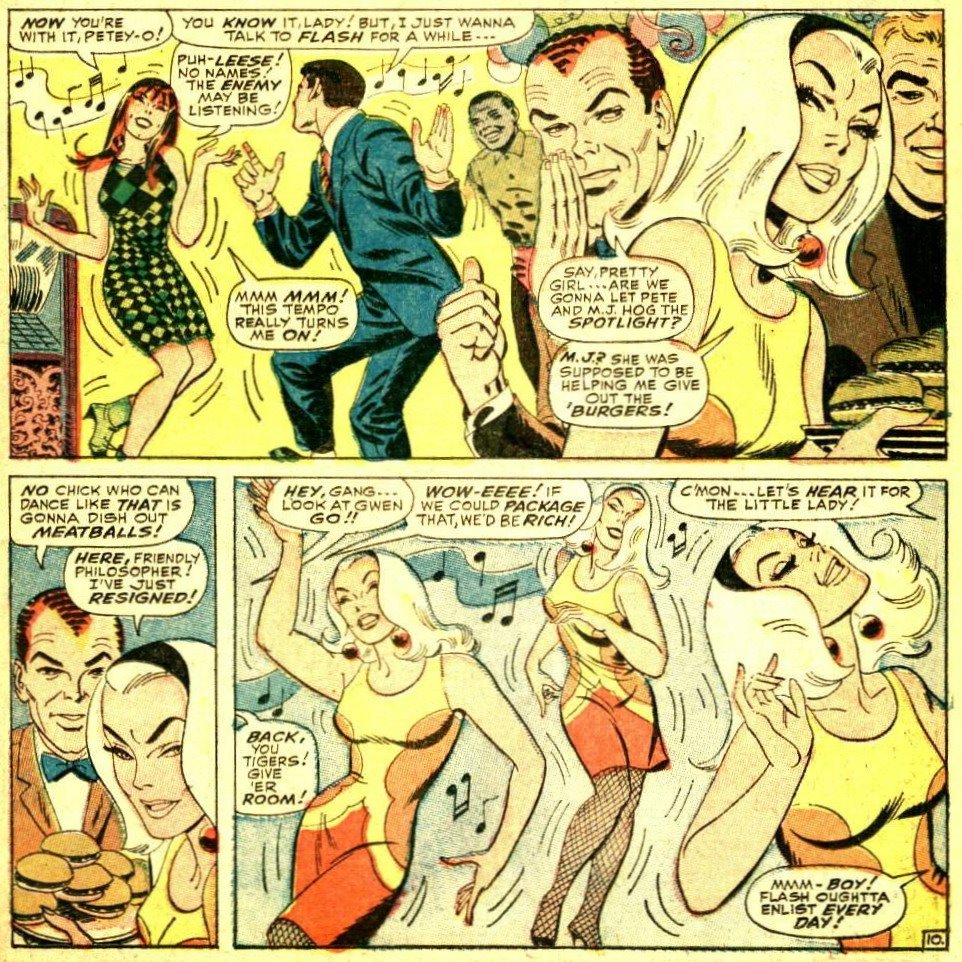
Spidey handles the Shocker in their second battle by not allowing the crook to use his thumbs on the vibrating gloves. Some modest pop culture and political references; Spidey mentions Hubert Humphrey and The Man from UNCLE. Still, we get some inevitable teenage angst here:


Kraven returns in #47, as well as (briefly, in flashback) the Green Goblin. We learn that Gobby had hired Kraven to attack Spiderman in ASM #34, something that was not disclosed at that time. In addition, Norman Osborn himself (aka the Green Goblin) had acted as a go-between, exposing himself as a crook to Kraven.

Kraven has developed a new ray that will eliminate Spidey's super-speed, and is confident once that is gone he will be able to subdue Webhead. We get a long dose of the Archie stuff:


But eventually the battle starts. Kraven decides to kidnap Harry, who's with Peter at a going-away party for Flash Thompson, who's been drafted into the army as discussed in earlier issues. Peter sneaks away and reappears as Spiderman. He taunts Kraven into dropping Harry and they fight. This time Kraven defeats him with his ray, but stops short of killing him when Norman Osborn shows up. However Kraven is baffled when his jungle senses tell him that Osborn doesn't remember him at all. Of course, he had no way of knowing that Osborn has amnesia about his Green Goblin years. Kraven decides that his victory over Spiderman is enough and dashes off.

Monday, September 04, 2006

Lo, There Shall Come a Geek

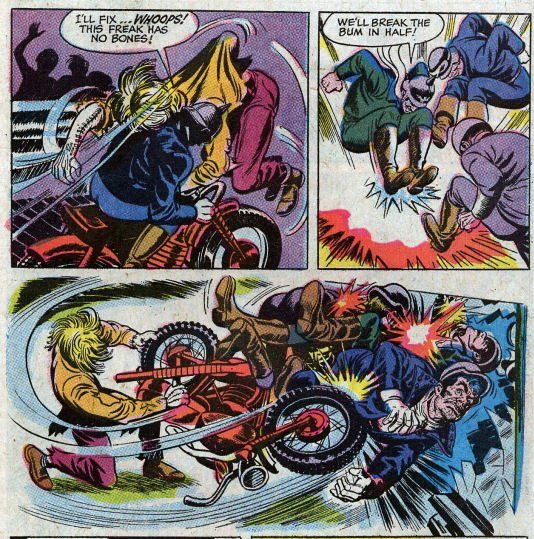
Of all the weird heroes to arise at the end of the Silver Age, and there were a lot of them, perhaps none was weirder than Brother Power, the Geek. A creation of Joe Simon, the less famous half of the Simon & Kirby team, Brother Power came to life via spontaneous generation. He was originally a tailor's dummy, but combined with the heat from a radiator, a little machine oil, and a spark from a bolt of lightning, he came to life.

He was initially a friend of hippies, but aspired to more than their lifestyle. He had incredible strength, which came in handy for beating up a bunch of motorcycle goons:


In the first issue he's kidnapped to be a featured attraction at a carnival freak show, but his hippie buddies rescue him. He decides he wants to become a politician, but the carnival operators convince the cops to arrest him for breaking up their tents. At the end of the first issue he drives off the Golden Gate Bridge.

In the second issue, after being pulled from the deep by another group of losers, and almost kidnapped by a bizarre Baron with a Fokker biplane (sic), Brother Power goes into the world of business. He rapidly moves up the ladder, with smart thinking and hard work. Eventually he runs a major missile plant, beating out a villain named Lord Sliderule. But Sliderule gets revenge by sabotaging a missile launch. BP is once again wanted by the police. He sneaks into the missile in an attempt to escape but Lord Sliderule blasts it into space. The hippies manage to convince the cops that LS is to blame for the problem with the missile launch, but in the meantime, what will happen to Brother Power?


Despite the promise of a next issue, none appeared and Brother Power, The Geek was sidelined for several decades, although he did pop up in a couple comics in the 1990s.

In retrospect, it seems like DC had decided to try to go after the burgeoning hippie market. In some ways this seems inspired, but of course as with much that DC did back then, it was half-hearted. It poked fun at the hippies for their laid-back lifestyle and while this was certainly a fair criticism, it did undercut the marketing to many teens who saw the hippies as role models (mostly because they were their older brothers).

This Wikipedia entry certainly indicates that BPtG was controversial in DC's halls.

While sales of the title were modest, Brother Power was not popular among the staff. DC Comics artist Carmine Infantino claimed in an interview that Superman editor Mort Weisinger disliked the character very strongly, and petitioned DC publisher Jack Liebowitz to shut down the title. Weisinger hated hippies and felt that Simon portrayed them too sympathetically.

Sunday, August 27, 2006

The Spiderman TV Cartoon


I don't remember the original 1960s run of these cartoons, but recall them more from the early 1970s in the afternoon. As you can see, the quality is pretty mediocre, and it would get worse before the end of the run (this was the tenth episode). Most adaptations of comics were pretty cheesy back then; it wasn't until the Superman movie in about 1978 that anybody approached the subject of superheroes with real respect.

Obviously the biggest impact of the Spiderman cartoon series was the theme song, (snipped from this cartoon) which has been incredibly durable. Here it is:


I always liked the part about "In the chill of night at the scene of a crime...."

Saturday, August 19, 2006

DC, The Home of WeirDCrooks

In the Golden Age, it was seldom necessary to give criminals a motivation. They were just crooks, simple as that. Some of them (Luthor notably) also were mad scientists, a bogeyman familiar to youngsters from the TV and radio serials.

But as the Silver Age wore on, establishing a motive for the criminal behavior became more important. Two of the oddest motivations came from Captain Cold and Sonar.

Captain Cold was one of the Silver Age Flash's first villains, appearing in Showcase #8, the second comic to feature the Scarlet Speedster. His weapon was a gun that could freeze things instantly; a rather pedestrian power. But he was an interesting character nonetheless because his reason for pursuing a life of crime was to impress women.

Initially he had a crush on Iris West, Barry Allen's girlfriend, but would later transfer his affections to other women. Along the way, he picked up a supervillain polar opposite named Heat Wave, who frequently was his rival for the affections of women.

Sonar, on the other hand, had the ability to control sounds with a special tuning fork. Again, this is not an ability likely to fascinate readers for long. But Sonar's back story was wild. He came from a small European country named Modora. Frustrated that his homeland was not a player on the world stage, he resolved to make it a major power.


In one of the annoying coincidences that plagued Green Lantern in the early years (see for example, my earlier post about Qward), GL discovers Sonar because he is searching for a stamp from Modora. He searches the mind of an old clockmaker, whose apprentice, Bito Wladon (Sonar) has just quit the job. The clockmaker is worried because Wladon had discussed his dangerous ideas before leaving.

GL battles Sonar twice, but each time the villain manages to escape. The third time turns out to be a charm and in gratitude, the citizens of Modora issue a special stamp for Green Lantern to give to Pie-Face.

Saturday, August 12, 2006

Fantastic Four Annual #1


As I have discussed earlier, DC's success with "Annuals" (really 80-page reprint mags) resulted in Marvel looking to add this profitable niche to its line. The problem was that Marvel had not been publishing their superheros long enough to be able to reprint stories and expect them to sell very well, or so they thought. So Fantastic Four Annual #1 featured a brand new double-length story with the FF facing the Sub-Mariner and his Atlantean hordes.

This was the first time since Namor's return in FF #4 that he appears in Atlantis. We learn that the Atlanteans are blue in color, which raises some questions about the claims that he is "a prince of the blood" as one character puts it. We also learn that he has a love, Lady Dorma, and a rival for both the throne and the girl, in the Warlord Krang. He gives a speech to his subjects in which he vows to make the "insolent human race pay for its crimes against our people."

The next sequence shows us the FF in a typical opening, with Johnny and Ben fighting. This time they damage some of Sue's priceless gowns. In an effort to relieve the team's tension while accomplishing some business, Reed suggests a cruise of the Atlantic, where sea monsters have been reported recently.

The sea monsters turn out to be a trap for the FF. Namor advises Reed that he declares the seas and the skies above them as his territory, banning any overseas boating or flights. This of course will mean war with the humans.

There follows a brief bio of Subby; turns out he's the product of a marriage between an human and an Atlantean princess; hence the caucasian skin. The Sub-Mariner's forces quickly take over New York and other major cities on the coast. However, the invasion is thwarted when Reed manages to create an evaporation ray, depriving the Atlanteans of the water in their helmets that they need to survive on land.

Angered, Namor kidnaps Sue Storm. While the boys fight it out above, Dorma, in a fit of jealousy, breaks a window in the undersea room where Sue is being held. Sue, realizing it is her only hope, jumps out the broken window. But she becomes tangled in some seaweed, and nearly drowns. Namor flies her back to the mainland to a hospital. But his act of selflessness has a price, as the Atlanteans feel betrayed and desert him.

In the second feature, the brief encounter between Spiderman and the FF from ASM #1 is retold in an extended version. The book also contains a reprint of the FF's origin from Fantastic Four #1, and a gallery of their most memorable villains.

Sunday, August 06, 2006

Ultra, the Multi-Alien

DC introduced a lot of weird characters in the late 1960s, but few of them were weirder than Ultra, The Multi-Alien. Ultra was Ace Arn, a space explorer from the near future, who was accidentally transformed into a freak with the composite powers and body of four different aliens. As was becoming common, some of the conflict in the story was actually internal; the hero was unhappy with being "different". See Ben Grimm (Thing), Metamorpho, the Doom Patrol and others. At first one of the agonies for him was the loss of his girlfriend, Bonnie Blake, but eventually she accepted him despite his strange appearance.

Ultra's powers were pretty basic--he could fly, had incredible strength in one arm, could shoot lightning and had magnetic powers as well. He first appeared in Mystery in Space #103, taking over the cover and feature slot from Adam Strange. There were eight appearances in all, with #110 spelling the end for both the Multi-Alien and Mystery in Space.