Monday, March 20, 2006

Dr Strange Begins

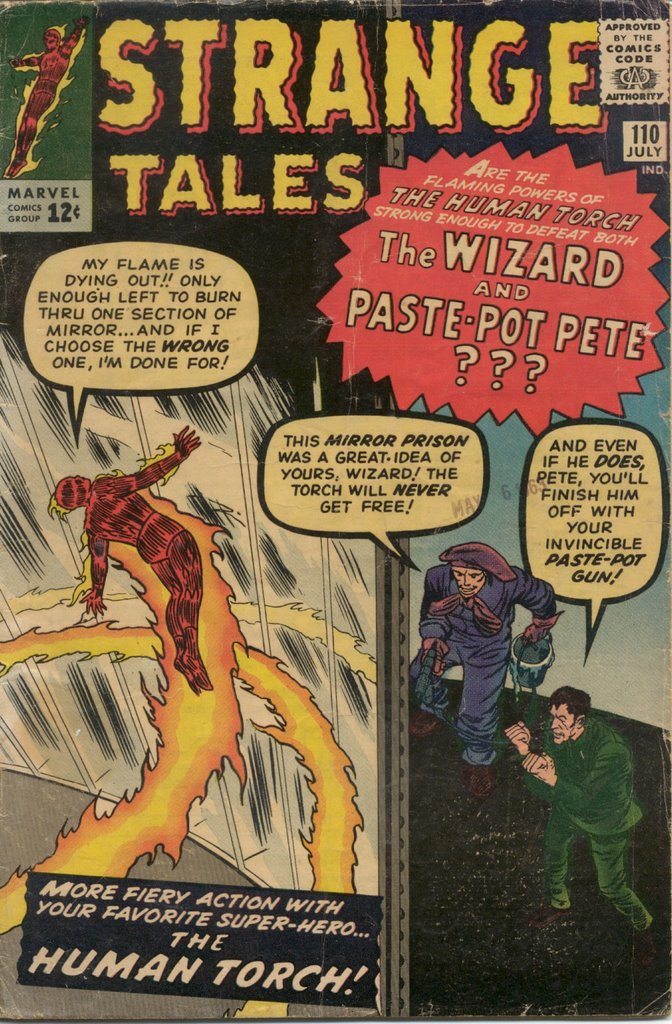
He first appeared in Strange Tales #110. To say that Marvel did not overly boast about it at the time would be putting it mildly. As you can see, the first appearance of Dr Strange didn't even rate a mention compared to the thrilling Human Torch story:


Suffice to say that this book is not worth over $1,000 in NM condition because it features the team-up of the Wizard and Paste-Pot Pete.

The Dr Strange story was relegated to six pages in the back of the magazine, but it was obviously intended to be a continuing character.


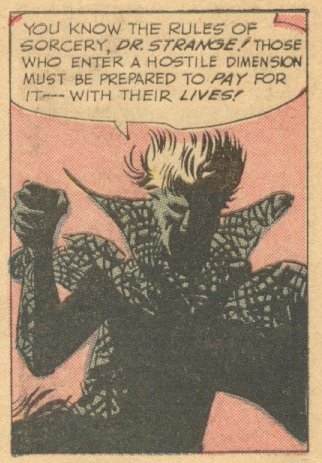
In the story, a man is haunted by nightmares. He hires Dr Strange, who "dabbles in black magic" to enter his dreams. Dr Strange soon learns that the man is troubled because he has robbed many of his business partners. Dr Strange must battle Nightmare, his ancient enemy:


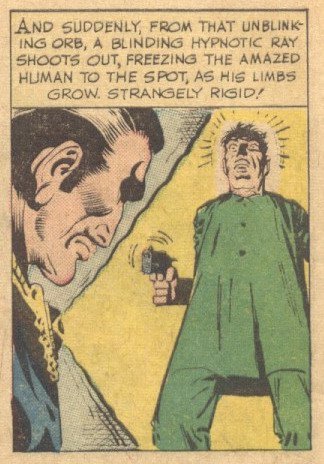
In the meantime, the man who hired Dr Strange realizes that the master of black magic knows about his crimes, and so decides to kill the doc. Fortunately, Dr Strange's master, the Ancient One, sees the peril and takes control of the amulet to save his favorite student:


At the same time, Dr Strange manages to escape his foe Nightmare.

It's a compact story with just enough background to intrigue us. Ditko was the perfect artist for the character; his use of shading and the surreal backgrounds add just the right touch of mystery.

Update: Booksteve has some speculation as to Ditko's possible inspiration for Dr Strange. Be sure to read all the way to the end of that post for a hilarious anecdote about the Daredevil TV movie.

Saturday, March 18, 2006

What's Worse Than a Monster in a WWII Story?

Pretending there's one and then not delivering.

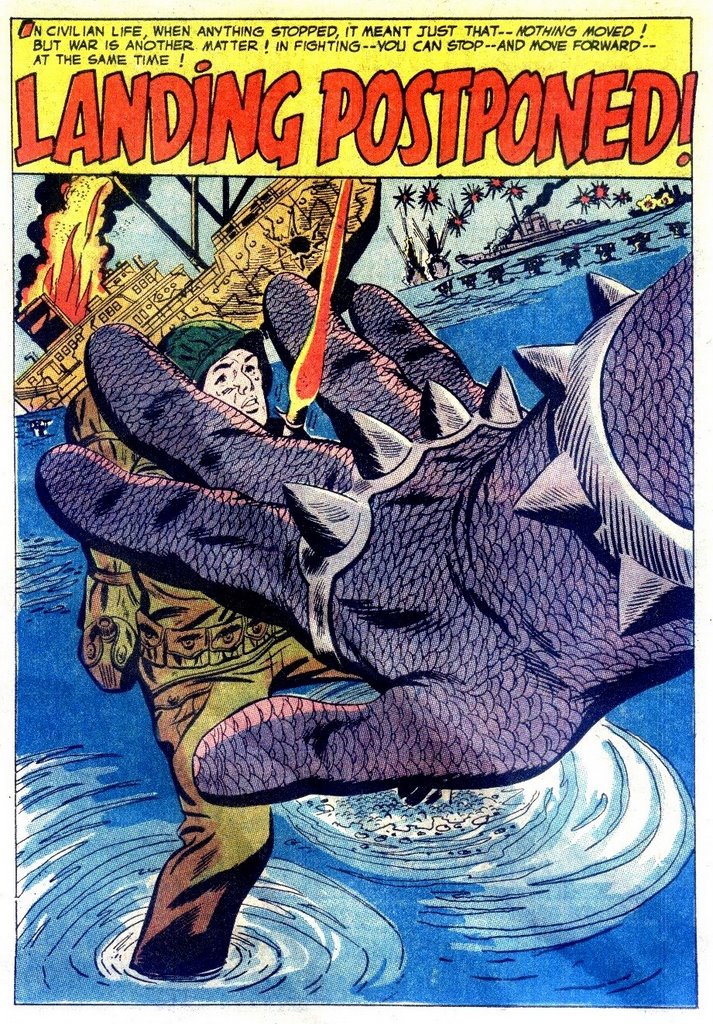
From GI Combat #130 comes this splash:


Okay, so it looks like the story's going to feature a monster with purple scales and studs on his knuckles. Except that nothing remotely like that happens. It's a straightforward war tale, with lots of fighting and enemies, but no purple monster.

Superboy's Transgendered Experience

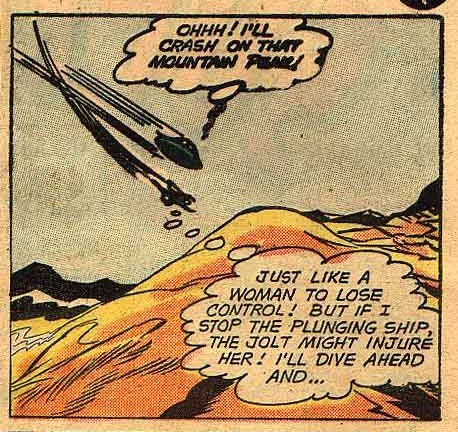
Here's a classic tale from Superboy #78, January 1960. Ma Kent tells Superboy that her intuition tells her that this is going to be a day of big changes for him. He laughs, believing a woman's intuition is a lot of nonsense. In the next sequence, he spots an alien spaceship. The woman piloting the ship is so startled to see a boy flying that she temporarily loses control. Superboy saves her, but indulges himself in a little careless sexism.


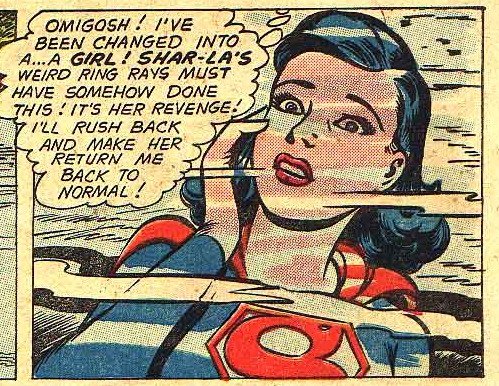
Although Superboy saved her, she's angry at him for his thoughts, so she bathes him in a ray from her ring that indeed produces quite a change:


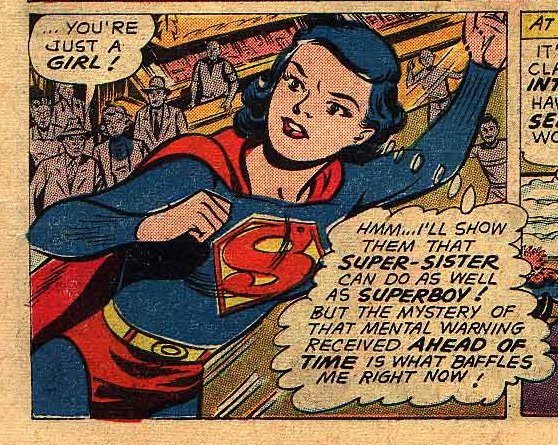
Initially, of course, Superboy is dismayed at the change. Then an interesting thing happens:


Of course, that mental warning received ahead of time is Super-Sister's woman's intution. For the rest of the story, Super-Sister helps women in trouble. At the very end, Superboy wakes up and discovers that he's been hallucinating the whole experience under the spell of Shar-La's ring.


Previous Superboy-related posts:

But Eddie Rolfe Stopped Supporting Them
Luthor's Evolution
I'm a (Time) Travelin' Man
Supergirl--Action #267
Early Legion of Superheroes
Problems with the Silver Age Superboy

Ideas for Future Posts

I've got a bunch I'll run through eventually, but I'm always up for suggestions. Some stuff that I'll likely post before long:

1. Barry Allen's decision to reveal his secret identity to his wife, as played out in Flash 165-?

2. The Lady Blackhawk as Queen Killer Shark series. Blackhawk's girlfriend turns evil.

3. Dr Strange--the Ditko years.

4. Spiderman #28-38.

5. The Time Trapper series in Legion of Super Heroes.

Feel free to suggest topics in the comments. I prefer something that stretches out over a few issues to single-story reviews. I'm also looking for off-beat topics, like posts on letter columns, fillers, bulletins, ads, etc.

Also, this doesn't have to be solely about superheroes; I like lots of different varieties of comics. At times I'm constrained by the limitations of what has been scanned (or my own collection), but fortunately, a lot has been scanned.

A note on posting frequency: I'll try to get a post up every day, but at times that's not possible, what with having to read several comics, then composing the post. Please consider visiting the blogs on the right sidebar when you don't find new content here.

Wednesday, March 15, 2006

Green Arrow's New Look

Green Arrow had been around forever in DC comics. Although most comics fans know that Superman, Batman and Wonder Woman were the only superheroes to make it from the Golden into the Silver Age in their own magazines, how many remember the other two heroes that were published continuously from 1940-1960? The answer is Green Arrow, and the fellow who debuted in the same More Fun #73 as he did, Aquaman.

Green Arrow's entertainment value consisted chiefly in his amazing assortment of arrows. If he had to stop a crook's car, he had an oil-slick arrow. If he needed help, he had a flare arrow. And getting a constant workout was the reliable boxing glove arrow.

Green Arrow and Speedy appeared on more covers of More Fun than the Spectre or Dr. Fate, showing up on all but a few from #77-103. They were essentially Batman and Robin clones, down to the wealthy playboy and youthful ward identities. Like B&R they had gadgetry with names like the Arrowcar and the Arrowplane. One thing the former had over the Batmobile was a catapult seat that could get the Emerald Archer and Speedy to the top of buildings fast.

GA appeared in the Seven Soldiers of Victory series, a sort of poor man's JSA, in Leading Comics, and had long runs in Adventure and World's Finest after being dropped from More Fun when that magazine converted to comedy stories. DC appeared to give the feature some more legs when they allowed Green Arrow to join the Justice League of America, but he quickly became a neglected character. GA was dropped from Adventure in 1959 after 14 years; he was used alternately with Aquaman in World's Finest in 1963-64 after having appeared in over 20 years in that mag.

And so it seemed quite likely that GA was going to go the way of Johnny Quick, or any number of other DC characters who had their moment in the sun but then faded into obscurity.

Many people probably assume that GA's renaissance came in Green Lantern #76. But in fact it began a while earlier in Brave & Bold #85. The story is entitled The Senator's Been Shot!, and given that it appeared about a year after RFK was shot in Los Angeles, it seems (and seemed) a bit like a tacky attempt to be "relevant".

Written by Bob Haney and drawn by the incomparable Neal Adams, the tale beings with the title action. Bruce Wayne is horrified by the sight of his friend being shot down before his eyes at a campaign event. The senator, Paul Cathcart, is pushing a big crime bill that Bruce has backed and is in intensive care. The governor wants to appoint Bruce as Cathcart's replacement, but of course this causes problems. How can Batman track down the killer if he's tied up as a senator in his other identity?

Ironically, at the same time Oliver Queen/Green Arrow is experiencing the same conflict between his two personas. As OQ, he has a bid in on a huge construction contract, but as GA he's able to prevent an assassination attempt. Which identity is more important.

Then, in a bit too perfect coincidence, both Batman and Green Arrow confide their secret identities to the senator's son, himself a successful psychiatrist. We don't get much of a reaction on the first revelation, but the second, which comes only an hour or so later, obviously rocks the shrink.


The next sequence sees Minotaur, the man behind the shooting (and Oliver Queen's rival on the huge contract) kidnapping the psychiatrist. Bruce decides to take the job as senator, while GA pursues Minotaur. As you might expect, Minotaur leads GA on a quest to a maze on an island in the Mediterranean. Batman arrives but now they both are on a tight time budget--Bruce because he needs to make the crucial vote in the Senate and Ollie because of the large contract.

Fortunately, GA comes through with a gimmick arrow, perhaps the last he ever fired?


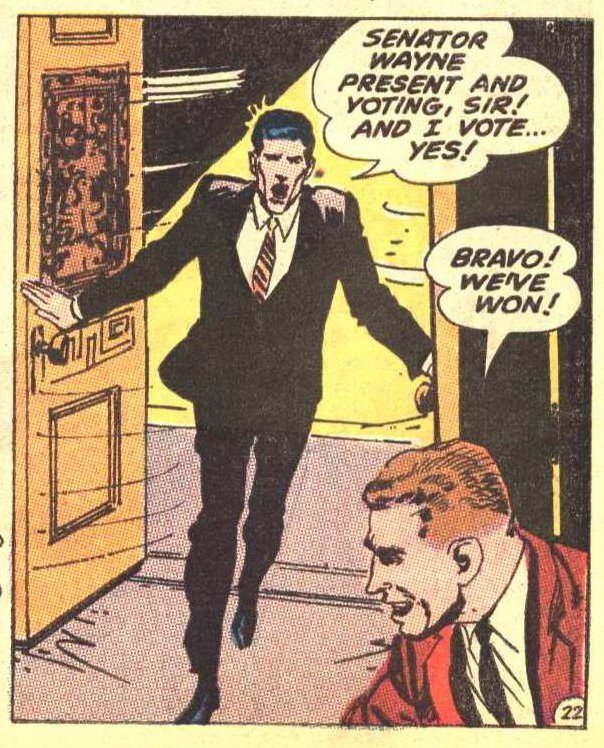
As must happen in all such dramas, Bruce arrives back at the Senate just in the nick of time:


Although the new Green Arrow became known as a firebrand of Leftist sentiment, it must be noted that there is not a hint of that in this story. Although Ollie now sports a Van Dyke, he's still obviously an enormously wealthy capitalist. The project he's working on is supposed to save the state from bankruptcy, but there's no sense that he's building it for charity. There is a note prior to the letters section:


I do remember that the new GA appeared in the JLA/JSA crossovers that introduced Black Canary to Earth-1. But I'll have to do some digging around to find out if they really explained his new circumstances in a JLA issue or if it was just hinted at in the first Green Lantern/Green Arrow crossover.

Update: Thanks to Tom Galloway in the comments who pointed out that the basic details of Oliver Queen's financial downfall are contained in Justice League of America #75,w which starts with Ollie being confronted by a financial rival with the claim that he made some money on some municipal bonds (shocking news no doubt to Oliver's investors). At any rate, this news destroys The Queen Funds and our man goes belly up (by the end of the story). Of course, this being 1969, he didn't have much of a parachute.

Previous Green Arrow Posts:

Worst. Swipe. Ever.

Here's a Rarity

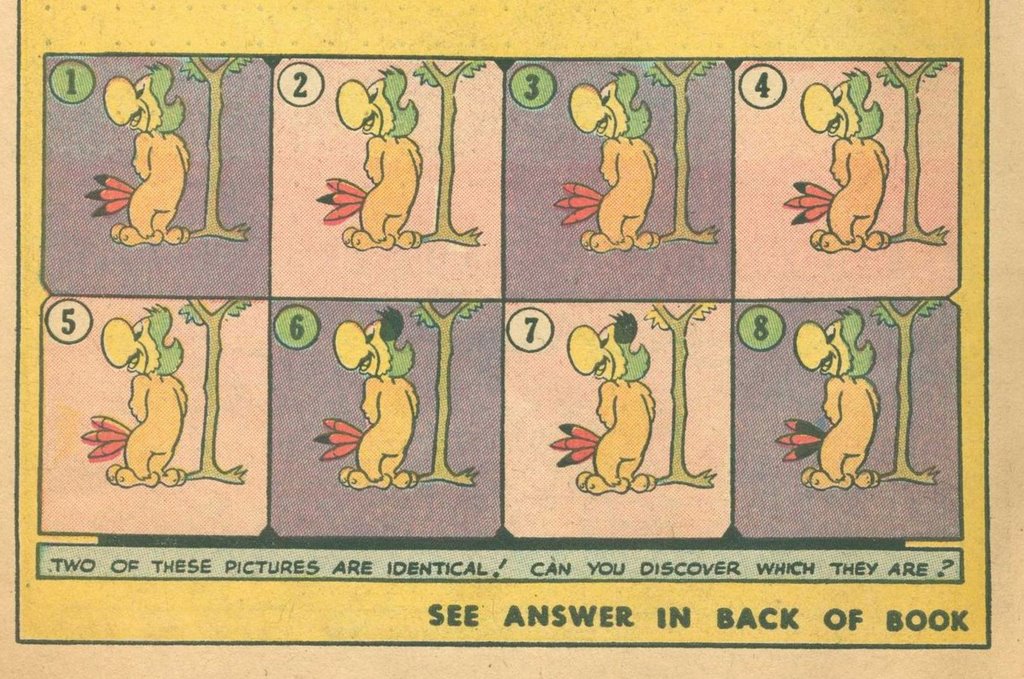
You don't see "It's Gametime" very often. This is a DC comic listed in Overstreet with four issues in 1955-56. A friend of mine came up with #4, and I noticed this little puzzle:


Uh, what exactly is that bird doing?

PS, before you go nuts trying to figure out which pictures are identical, they don't count the background color.

Tuesday, March 14, 2006

Spiderman 20-27

This is a great set of stories, with at least four consecutive classic issues (#24-27), and only one significant clunker (#21).

The sequence starts with ASM #20's The Coming of the Scorpion. J. Jonah Jameson decides to create a superhero to defeat Spiderman. He knows a scientist (Dr Farley Stillwell) who can cause artificial mutations in animals. He pays Stillwell $10,000 to mutate a human being. Max Gargan, a small-time private detective is chosen to be turned into the Scorpion. Unfortunately for JJJ, Gargan becomes so powerful that after beating Spiderman in a fight, he decides to go criminal. Realizing that JJJ is the only person to know his real identity, he decides to kill the newspaperman. Fortunately Spiderman does better in this battle and saves his worst enemy.

ASM #21 features When Flies the Beetle. This is a pedestrian story featuring the Torch and his old foe, the Beetle. In the tale, the Beetle decides to take revenge on Johnny Storm by kidnapping his girlfriend Dorrie Evans. Meanwhile, Peter has accidentally met Dorrie and ends up having a battle with the Beetle. The Beetle gets away with Dorrie. When the Torch shows up at her place, he finds webbing and assumes Spiderman is responsible for kidnapping her. They have a battle during which Spiderman inexplicably doesn't simply tell the Torch that Dorrie was kidnapped by the Beetle, although eventually they come upon that pair, and team up now to defeat the villain. Peter also fails to recognize Dorrie despite the fact that he had met her while Spiderman in ASM #8, in an oddball short drawn by Jack Kirby.

ASM #22 features a return engagement against the Crime Circus, who had previously appeared in ASM #16. However, they have deposed the Ringmaster, their former leader, and have turned things over to the Clown. While hosting an exhibit of wretched modern art, JJJ is robbed by the Clown and his cronies and nearly killed. Spiderman tracks them down and defeats them despite the wiles of Princess Python.

In ASM #23, the Green Goblin returns. He is determined to take over the gang of Lucky Lobo, and apparently feeds information to Frederick Foswell. Foswell had appeared in ASM #10, as an apparently meek reporter for JJJ, but who in reality was The Big Man, a crime boss himself, whom Spidey had defeated. Spiderman is suspicious of Foswell, whom JJJ has rehired after his prison term elapsed.

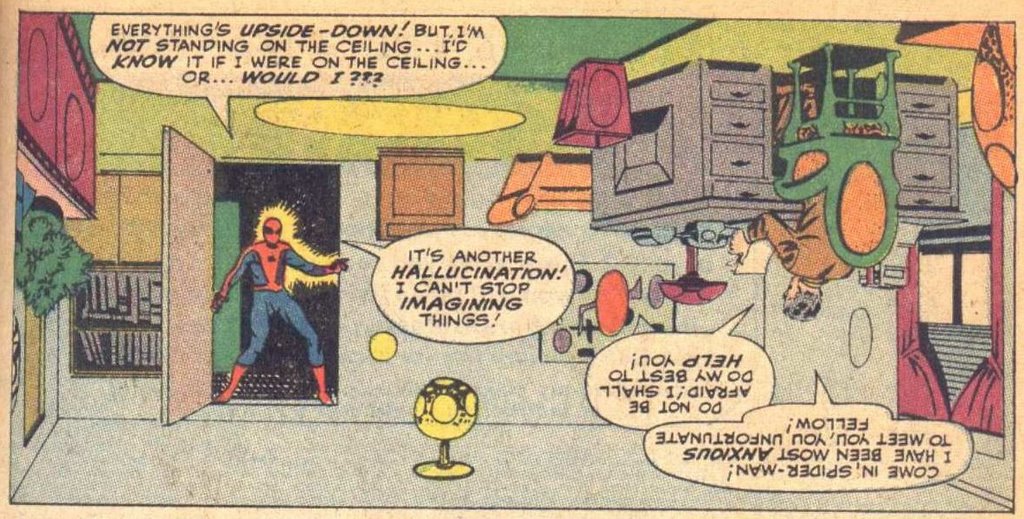
The classic run begins with ASM #24. JJJ publishes a series in which the public are encouraged to share why they hate Spiderman. In an effort to get their names in the paper, the people come up with a variety of reasons for despising the wallcrawler. A psychiatrist shows up at JJJ's office and tells him that Spidey will no doubt go insane. Upon reading this dire prediction in the Bugle, Peter gets worried that it might be true. While trying to visit JJJ to check on the story, he hallucinates, seeing the images of his old enemies coming after him. He decides to visit the doc, but freaks out at this sight:


After running out at first, Spidey is brought back by the shrink to this room, which is now magically normal side up. The psychiatrist explains to him that his problem is his secret identity, that if he just went public with his name his psyche would be relieved and he wouldn't have the hallucinations anymore. But then JJJ bursts in; Foswell has discovered that the psychiatrist is a fraud. JJJ confronts the shrink in front of Spidey, who chases down the phony. It's Spiderman's old foe, Mysterio, whom we first encountered in ASM #13, once again using stealth and deception to try to defeat our hero.

Captured by J. Jonah Jameson from ASM #25 is one of my all-time favorite comic stories. Jameson's editorials have gotten the attention of Smythe, an inventor who's convinced he's come up with a robot that can track down and capture Spiderman. Peter, feeling puckish, urges Jameson to try the device despite the newsman's initial skepticism. JJJ quickly sees that it's quite a powerful device, as does Peter. However, it appears to be malfunctioning as it attacks Parker briefly.

He knows that within a day or so the inventor will unleash his machine under the control of Jameson. Sure enough as the schoolday is ending, he spots the robot approaching, guided by Peter's spider nature. He dashes out a side door, chased by Flash Thompson, who had planned to beat him up. After a long battle, the robot traps Spiderman, and it looks like its all over as JJJ and Smythe travel to the site to unmask Peter. However, he's able to escape by prying off the chestplate of the robot and messing with the controls. As a gag, he leaves behind his costume to convince JJJ that his moment is at hand.

The reason I like this story so much is that since there is no supervillain introduced or returning, there is more space for the regular characters--Flash, Betty Brant, JJJ and Liz Allan all have significantly expanded roles in this story. We even get our first glimpse of Mary Jane Watson, although her face is unfortunately hidden:


We wouldn't see how MJ looked for another year and a half.

The two-part story in ASM #26-27 is another classic. The Green Goblin, having helped the Crime-Master become a big shot in the underworld, is disappointed to find his protege is now refusing to share the power. Who is the Crime-Master, and who is the Goblin? Spidey suspects strongly that one of them is secretly Foswell, the former crime boss and current reporter for JJJ. Of course, if he were using his head he'd know that Foswell was in prison during the Goblin's first two appearances.

The Crime-Master and the Goblin battle for control of the gangs. The Goblin seemingly takes the advantage when he shows up at a war council with Spiderman kayoed. But Spidey recovers and manages to fight his way to freedom. In the end, the Crime-Master is killed by the police. He turns out to be Lucky Lewis, a crime boss that Spidey has never heard mentioned. Foswell has a dual identity, but it's as Patch, a small-potatoes hood who's a stoolie.

One amusing bit is that because he had given up his costume to tweak JJJ, Peter has to buy a Spiderman costume from a store. It turns out to be low quality, so that constantly during his battle he has to stop and adjust his attire.

In this series of stories, Peter shows that the change he underwent at the end of ASM #18 was for real. He becomes much more confident and self-assured, to the point where Betty Brant even remarks on it. His romantic life seems a bit up in the air, with Liz Allan apparently settling for Flash Thompson, although still more interested in Peter. Betty and Peter seem to be on the skids, perhaps because he's turned out not to be the cowardly bookworm that he appeared they first met.

We had seen Betty on a date with Ned Leeds, a young reporter for the Bugle, in ASM #18, and Betty had introduced him to Peter in #19. In #20 she continues to see Ned, but in #21 he's seemingly out of the way in Europe for six months. However, she and Peter never really reconcile during this period, especially since he notices that she's getting letters from Ned.

Previous Spiderman Posts:

Spiderman--First Major Arc
An Unfortunate Error
Who's Liz Allen's Dad?

Monday, March 13, 2006

Fury Against Racism and Bigotry

I never know where I will get the inspiration for a post. In Amazing Spiderman #23, there was a letter to Marvel commending them on Sgt Fury #6 as a fine example of standing up against racism. Given that this was a fairly early (March 1964) story to tackle the subject I thought I'd take a look at it.

It's a surprisingly underplayed story. The Howlin' Commandos lose one of their members to injury and must take on a new recruit, named George Stonewell. Stonewell seems somewhat reserved around some of the men, particularly the Italian and the Jew. And when he meets the black bugler, it becomes obvious that he's prejudiced:


However, in a semi-suicidal mission, Stonewell is forced to rely on Izzy Cohen. In the end Cohen pulls him out alive but wounded. He needs a transfusion, and of course only Gabe Jones has the proper bloodtype. We are led to believe that Stonewell is unchanged, but in the end he leaves a note to Izzy and Gabe with his new address. The story closes with an admirable sentiment:


Marvel was miles ahead of DC in terms of diversity. Although it took a long time before black characters with substantial roles other than Gabe appeared, they did make an effort to include blacks in crowd scenes. If there were three cops in a scene, quite frequently one of them was a black man.

Previous Post on Nick Fury

Sunday, March 12, 2006

Fantastic Four: The Inhumans

The first member of the Inhumans to appear was Madame Medusa (later mostly referred to simply as Medusa). In FF #36, three villains team up. Paste-Pot Pete and the Wizard, two Human Torch villains from his series in Strange Tales, align themselves with a former Spiderman nemesis, the Sandman. The Wizard suggests calling themselves the Frightful Four, but obviously they are one female member short of matching up with the Fantastic Four. He knows of a woman they can recruit, who has the amazing power of using her long, red hair as a weapon:


Sue and Reed wonder where she came from here:


But although the Evil FF are featured quite prominently over the next several issues, appearing in FF #38, 41, 42 and 43, we do not find out any more about the background of Madame Medusa until #44. At the end of FF #43, the three male members of the Frightful Four are captured and turned over to the police. But Johnny inexplicably lets MM escape here:


The next issue occurs following the marriage of Reed and Sue (which took place in FF Annual #3). Madame Medusa is being chased by a new character named Gorgon, who has immense power in his hoofed feet. Gorgon gives us a bit of an explanation here:


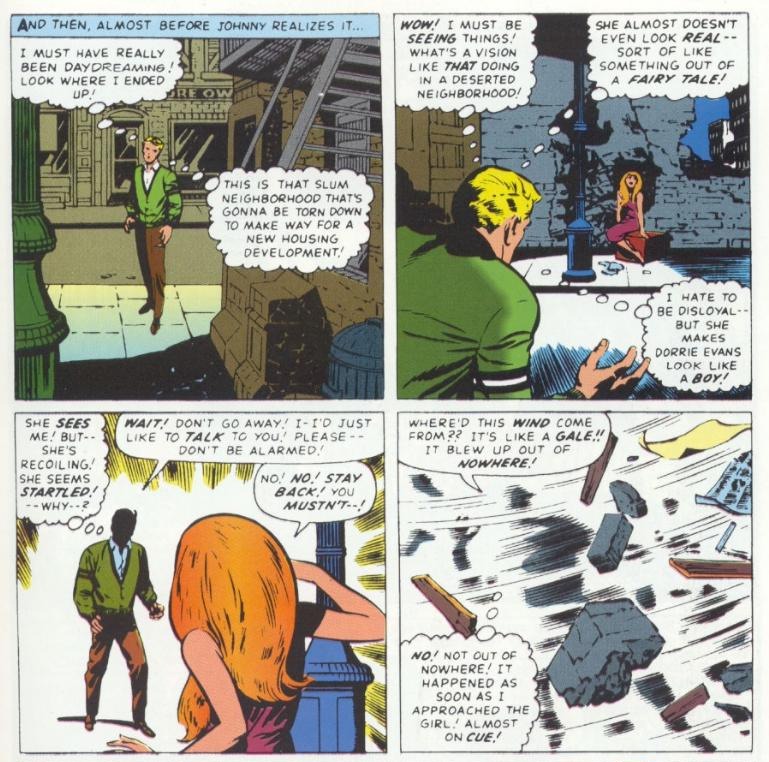
At the end of the story, Gorgon has apparently captured Medusa and vanished. The story picks up again in FF #45. Johnny, upset that his girlfriend, Dorrie Evans, has a date with another man, finds himself walking aimlessly through a deserted neighborhood of the city:


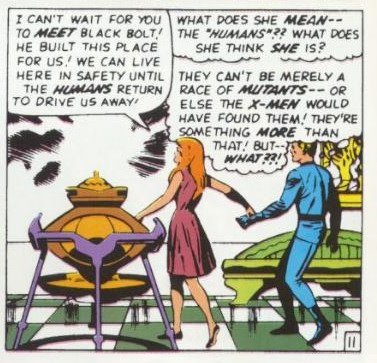
The girl turns out to be a member of the Inhumans. Believing Johnny to be one of them due to his superpowers, she confides in him:


But she quickly learns that Johnny is not among her race when they encounter Gorgon and Medusa. The Torch is briefly imprisoned, but he escapes and calls for his buddies.

The battle spills over into FF #46, where Black Bolt tangles with the Thing. At first we are unaware of BB's power. He's clearly a good fighter, as he's able to battle Ben to a standstill. Reed deduces that the tuning fork on Black Bolt's forehead converts energy into strength and speed. Oddly enough, the only member of the Inhumans who doesn't burst into fighting the Fantastic Four is Madame Medusa.

The next part of the background of the Inhumans is revealed here:


The Seeker? Hmmm, the Who had a song about this time (1966) called The Seeker:

They call me the Seeker,
I been searching low and high.
I won't get to get what I'm after
Till the day I die!


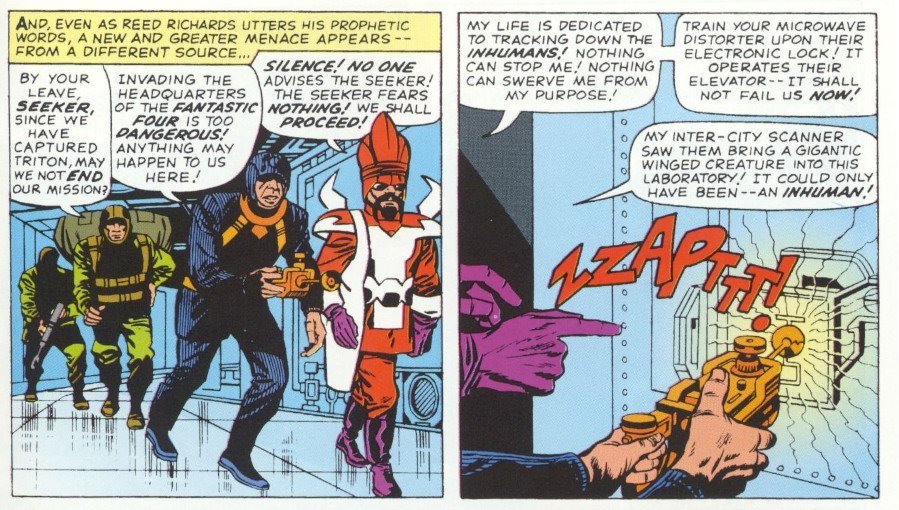
Anyway, we meet the Seeker here:


The FF eventually catch up to him, and he explains their history. They were an advanced race on Earth, with the ability to manipulate genes at will. As a result, they set up a super-powered society. However, the humans multiplied faster and battled against the Inhumans upon sight. So the Inhumans hid themselves away in the Great Refuge.

Black Bolt should rule the Inhumans, but his brother Maximus the Magnificent has usurped the throne. An aside: Ever notice that in the DC universe, other societies frequently are run by some sort of Science Council-e.g., Krypton, the future Earth of the Legion of Super Heroes, while in the Marvel universe they tend more towards dictatorships (benevolent or otherwise), like Asgard, the Inhumans, the Skrulls and Latveria?

Medusa is betrothed to Maximus, although she really loves Black Bolt. We also learn that Black Bolt is a mute due to some "accident". But Black Bolt seizes back the crown from his brother. Meanwhile, the FF has found the great refuge, hidden high in the Andes of South America. Maximus uses his Atmo Gun in an attempt to destroy the FF and all humanity, but it fails. This convinces Medusa that the Inhumans are not a separate race, but are related to humans. However, before we can absorb that, Maximus pulls the ultimate gambit. He seals off the Great Refuge from the rest of the world with a "Negative Zone". The FF, despite Johnny's attempt to remain with Crystal, escapes before the Zone can become hardened.

This takes us midway through Fantastic Four #48, but the story shifts abruptly to the Silver Surfer and Galactus' first appearance, followed by the introduction of the Black Panther in FF #52 and 53. There are abortive attempts to free the Inhumans in several issues that follows, but it is not until FF #59 that Black Bolt himself finally shatters the barrier.

Previous Posts on the Fantastic Four:

Another Embarrassing Mistake
The Fantastic Four

Saturday, March 11, 2006

Another Embarrassing Mistake


Why would Ben ask the blind Alicia who somebody is, "over there"?

Previous Posts on the Fantastic Four:
The Fantastic Four

Thursday, March 09, 2006

Robin's Romance With Batgirl

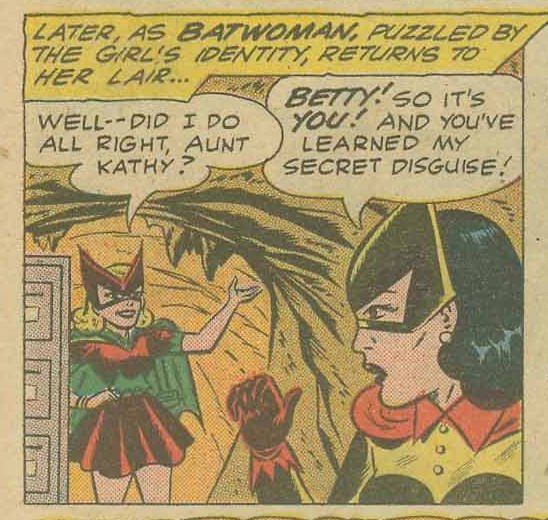
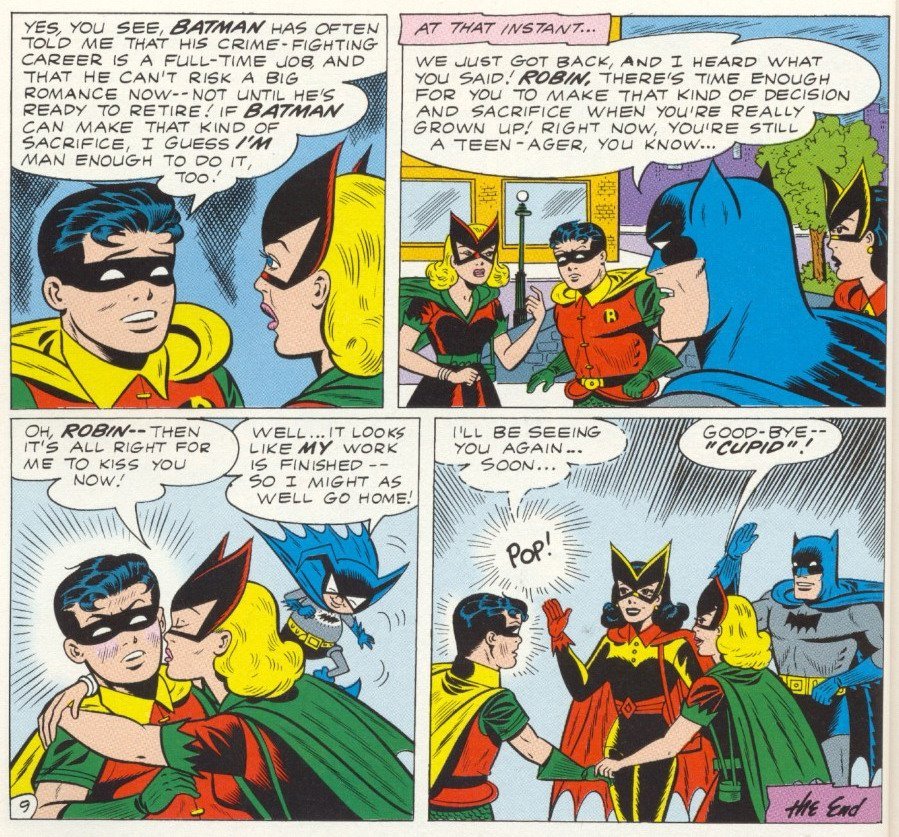
The first Batgirl was the niece of Kathy Kane, who had become Batwoman in Detective #233. When Betty Kane comes to visit for a vacation, the young girl quickly realizes that her aunt is secretly Batwoman. She decides to emulate Kathy and quickly designs a uniform:


Kathy is of course worried for the youngster, and after consulting with Batman, decides to require that Betty receive significant training before she can start crime-fighting, with the idea that this will discourage the young lady. Inevitably, Betty decides that she's ready on her own and attempts to capture the criminal gang Batman, Robin and Batwoman are hunting at the time. She gets caught instead, but is able to signal her location, which results in the gang getting caught. In the end, she displays some rather obvious affection for Robin despite his obvious embarrassment:


Over the next couple of years, this relationship was always a part of the Batgirl appearances. The next time Batgirl popped up in a story was in Batman #141, and she started pushing forward the romance a bit, still despite Robin's obvious timidity:


Batwoman knows a good thing when she sees it.

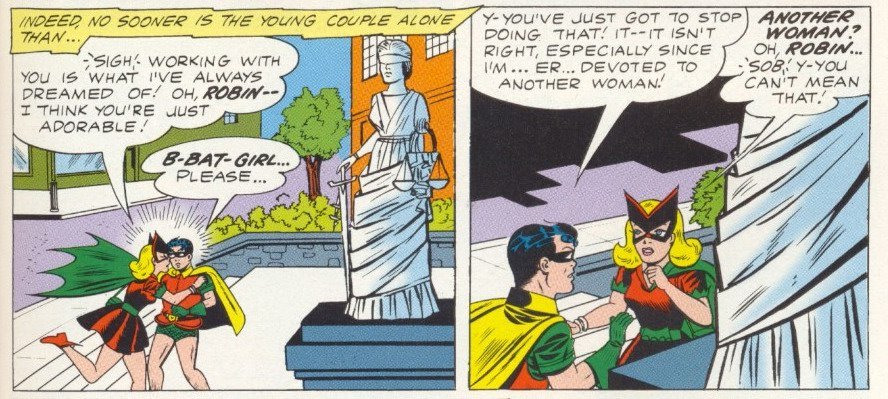
Batgirl returns in Batman #144, and this time she's determined to let Robin know how she feels:


Batgirl is upset that there's another woman in Robin's life. Batmite appears and offers to help her win the Boy Wonder's heart. Through a series of incidents, we see that Robin really does care for her, and that the other "woman" is the statue in the background of the panels above: Lady Justice. He explains:


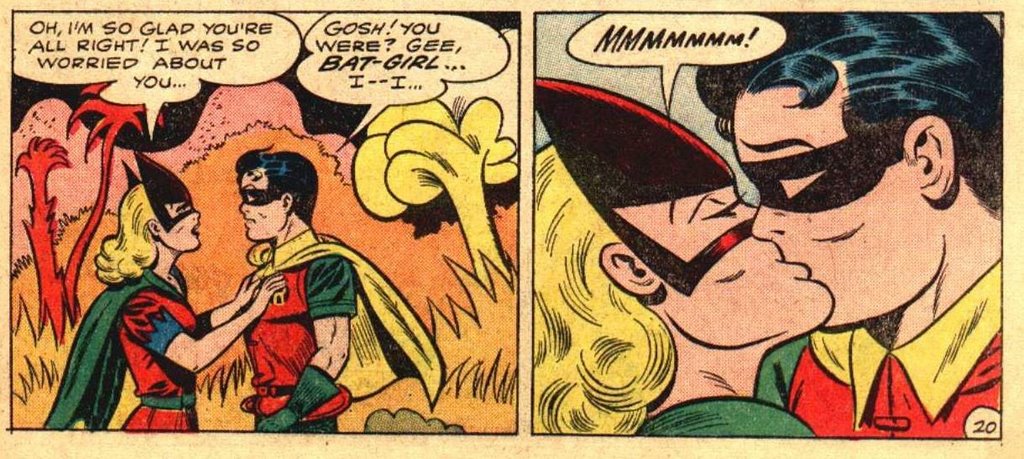
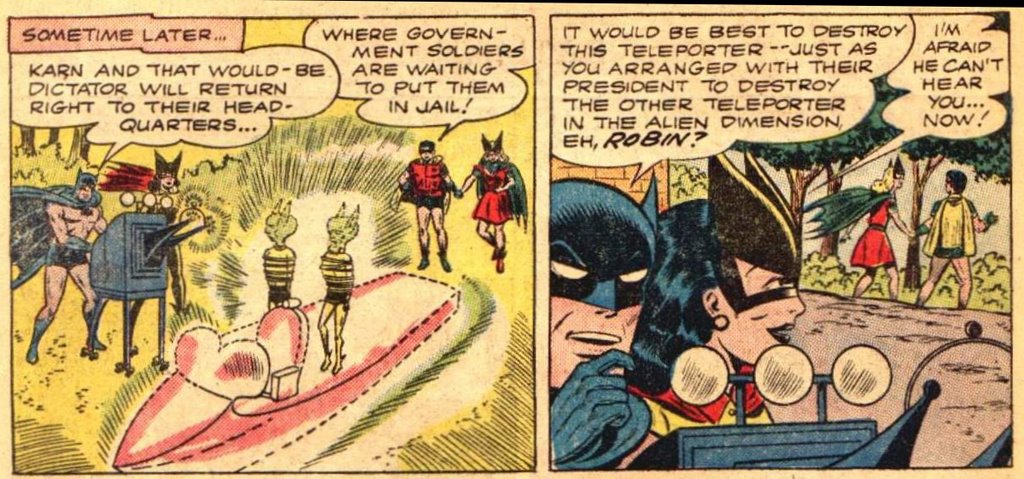
After that it was a full year before Batgirl appeared again, in Batman #153. But DC made up for the lapse by making this Batman's first ever book-length story, and one that featured prominently the continuing romance between Robin and Batgirl:


As usual, Batgirl makes the move, but this time Robin seems noticeably less resistant, especially considering this sequence later in the story:


And we can see that Robin is quite pleased to see Betty in this sequence:


Even Auntie Batwoman feels that Betty pours it on a little thick here:


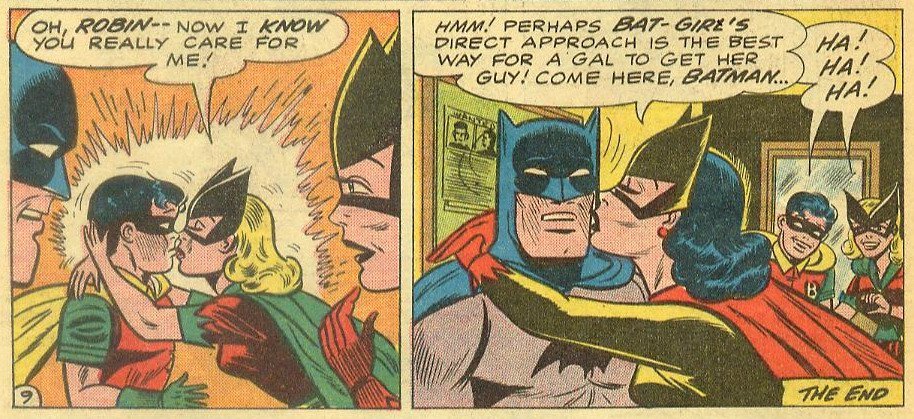
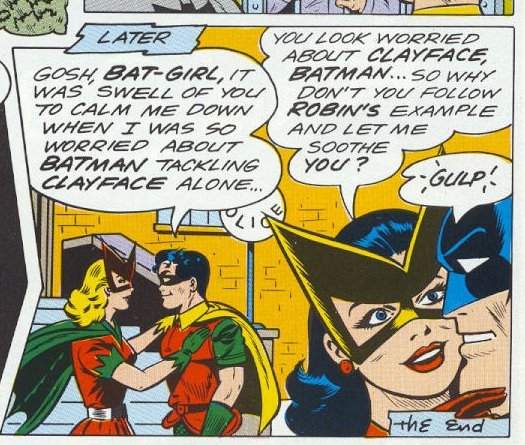
The story ends with Robin expressing his appeciation for Batgirl here:


I'd love to say that DC developed this romance throughout the decade, but in fact Batgirl was basically through. She popped up in Batman #163 but this was one of Alfred's fantasy adventures of Batman II and Robin II. In Batman #164 DC inaugurated the "New Look" Batman, in which most of the characters who had become the Batman Family were killed off either literally (in the case of Alfred) or politically (like former Soviet heroes who disappeared from official photos).

Betty was disappeared, as was her aunt Kathy. This whole terrific little romance that DC had built up over time simply blew away like autumn leaves. It was a sweet little sequence that deserves to be remembered among the general mediocrity of the Silver Age Batman.

Previous Posts on Batman & Robin:
Worst Batman Story of the Silver Age
A Salute to Batman Annual #1
The Disappearance of the Catwoman
Gay Batman?
Favorite Covers of the Golden Age: Batman #23
The Horrifying Batman Era in Covers: Detective
Batman 1957
Batman and Guns
Batman 1956
Batman 1955
Classic DC Sagas of the 1960s
The New Look Batman

Wednesday, March 08, 2006

Worst Batman Story of the Silver Age

There’s a fair amount of competition for the dishonor of the worst Batman story of the Silver Age. Although this time period was when I formed my affection for Batman, it is clearly the worst era for the character. Many of the Golden Age Batman stories are classics, but the SA Batman was marked by poor art (mostly Moldoff) and mediocre stories.

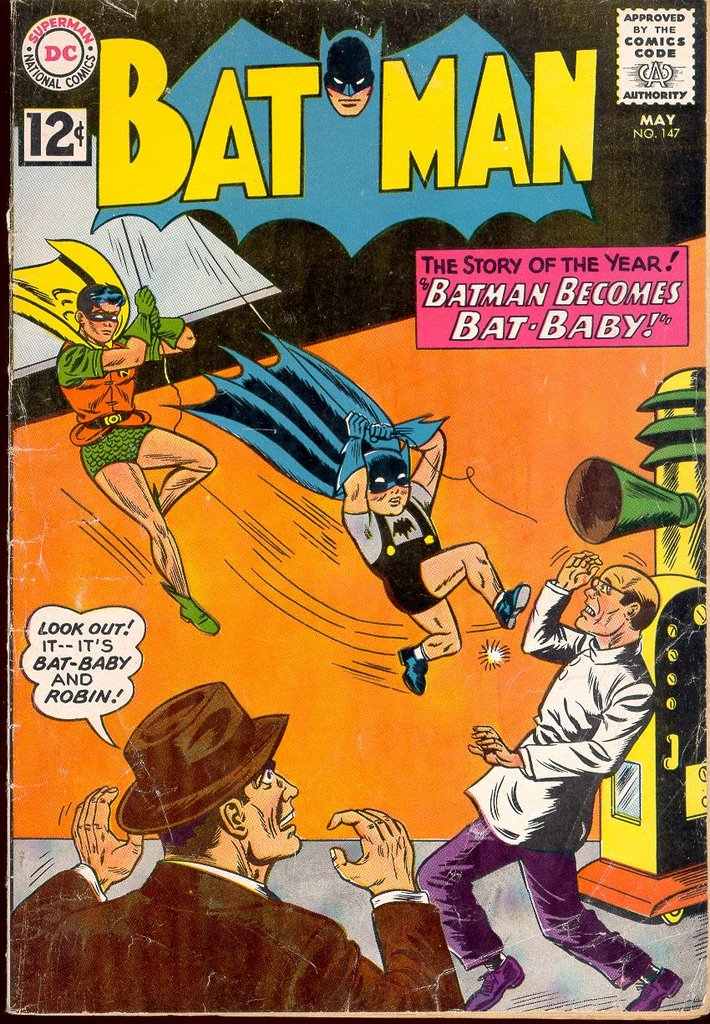
But I’m confident that no other story featuring the Caped Crusader could be quite as bad as Batman #147’s Batman Becomes Bat-Baby.


A word of background on this. Superman and Action had recently published stories of Superbaby, Superman when he was a toddler. Obviously the comics sold well enough that it caught the eye of Batman editor Jack Schiff. Now it should be obvious that while Superbaby was still amazingly strong, could fly, and was invulnerable, Bat-Baby would have none of these advantages.

In the story, the renegade scientist Garth (no other name) has teamed up with gangster Nails Finney. When Batman tries to catch the latter, Garth beams Batman with a ray that turns him into a baby. Due to a “flaw” in the machine, Batman retains his adult mind and strength. Never mind that Garth would have to be a pretty goofy renegade scientist to miss the enormous commercial applications of his product—suppose he could turn everybody into a teenager physically again; who wouldn’t be lining up to pay thousands?

Batman does do some exercising to get the hang of his new body, but a day later he’s ready to tackle the world in his new garb.


Yep, that'll teach those gangsters!

However, Batman still supposedly weighs only as much as a toddler, which makes this scene highly unlikely.


Mercifully they track down Garth and manage to reverse the effect.

Previous Posts on Batman & Robin:
A Salute to Batman Annual #1
The Disappearance of the Catwoman
Gay Batman?
Favorite Covers of the Golden Age: Batman #23
The Horrifying Batman Era in Covers: Detective
Batman 1957
Batman and Guns
Batman 1956
Batman 1955
Classic DC Sagas of the 1960s
The New Look Batman

Sunday, March 05, 2006

Spiderman--First Major Arc

Spiderman (no, I'm not going to use the hyphen) debuted in Amazing Fantasy #15. It was the final issue of that title. Reportedly sales of the comic were good enough that Marvel decided to grant Spidey his own magazine.

The first major story arc ran from Amazing Spiderman #1 to #19. In those issues we saw the beginnings of the themes that would dominate the decade and turn Spidey into one of the hottest characters in the comic book world.

First of all, Spidey had real world problems. For the most part, characters had been designed so as not to have real world problems. Why was Bruce Wayne a millionaire playboy? Answer: So he could go anywhere, do anything at the drop of a dime.

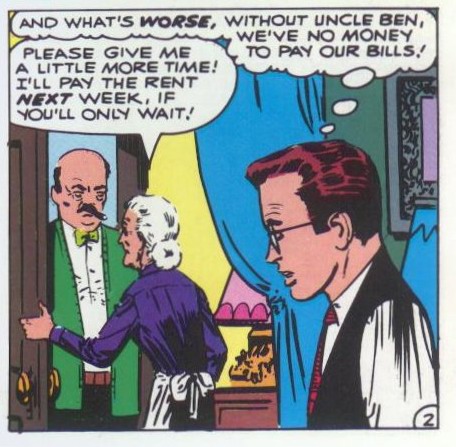
ASM #1 opens with a quick recap of Spiderman's origin, followed by Peter's first problem:
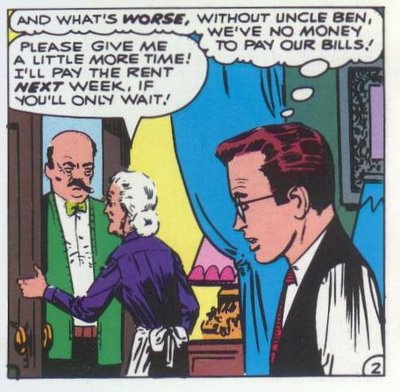


Money of course is a common problem. Peter briefly considers a life of crime, but can't live with the fear that he will be caught and break Aunt May's heart.

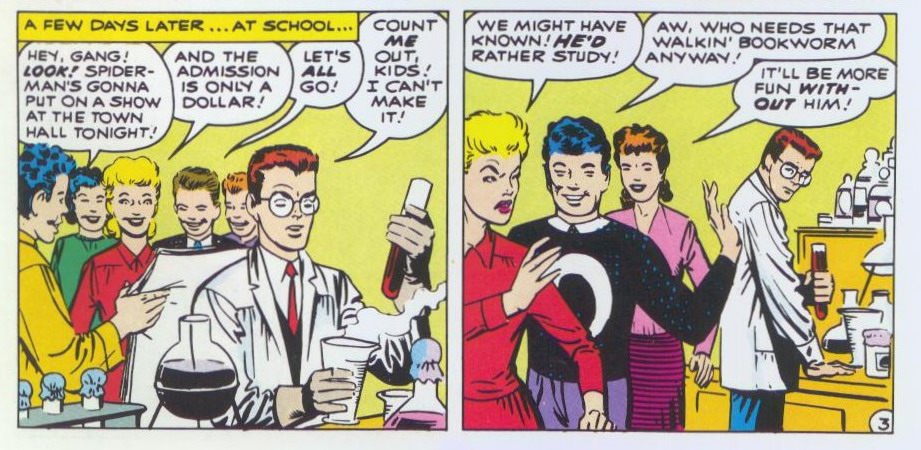
At school we encounter Peter's second problem:
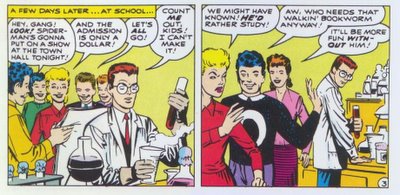


Gee, lack of popularity? None of us have ever had to deal with that!

Parker meets with a booking agent and puts on a show as Spiderman. But because he is not willing to divulge his identity, he asks that the check be made payable to Spiderman. This leads to his third problem:
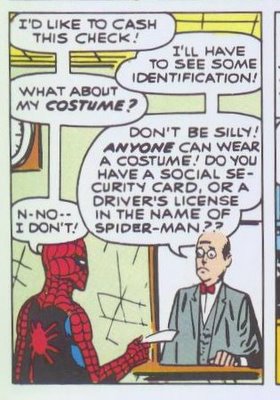


The fourth problem comes from a local newspaper editor. J. Jonah Jameson goes on a crusade against Spiderman, calling him a negative influence on youth.

None of his problems are resolved by the end of the first issue. In the second issue Peter realizes that he can make money by photographing himself fighting crooks. He attaches a camera to his belt, and goes into action against the Vulture, the first major villain in Spiderman's Rogues Gallery. The second issue also introduces Flash Thompson, Peter's high school nemesis.

The third issue introduces Spiderman's second most important villain: Dr Octopus. It also includes the first example of Spidey doubting himself, after being beaten in a fight by Doc Oc.

ASM #4 introduces the romance element into Peter Parker's life. Betty Brant is a perky brunette working for JJJ, while Liz Allan is a cute blonde who had actually agreed to go on a date with Peter. But with the Sandman causing problems and Peter broke, he can't keep that engagement.

The following issue has a crossover by Dr. Doom. Marvel, much more than DC, frequently had villains from one magazine crossover into another. It makes a lot of sense from a creative standpoint; why have to keep creating 10 villains for every hero, when you can just reuse a bunch that have been popular against another hero, especially when it gives you a different matchup. In the sixth issue, we meet Dr. Curt Connors, aka the Lizard. The seventh brought back the Vulture for a second battle with webhead.

The eight issue features two stories, including a Kirby short featuring a semi-serious battle between Spiderman and the Human Torch over the latter's girlfriend, Dorrie. The main story features Spiderman battling a robot.

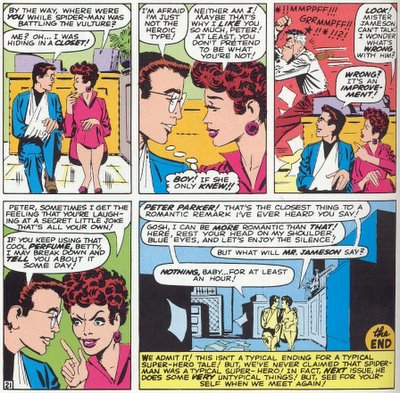
All this time, Lee and Ditko were doing little things with the character. Peter and Betty Brant seem to be getting closer in this scene from #7:


We discover that there is some secret in her past in Amazing Spiderman #9:
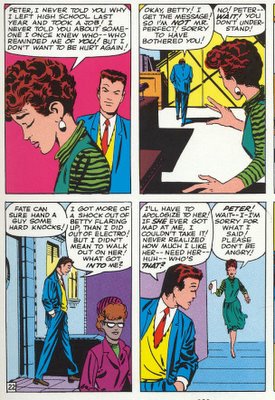


This issue also introduces the handy plot device of Aunt May's fragile health, which adds to Peter's woes immeasurably over the years.

In the tenth issue, Betty gets involved with some minor crooks; apparently she borrowed money from a loan shark. By the end of the story she has disappeared, including leaving her job. Spidey finds out where she's gone in the following issue, in which, to his shock, she picks up Dr. Octopus when he is released from prison. We learn that she's doing it to protect her brother, a lawyer who made the mistake of gambling over his head and now must do the bidding of the crooks. Unfortunately, while Spiderman is battling the hoods, a stray bullet kills Betty's brother. Betty irrationally blames it on Spiderman, unknowingly driving a wedge between her and Peter Parker.

The next two issues featured solid battles with Doc Ock and Mysterio. Amazing Spiderman #14 introduced Spiderman's biggest enemy, the Green Goblin. And we pretty quickly see that the Goblin is unlike many of Spiderman's other foes. He starts out determined to destroy Spiderman, while the others have only gotten angry at him when he starts foiling their crooked schemes.

He plots to get Spiderman to agree to appear in a movie featuring himself and the Enforcers, a fighting trio that had battled Spidey in ASM #10. Of course, Spiderman thinks it will simply be fake fighting, but the Goblin and the Enforcers are planning on battling for real. But their plan goes awry when it turns out that the cave that they are fighting in also contains the Hulk, who battles both sides. The Goblin escapes.

ASM #15 and #16 were mostly one-offs featuring Kraven the Hunter, a new villain, and the Ringmaster and his Circus of Crime, who had previously battled the Hulk. The latter also featured an early crossover by Daredevil into ASM.

The Green Goblin appeared again in ASM #17. Flash Thompson has started a Spiderman Fan Club and everybody's going to show up to demonstrate their support for Spidey. But the Goblin arrives as an uninvited guest, and he battles the wall-crawler. The crowd at first enjoys the fight, assuming it's all an act. But at a crucial moment, Spiderman overhears somebody on the phone saying that his Aunt May has had another heart attack and is in the hospital. He runs away from the battle, but fortunately the Human Torch is there to convince the Goblin to leave.

This issue also introduces (on the telephone) Mary Jane Watson. In a long-running gag, Peter would often hear of this wonderful young lady that Aunt May wants to fix him up with, but they never quite seemed to meet.

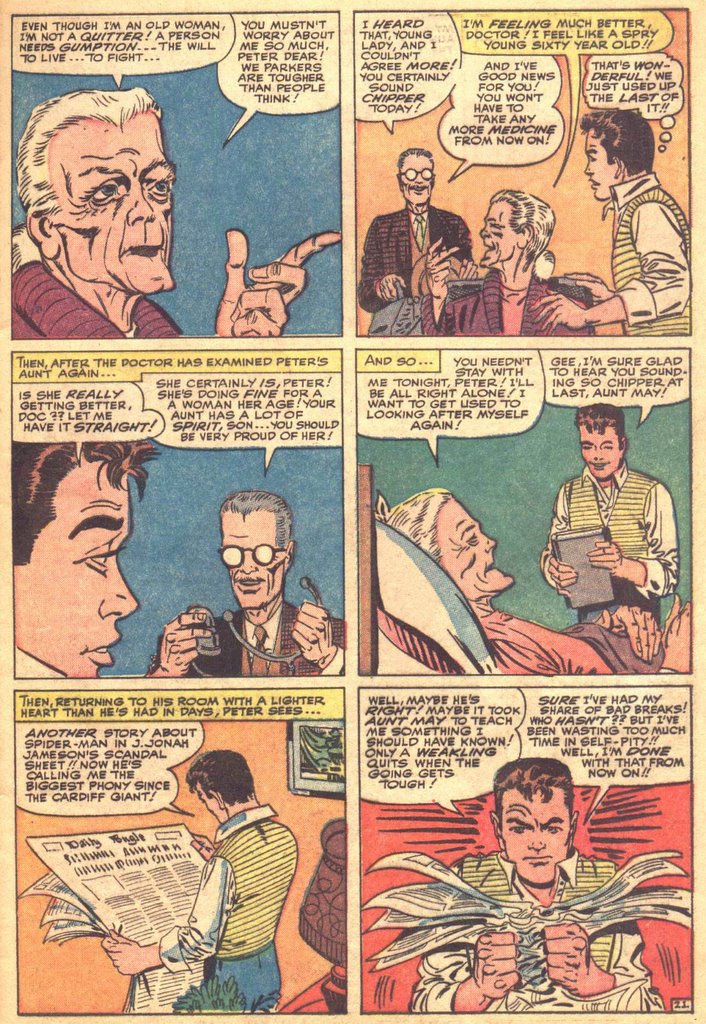
In the next issue the town is buzzing with the news that Spiderman has turned yellow. It's apparently confirmed, when he ducks a fight with the Sandman in front of a crowd. The Bugle of course publishes the news prominently and worse still, he finds out that Betty is dating another young man. In a fit of anger, Peter resolves to give up web-slinging. But then he finds Aunt May out of her wheelchair and walking about. She gives him a little spine-stiffening here:
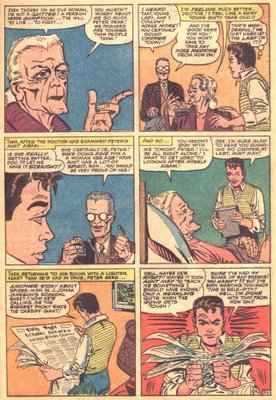


Of course, this little pep speech results in Peter resuming his career as Spiderman, and in the following issue he strikes back in convincing fashion.

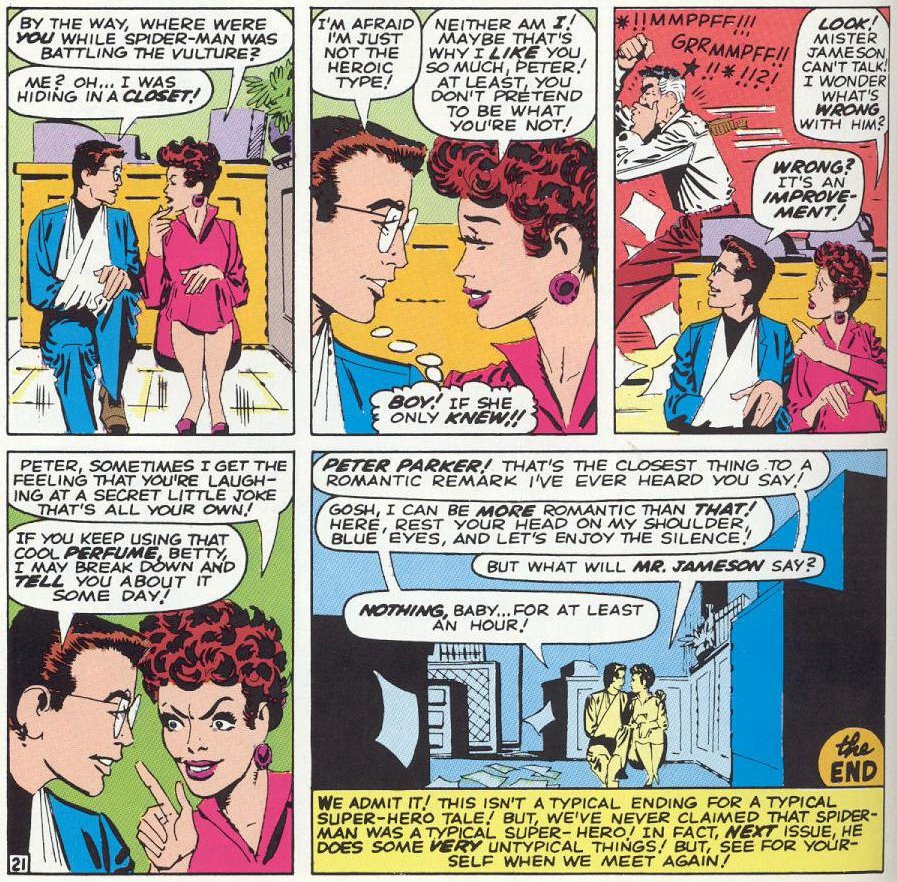
The themes and plot devices explored during these issues would recur many times over the years. Betty Brant blamed Spiderman for her brother's death; Gwen would blame him for her dad's; Harry for his father's; and Ned Leeds for Gwen's. His romances would continually be threatened by his Spiderman identity. His Aunt would always get sick at inconvenient times. And he would often contemplate giving up crimefighting.

Friday, March 03, 2006

But Eddie Rolfe Stopped Supporting Them

(Welcome fellow Fred Hembeck fans!)

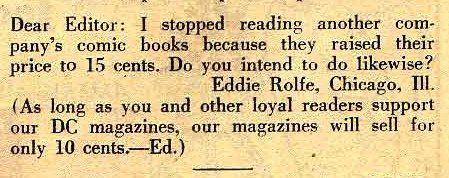
Here's an unfortunate pairing. From the letters column in Superboy #92:
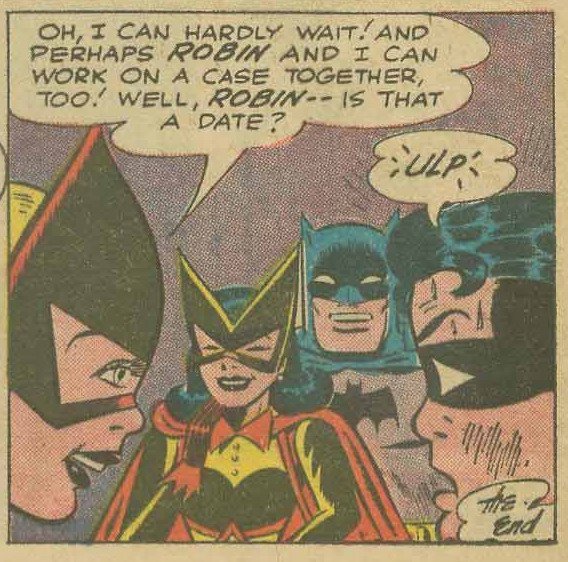


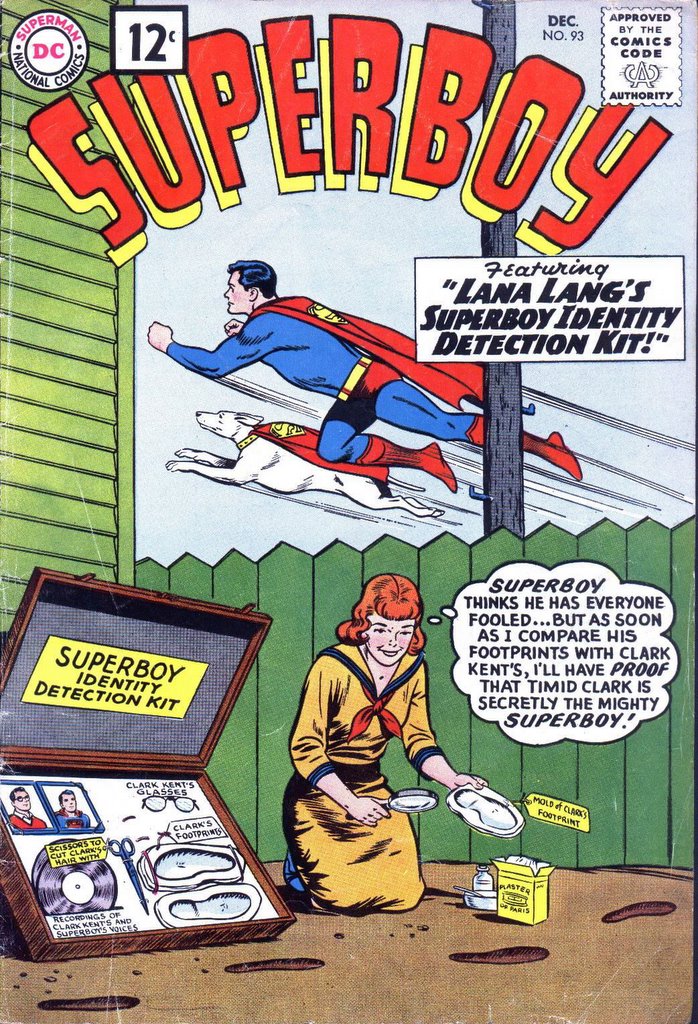
And the cover of the very next issue:


So if Fred Hembeck's looking for somebody to blame the great price rise of 1961 on, Eddie's probably the culprit. Because we all know an editor would never lie to his readers!
Wednesday, March 01, 2006

Luthor's Evolution

Superman was not blessed with terrific enemies during the Golden Age. For various reasons (most likely Captain Marvel), Superman began to take on a more whimsical tone during the 1940s. Some of that may have been due to the limitations of story-telling for a character so overwhelming in his power that it became difficult to imagine him being seriously threatened. Remember, these were the days before Kryptonite.

He did have a few recurring villains, but all of them had something in common: They depended on guile and trickery: the Prankster, Toyman, and Wolfingham were all conmen at heart. Luthor was slightly different; he was a throwback to the mad scientist villains of the movie serials, but even he was usually behind the scenes until well into the story.

It was never quite explained why Luthor was so mad to destroy Superman; we were led to believe it was simply a mania. Then came Adventure #271. This was Luthor's second appearance in the 1960s in a comic mag, but at the time it was his first ever appearance chronologically going by Luthor's age, because he appeared in a Superboy story.

In the story, Superboy befriends the teenaged Lex (first time the given name is mentioned) and they become fast pals. But when Superboy rescues Luthor from a misguided science experiment, it is too late to save the young man's hair. Now we know why Lex Luthor is bald, and in an irrational outburst, he blames Superboy for the whole incident and vows revenge.

Luthor's character continued to evolve throughout the 1960s. In a memorable series, he became the hero of the planet Lexor. In Superman #164, Luthor decided to have a showdown with Superman, but smartly challenged the Man of Steel to a duel on a planet with a red sun. They started with a boxing match, which Superman won after a rope-a-dope strategy. Then they made their way into an alien city. Luthor was able to take advantage of his skill with machines and science to assist the aliens and was proclaimed a hero. When Superman comes along to continue their duel, Luthor initially wins, but then gives up. Why? Because he wants to help the people of the world who have adopted him to find water, but there is none on the planet. Only Superman can save them by sending a mountain of ice to the planet. In the end, Superman shows Luthor that the inhabitants of that planet have constructed a statue to him.

Luthor pays a brief visit to Lexor in Superman #167, in which he meets an attractive woman named Tharla. When he returns to Lexor the following issue, Tharla has changed her name to Ardora. He continues to experiment with the alien machines while wooing Ardora. Meanwhile Superman arrives and finds himself oddly compelled to steal rainbow crystals that the citizens of Lexor are presenting to their benefactor.

Lex discovers a super-power producing ray, and decides to take a secret identity as the Defender. In a hilarious bit, Ardora suspects Luthor of being the Defender; echoes of Lois Lane! But although Lex captures Superman, once again he is convinced he must free the Man of Steel in order to save Lexor. The rainbow crystals turn out to have an effect on people, lowering their intelligence level.

But Lex cannot just let Superman go, so he creates some red Kryptonite that will steal Superman's powers temporarily and heads to Earth to capture his nemesis. By a fluke, Luthor is sent back into the past, to San Francisco 1906. He becomes the editor of the Daily Planet in that city. Superman finds out that Luthor's there via a "psycho-locater" built by the scientists of Kandor, but when he travels back in time, he somehow doesn't realize that his boss is Lex, under some muttonchop whiskers.

Lexor is barely mentioned in the second half of this story. Luthor is eventually caught, and Ardora is left wondering what happened to her boyfriend.

She finds out in Action 318-319. Luthor returns to Lexor after escaping prison. He is obsessed with the knowledge that Superman will eventually come after him. Sure enough, Superman finds him and during a fight, apparently accidentally kills Luthor. Superman is put on trial for his life. Fortunately, he is able to escape long enough to prove that Luthor had not died, that he'd just slipped into a temporary coma with the aid of a pill. Superman is set free, but Luthor remains behind on Lexor, still the hero of his world.

I was unable to locate the next adventure in the series, because the next time we see Lexor mentioned in Action #333, Luthor is in jail, further angered at Superman because he had revealed to Ardora that Lex was actually a famous criminal. Looking at the GCD for appearances of Luthor in the 1960s, we can see that Luthor appeared in Superman #173, #175 and #179 in between Action #319 and #333, as well as a couple appearances in Superboy and Adventure, and two in World's Finest, but none of these seem to be the story in question. Anybody know what I'm missing?

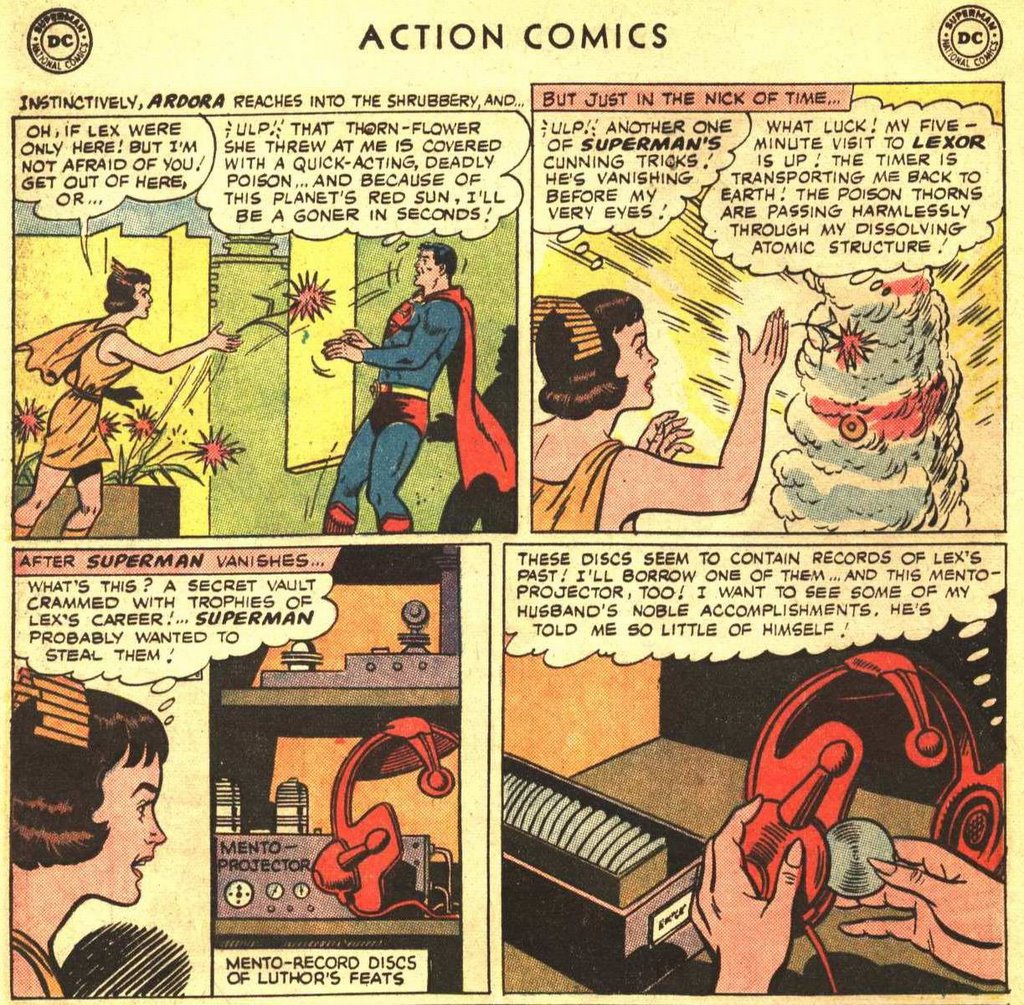
Update: Found it. In between the stories in Action #319 and #333, Luthor appears in Jimmy Olsen #87. He, Brainiac and the Legion of Super Villains get trapped on the Devil's Island of Space. Then, in Action #332, he escapes from that prison planet. Superman, realizing he may be hiding on Lexor, arranges with some scientists to be teleported to that planet for a five-minute period. While there, he accidently discovers a hiding place where Luthor has hidden mementos of his criminal exploits. Ardora discovers him and:


Interesting; shiny disks that contain lots of data. Of course, Ardora is horrified to learn that the man she loves is pure evil (although she seemed quite ready to murder Superman only a page before). But she still loves Lex despite his criminal past.

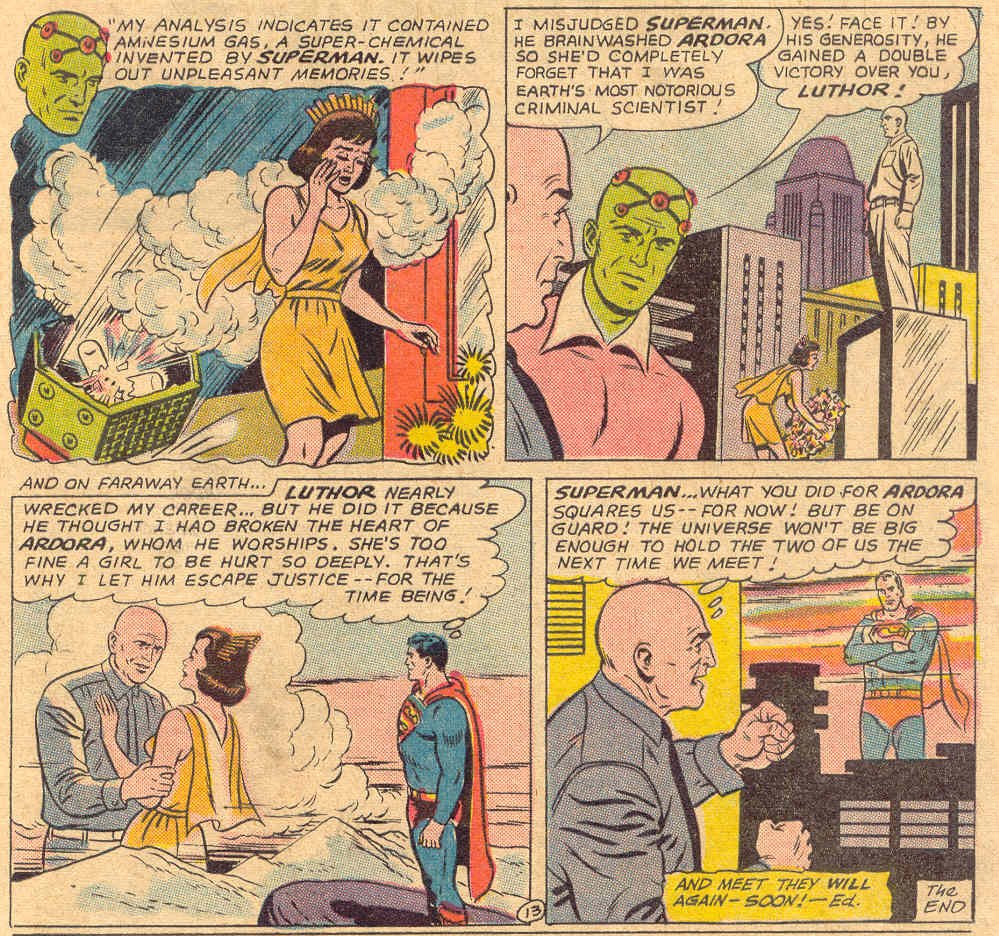
The rest of the story concern's Luthor's attempt to drive Superman crazy, by saving his life time after time. In the end, though, Superman figures out the diabolical plot. However Luthor escapes to Lexor with Brainiac, apparently just avoiding being hit by an object thrown by Superman. However, the object was not aimed at Luthor and Brainiac, but at Ardora:


This series does a good job of humanizing Luthor. The story of Ardora and Luthor was largely dropped after this, at least in the Silver Age, although it would appear again much later, as it turned out Ardora had borne Luthor a son.